
Retirement Strategies That Maximize Income, Eliminate Risk, and Help Ensure You Never Run Out of Money How to Achieve The Retirement Future Everyone Seeks
Most retirement plans are built on assumptions that no longer hold up—market averages, predictable tax rates, and the belief that time will always recover losses. But as you approach or enter retirement, the rules change. What worked during your accumulation years can become a liability during the withdrawal phase.
This blog is designed to help you rethink traditional strategies and discover a more engineered approach to retirement income—one focused on certainty, efficiency, and control.
Here, you’ll learn how to reduce or eliminate the biggest threats to your financial future, including market losses, rising taxes, hidden fees, and the silent erosion caused by lost time. We break down complex financial concepts into clear, actionable insights so you can make better decisions about your 401(k), IRA, and retirement income strategy.
You’ll also discover why many conventional approaches—like relying on average returns or the 4% rule—can expose you to unnecessary risk, especially when withdrawals begin. Instead, we explore strategies designed to protect your principal, improve compounding efficiency, and create predictable income streams that last.
Our focus is on helping you transition from “assets at risk” to a more stable and structured approach using fully performing assets—where growth, income, and protection work together instead of against each other.
Whether you’re still working or already retired, the goal is simple:
help you keep more of what you earn, generate more reliable income, and build a plan that doesn’t depend on hope, timing, or market luck.
If you’ve ever wondered:
* How to create tax-efficient retirement income
* How to avoid sequence of returns risk
* How to reduce fees and increase net returns
* How to design income that doesn’t run out
—you’re in the right place.
Explore the articles below and start building a retirement strategy based on engineering, not guesswork.

7-Question Retirement Stress Test for Market Crashes
The 7-Question Stress Test: If the Market Dropped 30% on Monday, Would Your Retirement Survive?
One of the fastest ways to uncover hidden risk is to take our 7 Question Retirement Stress Test.
![[HERO] The 7-Question Stress Test: If the Market Dropped 30% on Monday, Would Your Retirement Survive?](https://cdn.marblism.com/wwvCnNYF2Df.webp "[HERO] The 7-Question Stress Test: If the Market Dropped 30% on Monday, Would Your Retirement Survive?")
Start here: See what your retirement actually looks like → 👉 Book Your Million Dollar Hour™
Why "Hoping" Is a Financial Suicide Mission (And the 7 Questions That Prove It)
Most retirement plans aren’t actually "plans." They are a collection of hopes held together by Wall Street marketing and a few spreadsheets that assume the future will look exactly like a cherry-picked version of the past.
If you are a "Quiet Builder", someone who has spent the last thirty years working, saving, and building a business, you’ve likely entered the Red Zone. This is the critical window five to ten years before and after retirement where a single market event can derail three decades of discipline.
Wall Street wants you to believe in "Participation." They want you to keep your money in their casino, riding the roller coaster of "maybe" and "eventually." But in the Red Zone, "eventually" is a luxury you no longer have. Wealth is built on micro margins, not macro headlines. It’s time to move from the uncertainty of Wall Street to the engineered certainty of Your Street.
Audit the margin. Protect your time. Let’s see if your plan is actually built to last or if it’s just a Rolodex in a SpaceX world.
The Math of Recovery: Why a 30% Drop is Deadlier Than You Think
Before we dive into the questions, we have to unlearn a Wall Street myth: the "Average Return."
If you lose 30% of your portfolio on Monday, you don’t need a 30% gain to get back to even. You need a 42.8% gain just to see $0 in growth. This is the Volatility Recovery Analysis. While your money is trying to "recover," time is passing. You are getting older. Inflation is eating your purchasing power. Fees are still being deducted.
Money can recover. Time never does.
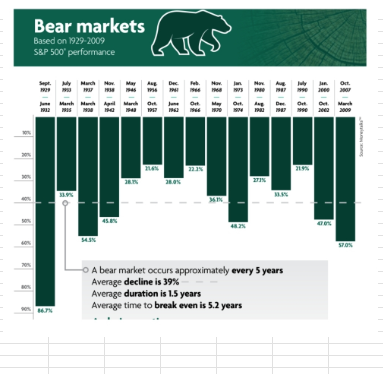
When you look at the frequency of bear markets, averaging a 39% loss every five years, you realize that "hoping for the best" isn't a strategy; it’s a gamble.
Question 1: What is your "Sequence of Return Margin"?
If the market drops 30% on Monday, and you start taking withdrawals on Tuesday, you are committing "Sequence of Returns" suicide.
When you sell assets in a down market to create income, you are permanently destroying the compounding efficiency of your remaining capital. Your "Sequence of Return Margin" is the gap between what you need to take out and what the market is giving you.
In the traditional Wall Street model, your income is dependent on market performance. In the Your Street model, income is designed.
The Test: If your portfolio value drops by 30%, does your withdrawal rate jump above 5%? If so, your plan is fragile.
Question 2: Are you holding "Single-Pillar" or "Multi-Pillar" Assets?
Traditional retirement planning relies on a "Rolodex" of single-pillar assets: Banks (safe but no growth), Stocks (growth but high risk), and Real Estate (income but high friction). These are outdated, single-use tools.
We look for Fully Performing Assets (FPA). Think of an FPA as the "smartphone" of finance. Just as your phone consolidated your pager, camera, and map into one device, an FPA consolidates 5 to 15 "pillars" of value, like Guaranteed Principal Value (GPV), Uncapped Gains (UCG), and tax-free access, into one vehicle.
The Test: How many of your assets provide a guarantee against loss while still offering uncapped market participation? If the answer is "none," you are spinning sharp knives.
Question 3: Can you pass the "Margin Audit™"?
Wealth isn't about how much you make; it’s about how much you keep. Most plans have massive "Wealth Killers" hiding in the fine print: excessive fees, unnecessary taxes, and the "Silent Thief" known as inflation.
A Margin Audit™ identifies these leaks. If a 30% market drop occurs, these leaks become gushing wounds.
The Test: If you had to cut your spending by 20% tomorrow to preserve your capital, could you do it without changing your lifestyle? If not, you have zero margin for error.

Question 4: Is your growth "Participation" or "Engineered Performance"?
Wall Street sells you "Participation", the right to ride the waves and hope the tide stays high. We focus on Engineered Performance.
This involves using Expanded Market Participation (EMP), which can act as a 110% to 200% multiplier on market gains without the risk of the downside. Imagine the market goes up 10%, but your engineered asset yields 15% because of the internal architecture of the FPA. Now imagine the market goes down 30%, and your asset stays at 0% (or even grows slightly).
The Test: Does your current plan have a contractual floor of 0%? If not, you aren't investing; you're gambling with your time.
Question 5: Would a surviving spouse be left with a "Tax Time Bomb"?
For many Quiet Builders, the plan works as long as both spouses are alive. But when one passes, the "Survivor Scenario" kicks in. Social Security drops. Tax brackets shift from "Married" to "Single" (the Single Person Tax Penalty). The "Tax Time Bomb" explodes right when the survivor is most vulnerable.
The Test: If you passed away on Monday during a 30% market crash, would your spouse have the same guaranteed income for life, or would they be forced to downsize their life during a period of grief?

Question 6: Does your plan account for the "Silent Thief"?
Inflation doesn't just make things more expensive; it destroys the future value of your fixed income. If you have a pension or an annuity that doesn't have an inflation adjustment, you are getting a pay cut every single year.
In a market crash, people tend to flock to "safe" assets like cash or bonds. But if inflation is running at 4% and your "safe" asset is paying 2%, you are losing 2% of your wealth every year with 100% certainty.
The Test: Do your income sources have an "increasing income" feature that mimics or beats the rising cost of living, even if the market is flat?
Question 7: Do you have a "Guaranteed Wealth Navigation System"?
Most people fly their retirement plane by looking out the window. They react to the clouds (the news) and the turbulence (the market).
At Your Street Wealth, we use the 7-Vector Wealth Navigation System™. This isn't a "feeling"; it’s a mathematical audit of Protection, Time, Income, Legacy, Liquidity, and Growth. It grounds your plan in Asset Liability Management (ALM): the same principles used by major banks and institutions to ensure they never go bust.
The Test: Can you point to a single document that proves: mathematically: that your income will never run out, regardless of what the S&P 500 does?

The Reality Check: Knowing vs. Hoping
If you couldn't answer "Yes" to at least five of these questions, your retirement is currently in a state of Participation, not Performance. You are depending on a "False Model" driven by the greed and fear of the masses.
You can estimate your income needs all day long, but you cannot predict your future portfolio value when losses and leaks are uncontrollable. You need a designed process that grows and heals: not a collection of tickers that extract value from you.
Wealth is built on the architecture of certainty.
Stop being a passenger in Wall Street's casino. It’s time to act like the architect of your own future. You’ve spent your life building; don't let a "Monday Morning Surprise" tear it all down because you were using a Rolodex in a SpaceX world.
Peace is the path, wisdom is the way.
The Million Dollar Hour™ Forecast
If this stress test made you uneasy, good. Unease is the first step toward clarity.
The Million Dollar Hour™ is not a "sales pitch" or a free consultation for tire-kickers. It is a premium, $995 engineering audit designed for high-intent Quiet Builders who want to see the actual math behind their survival. Guaranteed to show you how to Increase your account value by $20,000 - $100,000 immediately.
In 60 minutes, we perform a Margin Audit™ and a Volatility Recovery Analysis on your specific numbers. We move you from "Hoping" to "Knowing." We show you how to implement Fully Performing Assets that provide the 5–15 pillars of protection your current plan is missing.
Your Money, Your Rules, In Your Time, On Your Street.
Ready for clarity instead of confusion?
The Million Dollar Hour™ is your educational, one-on-one retirement review that reveals where your plan leads : not just where it’s been.
👉 Schedule your session today.
Discover Which Wealth Killers Are Affecting You
Most people are impacted by 6–9 and don’t realize it
Wealth Killer #1: The Granddaddy : Why Market Volatility is Your Retirement’s Greatest Enemy
Concerned about market losses, taxes, or income reliability?
Take the 7 Question Retirement Stress Test →
You can keep participating… Or you can finally see the outcome. The Million Dollar Hour™ shows you exactly:
✔ Where you are ✔ Where you’re going ✔ How to fix the gaps 👉 Book your session now
Check out the Retirement Blueprint
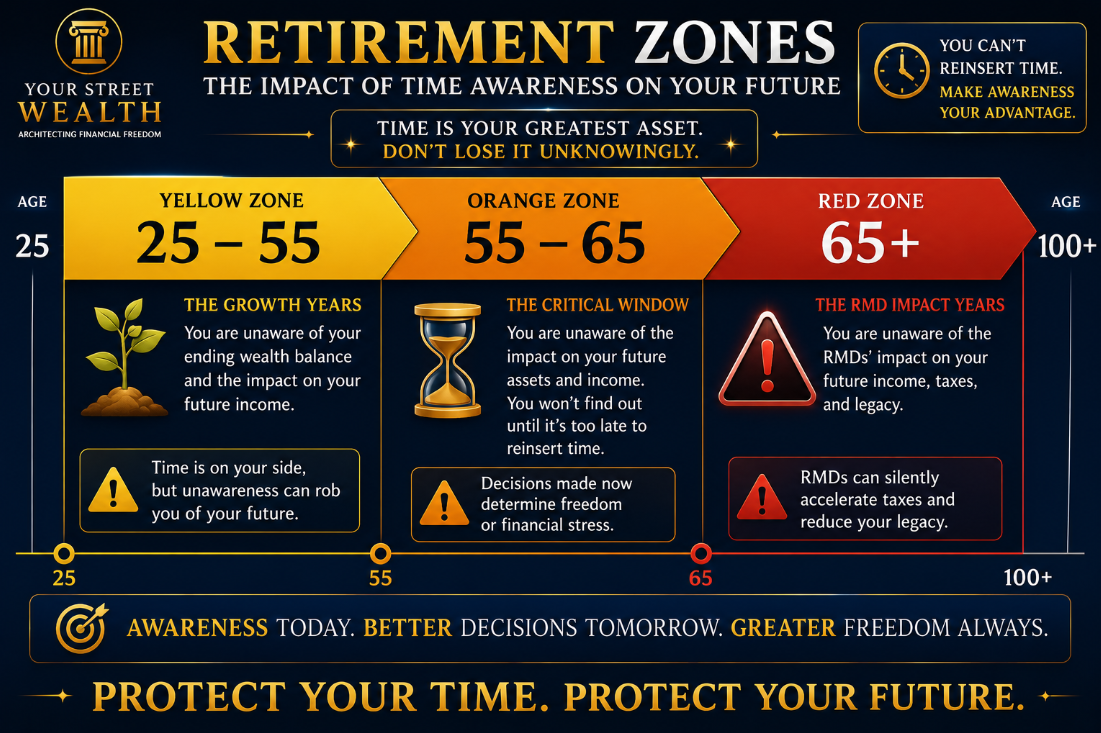
How much trouble goes with your age? The Orange Zone (Ages 45–65): — The "Great Unknown" where market retracements keep you in the dark.