
Retirement Strategies That Maximize Income, Eliminate Risk, and Help Ensure You Never Run Out of Money How to Achieve The Retirement Future Everyone Seeks
Most retirement plans are built on assumptions that no longer hold up—market averages, predictable tax rates, and the belief that time will always recover losses. But as you approach or enter retirement, the rules change. What worked during your accumulation years can become a liability during the withdrawal phase.
This blog is designed to help you rethink traditional strategies and discover a more engineered approach to retirement income—one focused on certainty, efficiency, and control.
Here, you’ll learn how to reduce or eliminate the biggest threats to your financial future, including market losses, rising taxes, hidden fees, and the silent erosion caused by lost time. We break down complex financial concepts into clear, actionable insights so you can make better decisions about your 401(k), IRA, and retirement income strategy.
You’ll also discover why many conventional approaches—like relying on average returns or the 4% rule—can expose you to unnecessary risk, especially when withdrawals begin. Instead, we explore strategies designed to protect your principal, improve compounding efficiency, and create predictable income streams that last.
Our focus is on helping you transition from “assets at risk” to a more stable and structured approach using fully performing assets—where growth, income, and protection work together instead of against each other.
Whether you’re still working or already retired, the goal is simple:
help you keep more of what you earn, generate more reliable income, and build a plan that doesn’t depend on hope, timing, or market luck.
If you’ve ever wondered:
* How to create tax-efficient retirement income
* How to avoid sequence of returns risk
* How to reduce fees and increase net returns
* How to design income that doesn’t run out
—you’re in the right place.
Explore the articles below and start building a retirement strategy based on engineering, not guesswork.

Protect Retirement from Death of Averages SoRR
The Death of Averages: The Hidden Math That’s Killing Your Retirement Wealth
One of the fastest ways to uncover hidden risk is to take our 7 Question Retirement Stress Test.
![[HERO] The Death of Averages: The Hidden Math That’s Killing Your Retirement Wealth](https://cdn.marblism.com/QKfDTyjypf1.webp "[HERO] The Death of Averages: The Hidden Math That’s Killing Your Retirement Wealth")
Start here: See what your retirement actually looks like → 👉 Book Your Million Dollar Hour™
Why "Average" Returns are the Fastest Way to Go Broke in Retirement
Wall Street loves to sell you on a dream built on a single, shaky word: Average.
You’ve heard it a thousand times. "The market returns 7% to 10% on average over the long term." It sounds safe. It sounds predictable. It sounds like a plan. But here is the cold, hard truth: You cannot spend "average" returns.
In the real world: the one where you actually have to pay for groceries and healthcare: averages are a mathematical fiction that hides the very risks capable of vaporizing your life savings. When you transition from "Quiet Builder" to retiree, the math changes. The "Participation" model you used to build your nest egg becomes a "Wealth Killer" the moment you start taking withdrawals.
It’s time to stop gambling on participation and start engineering performance.
The Brutal Math of Recovery
Wall Street treats a 10% loss and a 10% gain as if they cancel each other out. They don’t. This is the first "unlearning" step for any serious investor. We call this the Math of Recovery, and it’s the silent engine behind the "recovery drag" that kills wealth.
Imagine you have $100,000. The market takes a nasty 50% dive. You’re left with $50,000. To get back to your original $100,000, do you need a 50% gain?
Not even close.
You need a 100% gain just to break even. If the market gains 10% a year steadily after that crash, it will take you over seven years just to get back to where you started. That is seven years of your life traded for zero growth. Money can recover. Time never does.
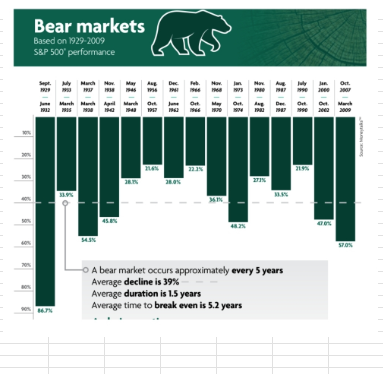
When your portfolio is hit by these drawdowns, you aren't just losing money; you’re losing the "Compounding Efficiency" of your retirement. Audit the margin. If your plan allows for 30% to 50% drawdowns, you aren't following a strategy: you’re spinning sharp knives and hoping you don't get cut.
Sequence of Returns Risk: The Hidden Retirement Killer
If you are in the "Accumulation Phase" (still working and saving), market volatility is annoying but manageable. But once you enter the "Distribution Phase" (living off your money), the order of your returns matters more than the average of your returns.
This is Sequence of Returns Risk.
Two people can have the exact same "average" return over 20 years, but if one person experiences a market crash in the first three years of retirement while taking withdrawals, they could run out of money in a decade. Meanwhile, the person who sees the crash at the end of their retirement dies with millions.
The "Average" return looks identical on a spreadsheet, but the reality is the difference between a Mediterranean cruise and a part-time job at 80 years old. Traditional Wall Street methods are a "Rolodex in a SpaceX world": they were durable in the 80s, but they are inadequate for the modern volatility we face today.
The "Average" Longevity Trap
The "Death of Averages" doesn't just apply to your money; it applies to your life.
Financial planners often model your retirement based on "average life expectancy." For a 65-year-old male, that might be 84. But life expectancy is a midpoint, not a ceiling. Roughly half of people will live longer than the average. If you plan your spending to hit zero at age 84, you have a 50% chance of being broke while you're still very much alive.
On the flip side, many "Quiet Builders" are so terrified of the "Sequence of Return Margin" that they chronically under-spend. They scrimp and save, missing out on life experiences, only to die with three times more money than they started with.
Why? Because they were following "probabilities" instead of "guarantees." They were depending on markets instead of controlling outcomes.
Single-Pillar Assets vs. Multi-Pillar Architecture
Most people build their retirement on "Single-Pillar" assets.
Banks: Low risk, but zero growth and no tax benefits.
Stocks: High growth potential, but high risk and high fees.
Real Estate: Good income, but low liquidity and high management "noise."
Think of these like old-school gadgets: a pager, a camera, and a map. They all do one thing, and they do it okay. But we live in the era of the smartphone: a device that consolidates 15 different tools into one sleek package.
In the financial world, we call the "smartphone" a Fully Performing Asset (FPA). While traditional assets are subject to the "Greed/Fear meter" of Wall Street, FPAs are engineered for stability. An FPA can provide 5 to 15 "pillars" of value: including uncapped gains, protection from market crashes, tax-free income, and long-term care benefits: all within a single vehicle.
By moving from "Participation" in a volatile market to "Engineered Performance" in a multi-pillar system, you eliminate the "Volatility Recovery Analysis" nightmare. You trade the -30%/+30% roller coaster for a 0%/+30% path where your floor is always locked in.

The Margin Audit™: Stop the Leaks
Wealth is built on micro margins, not macro headlines. Wall Street wants you focused on the "Average Return" headline so you don't notice the "leaks" in your bucket:
Management Fees: Even a "small" 1.5% fee can eat 30% of your total wealth over 20 years.
Taxes: If you’re building your retirement in a traditional 401(k), you have a massive, growing debt to the IRS that will be called due exactly when you need the money most.
Inflation: The silent thief that ensures your "average" return buys 3% to 5% less every single year.
You need a Margin Audit™. You need to look at your "Compounding Efficiency" and realize that a 7% return with 0% fees and 0% taxes is worth significantly more than a 10% "average" return that gets haircut by the Wall Street "False Model."
Engineer Your Certainty
If you are feeling financially fatigued by the constant noise of the markets, it’s because you are operating in a system designed to extract value from you, not create certainty for you.
Peace is the path, and wisdom is the way. You don't need more "research" or "daily updates" from a broker who profits whether you win or lose. You need a blueprint. You need architecture.
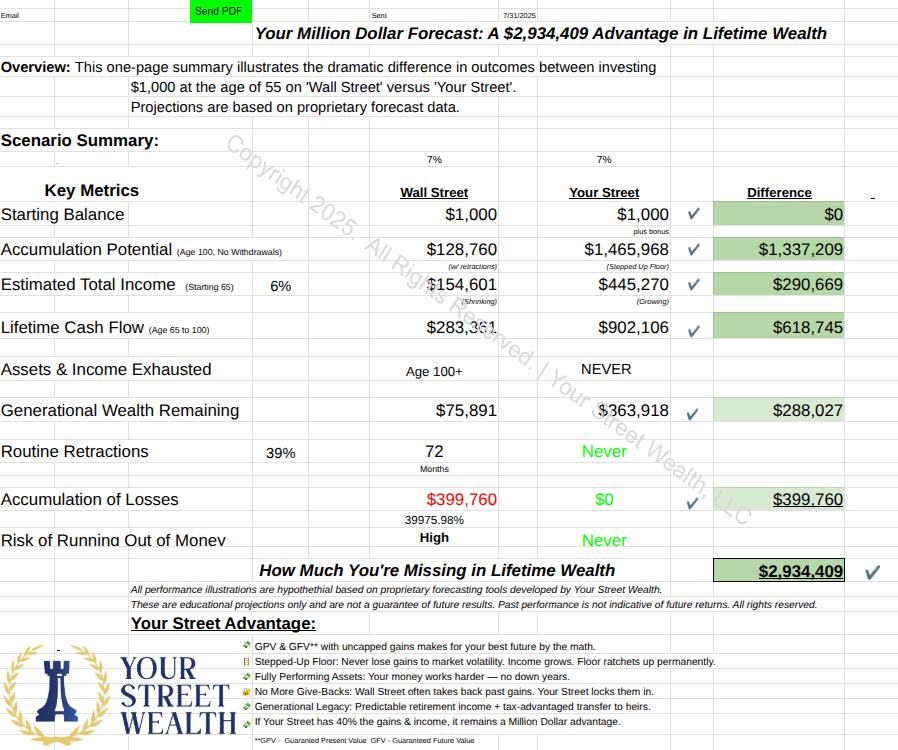
We created the Million Dollar Hour™ to be that architectural review. In 60 minutes, we move past the myths of "averages" and perform a deep-dive Million Dollar Hour™ Forecast. We look at your current path and contrast it with an engineered, guaranteed path. No jargon, no "Shakespearean" complexity: just institutional-grade engineering applied to your personal balance sheet.
It’s time to unlearn the "Average" lie and start building on "Your Street."
Your Money. Your Rules. In Your Time. On Your Street.
Take the Next Step
Read the Blueprint: Grab your copy of the Seven Pillars Guaranteed book to see how we engineer these outcomes.
Audit Your Plan: Stop wondering if your "average" will hold up. Book your Million Dollar Hour™ and get the clarity you deserve.
Ready for clarity instead of confusion?
The Million Dollar Hour™ is your educational, one-on-one retirement review that reveals where your plan leads : not just where it’s been.
👉 Schedule your session today.
Discover Which Wealth Killers Are Affecting You
Most people are impacted by 6–9 and don’t realize it
Wealth Killer #1: The Granddaddy : Why Market Volatility is Your Retirement’s Greatest Enemy
Concerned about market losses, taxes, or income reliability?
Take the 7 Question Retirement Stress Test →
You can keep participating… Or you can finally see the outcome. The Million Dollar Hour™ shows you exactly:
✔ Where you are ✔ Where you’re going ✔ How to fix the gaps 👉 Book your session now
Check out the Retirement Blueprint
The Orange Zone (Ages 45–65): — The "Great Unknown" where market retracements keep you in the dark.
Wealth Killer #2: The 4% Rule Myth : Why 'Safe' Withdrawal Rates Are Dangerous
Concerned about market losses, taxes, or income reliability?
Take the 7 Question Retirement Stress Test →