Retirement Strategies That Maximize Income, Eliminate Risk, and Help Ensure You Never Run Out of Money How to Achieve The Retirement Future Everyone Seeks
Most retirement plans are built on assumptions that no longer hold up—market averages, predictable tax rates, and the belief that time will always recover losses. But as you approach or enter retirement, the rules change. What worked during your accumulation years can become a liability during the withdrawal phase.
This blog is designed to help you rethink traditional strategies and discover a more engineered approach to retirement income—one focused on certainty, efficiency, and control.
Here, you’ll learn how to reduce or eliminate the biggest threats to your financial future, including market losses, rising taxes, hidden fees, and the silent erosion caused by lost time. We break down complex financial concepts into clear, actionable insights so you can make better decisions about your 401(k), IRA, and retirement income strategy.
You’ll also discover why many conventional approaches—like relying on average returns or the 4% rule—can expose you to unnecessary risk, especially when withdrawals begin. Instead, we explore strategies designed to protect your principal, improve compounding efficiency, and create predictable income streams that last.
Our focus is on helping you transition from “assets at risk” to a more stable and structured approach using fully performing assets—where growth, income, and protection work together instead of against each other.
Whether you’re still working or already retired, the goal is simple:
help you keep more of what you earn, generate more reliable income, and build a plan that doesn’t depend on hope, timing, or market luck.
If you’ve ever wondered:
* How to create tax-efficient retirement income
* How to avoid sequence of returns risk
* How to reduce fees and increase net returns
* How to design income that doesn’t run out
—you’re in the right place.
Explore the articles below and start building a retirement strategy based on engineering, not guesswork.
Why the Strong US Economy Could Risk Your Retirement Portfolio
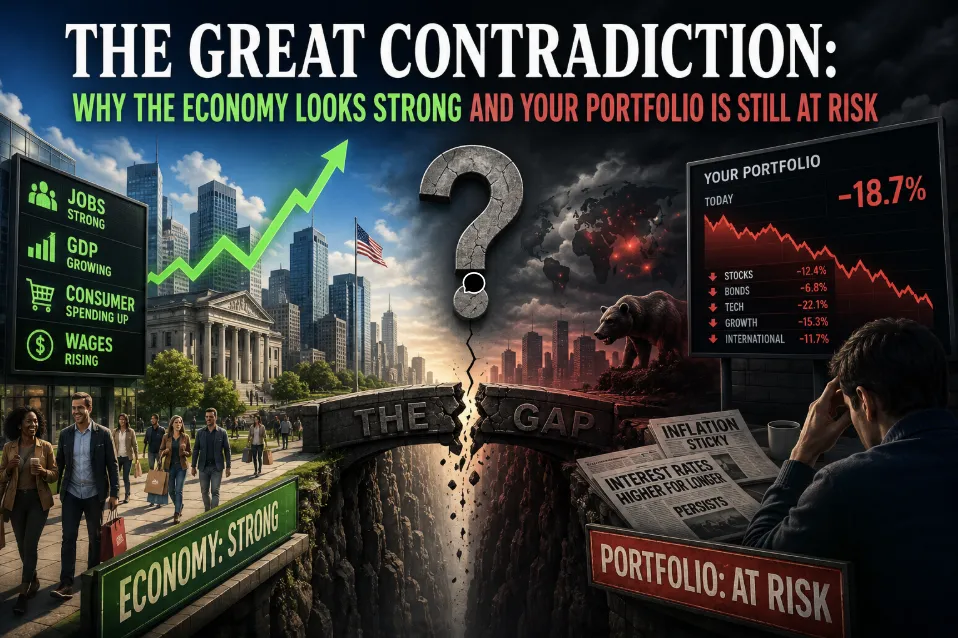
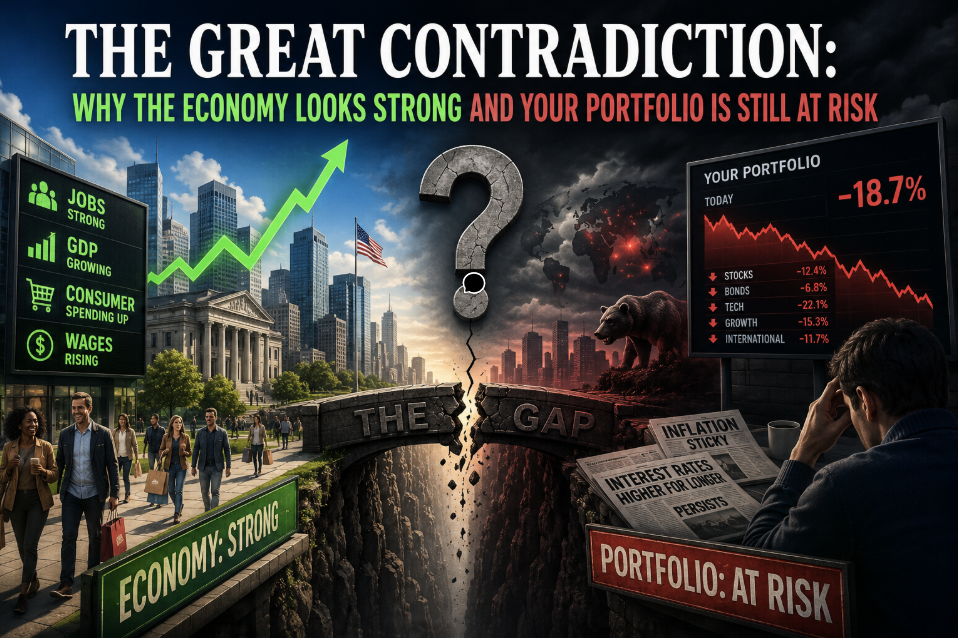
The Great Contradiction: Why the Economy Looks Strong and Your Portfolio Is Still at Risk
Start here: See what your retirement actually looks like → 👉 Book Your Million Dollar Hour™
One of the fastest ways to uncover hidden risk is to take our 7 Question Retirement Stress Test.
The Economic Mirage: Why the Crowd is Cheering While Your Retirement Foundation Cracks
It’s the great contradiction of our time.
You turn on the news and see talk of reshoring, massive capital inflows, and a US economy that looks like the only clean shirt in a very dirty global laundry basket. On the surface, the "Shiny Object" of economic momentum is dazzling. But beneath that surface, the "Dark Object": the structural reality of your retirement portfolio: is facing a set of physics it wasn't designed to handle.
At Your Street Wealth, we call this the Peter Pan Paradox: the refusal to grow up and adjust your risk management as you near the finish line. Most people are still playing by the rules of the 1990s in a 2026 world. They are participating in a market driven by "Flow" (money moving into the dollar for safety) while ignoring the "Stock" (the fact that everything is priced for perfection).
If you’re a Quiet Builder: someone who has spent decades accumulating wealth through discipline and stewardship: now is not the time to hope the contradiction resolves in your favor. It’s time to engineer certainty.
Riches vs. Wealth: Stop Confusing the Feeling With the Foundation
Before we talk about why the economy looks strong, define the real target.
Riches and wealth are not the same thing.
Riches are emotional. They are spendable. They are market-dependent. They are easily manipulated by other people through stories, headlines, quarterly statements, upgraded lifestyles, and the seductive idea that you finally have "enough." Riches are often just the feeling of wealth rented to you by Wall Street and Main Street.
Wealth is engineered. It is principal protected as an engine. It is not built to be casually spent. It is controlled by the individual through architecture, rules, and disciplined design.
That distinction matters because the world is optimized to hand you the sensation of progress without the structure of permanence. Wall Street celebrates quarterly gains. Main Street encourages lifestyle creep. Both systems quietly train you to measure safety by how good you feel right now.
Reject that measurement.
A rising statement balance is not automatically wealth. A nicer car is not wealth. A bigger house payment is not wealth. The comforting idea that you are "probably fine" is not wealth. Those are riches signals. They create emotional satisfaction, but they do not necessarily preserve your financial engine.
Wealth begins small. Wealth begins when even $20 is treated as principal that will never be destroyed. Treat that principal as an engine, not a spending account. Protect it. Design around it. Multiply it through architecture.
The moment you touch principal for lifestyle, you convert wealth back into riches.
That is why this subject belongs under Discipline 1 — Protect the Principal (Never Spend the Engine) and Discipline 4 — Protect Time (Time Is Your Most Valuable Asset). Ask the harder question: Is your retirement plan designed to preserve your wealth engine? Then ask the companion question: How much future income is lost when time is lost recovering what never should have been exposed in the first place?
Moving from riches to wealth requires sacrifice. Not dramatic sacrifice. Deliberate sacrifice.
Emotional sacrifice: Move from gratification to fulfillment. Stop chasing the temporary high of account bumps, applause, and visible upgrades.
Physical sacrifice: Focus your habits. Separate needs from wants. Build a life that serves the engine instead of draining it.
Financial sacrifice: Accept that some money will never be spent. Preserve part of your principal permanently so it can keep producing.
Call this the Sacrifice Triangle. Each step is simple when you see it on paper. None of it is easy without mental and emotional control. That is the point. Quiet Builders must learn, unlearn, and govern their own behavior. Stewardship is not a slogan. It is self-command.
Wall Street is not designed to help you build fulfillment. It is designed as a quarter-by-quarter, annual satisfaction exercise. It is a gratification machine. It feeds on comparison, optimism, fear, and reaction. It rewards participation, not engineered performance.
Wealth works differently.
Think of the difference between a Stepped Up Floor and a roller coaster. The roller coaster gets attention. It roars past. It looks exciting. It creates emotional motion. But the Stepped Up Floor quietly locks in progress one level at a time. Each step seems unimpressive in isolation. Each step requires you to resist the noise, reject envy, and stay with the architecture while the coaster screams by.
Do that work. Protect your thinking. Audit your behavior. Engineer your floor. The easy-to-see steps still require not-so-simple emotional discipline.
This is also where the 9 Levels of Retirement Discovery™ begin to matter. At Level 4 (Barrier), you challenge the belief that feeling wealthy is the same as being wealthy. At Level 5 (Truth), you separate average-return storytelling from actual engineered outcomes. At Level 7 (Principle), you protect principal. At Level 8 (Value), you measure money by its lifetime usefulness, not by its entertainment value. And at Level 9 (Synergy), you coordinate assets so the engine supports income, protection, tax efficiency, and legacy instead of feeding a lifestyle illusion.
Use the right standard: What is the maximum lifetime income your assets can produce while preserving the greatest amount of generational wealth?
That question exposes riches. That question builds wealth.
The Flow Mirage: Why the Economy Looks Strong
Right now, the US is experiencing a massive inflow of global capital. Why? Because the rest of the world is a mess.
China is nursing a multi-year property and credit hangover that makes 2008 look like a weekend headache.
The EU is in a state of structural stagnation, caught between high energy costs and a demographic cliff.
Emerging Markets are buckling under the weight of dollar-denominated debt.
Naturally, money is running to the US Dollar. This creates a "Flow" that pushes up asset prices and makes the economy look invincible. But don't confuse a crowded exit for a solid foundation.
This is where Discipline 6 : Upgrade Your Thinking comes into play. Most investors assume that a strong economy equals a safe portfolio. But accumulation strategies (buying and holding) are not retirement strategies. Retirement requires a shift from participating in market noise to engineering a result that doesn't depend on the "Wall Street Cycle."
The Slow-Motion "Plan B": BRICS and the De-Dollarization Trend
While the USD still cleared roughly 88% of FX transactions and sat in 58% of global reserves in early 2026, the trend is unmistakable. The BRICS nations (Brazil, Russia, India, China, South Africa, and their new partners) are building a "Plan B."
Through systems like CIPS (Cross-Border Interbank Payment System) and bilateral local-currency swap networks, they are slowly circumventing the dollar. By January 2026, CIPS saw transaction volumes jump 24% year-over-year.
Why does this matter to your retirement?
Treasury Risk: If global central banks shift even 10% of their reserves away from US Treasuries, interest rates must rise to attract buyers. This kills bond values: the very things your "safe" 60/40 basket of risk relies on.
Import Inflation: As the dollar’s absolute dominance erodes, your purchasing power at the grocery store and the gas pump becomes a "silent wealth leak."
The Gold Canary: For the first time in decades, foreign central banks’ holdings of gold have exceeded their holdings of US Treasuries in value. They are voting with their feet.

The Wall Street Cycle and the Math of Recovery
Wall Street loves to sell the "Shiny Object" of 7–10% average annual returns. But "average" is a rouge number that ignores the total of all negatives.
The reality is the Wall Street Cycle: 10–20% swings every 18 months and a major ~40% retraction roughly every 5–7 years. If you are 55 or 65, you don't have the time to "wait for the market to come back."
Every major crash costs a minimum of 3.3+ years of lost time. That’s 3.3 years where your money isn't just "down": it's failing to compound. This is the 5x Accumulated Loss Truth: a $100k contribution can easily lead to $500k in cumulative losses over a lifetime when you factor in the lost time and interrupted compounding.

The 60/40 Myth and the "Smartphone" of Finance
Most retirees are still using a "Rolodex" strategy in a SpaceX world. They hold a mix of stocks and bonds (the 60/40 myth) and assume that because they have two "single-pillar" assets, they are diversified.
In reality, in a world of rising debt and shifting global currencies, those two pillars often fall together.
Contrast this with Fully Performing Assets (FPA). Think of FPA as the "smartphone" of finance. Just as your phone consolidated your camera, pager, map, and computer into one device, an FPA consolidates 5–15 "pillars" of value: growth, protection, tax-free income, and LTC: into one engineered vehicle.
This is the difference between Participation (gambling on which way the wind blows) and Performance (engineering the outcome regardless of the weather).
The Choice: Stewardship vs. Hope
Stewardship isn't just about saving money; it’s about managing what you’ve been given with wisdom. It is your moral and intellectual duty to unlearn the myths that say you must accept market losses as a "natural" part of investing.
Market losses are not natural; they are a failure of engineering.
We see it all the time in our Margin Audit™. People unknowingly lose six or seven digits in their lifetime because they don't know the value of what they are losing. They are focused on the "Shiny Object" of growth while the "Dark Object" of fees, taxes, and volatility is hollowing out their engine.

Engineer Your Certainty
The economy may look strong today because of capital flows, but the structural groundwork is being laid for that flow to reverse. You can't control the BRICS payment system, China's debt, or Wall Street's next 40% retraction.
But you can control your rules.
The Million Dollar Hour™ Forecast is a 60-minute session where we move past the "probabilities" and into "guarantees." We scrutinize your current plan, calculate your actual years lost to risk, and show you a path to uncapped gains with a 0% floor.
Don't be the investor who watches their wealth evaporate because they refused to Upgrade Their Thinking.
Peace is the path. Wisdom is the way. Your money, your rules, in your time, on your street.
Ready for clarity instead of confusion?
The Million Dollar Hour™ is your educational, one-on-one retirement review that reveals where your plan leads : not just where it’s been.
👉 Schedule your session today.

Discover Which Wealth Killers Are Affecting You
Most people are impacted by 6–9 and don’t realize it
Wealth Killer #1: The Granddaddy : Why Market Volatility is Your Retirement’s Greatest Enemy
Concerned about market losses, taxes, or income reliability?
Take the 7 Question Retirement Stress Test →
You can keep participating… Or you can finally see the outcome. The Million Dollar Hour™ shows you exactly:
✔ Where you are ✔ Where you’re going ✔ How to fix the gaps 👉 Book your session now