
Retirement Strategies That Maximize Income, Eliminate Risk, and Help Ensure You Never Run Out of Money How to Achieve The Retirement Future Everyone Seeks
Most retirement plans are built on assumptions that no longer hold up—market averages, predictable tax rates, and the belief that time will always recover losses. But as you approach or enter retirement, the rules change. What worked during your accumulation years can become a liability during the withdrawal phase.
This blog is designed to help you rethink traditional strategies and discover a more engineered approach to retirement income—one focused on certainty, efficiency, and control.
Here, you’ll learn how to reduce or eliminate the biggest threats to your financial future, including market losses, rising taxes, hidden fees, and the silent erosion caused by lost time. We break down complex financial concepts into clear, actionable insights so you can make better decisions about your 401(k), IRA, and retirement income strategy.
You’ll also discover why many conventional approaches—like relying on average returns or the 4% rule—can expose you to unnecessary risk, especially when withdrawals begin. Instead, we explore strategies designed to protect your principal, improve compounding efficiency, and create predictable income streams that last.
Our focus is on helping you transition from “assets at risk” to a more stable and structured approach using fully performing assets—where growth, income, and protection work together instead of against each other.
Whether you’re still working or already retired, the goal is simple:
help you keep more of what you earn, generate more reliable income, and build a plan that doesn’t depend on hope, timing, or market luck.
If you’ve ever wondered:
* How to create tax-efficient retirement income
* How to avoid sequence of returns risk
* How to reduce fees and increase net returns
* How to design income that doesn’t run out
—you’re in the right place.
Explore the articles below and start building a retirement strategy based on engineering, not guesswork.

Retirement Planning Fees: Wall Street vs. Your Street
Stop Comparing Fees Like a Tourist: Why a Roller Coaster Ticket Isn't the Same as an Engineering Retainer
Start here: See what your retirement actually looks like → 👉 Book Your Million Dollar Hour™

One of the fastest ways to uncover hidden risk is to take our 7 Question Retirement Stress Test.
Why a Roller Coaster Ticket Isn't the Same as an Engineering Retainer. The Ultimate Head Fake.
When most people review their retirement plan, they get fixated on a single number: the fee percentage. They look at 1% here or 1.5% there and try to shop for a "deal" as if they are buying a gallon of milk or a flight to Orlando.
This is a classic case of False Equivalence.
In the world of retirement income planning, not all fees are created equal because not all assets perform the same function. If you are a "Quiet Builder": successful, financially fatigued, and looking for a strategy to protect retirement savings from a market crash: you must stop thinking like a tourist.
A fee isn't just a cost; it’s a reflection of what is being delivered.
Are you paying for a ticket to a ride you can't control, or are you paying for an engineering retainer to build a bridge that never collapses? There is a massive difference between Participation and Performance.
> Who would pay a fee without value and refuse a similar fee that delivers exponential value and potentially more? The false-equivalence creates the blindness.
The Three Buckets: AAR, NPA, and FPA
To understand why your fees aren't what they seem, you have to look at your Balance Sheet (the Source of Funds) and categorize your assets. We use a specific framework to differentiate between the quality of what you own.

1. Assets at Risk (AAR): The Roller Coaster Ticket
Most people spend their lives in the AAR category. These are your typical Wall Street products: stocks, mutual funds, and ETFs.
When you pay a 1% or 1.5% fee on these assets, what are you actually getting? You are paying for the "privilege" to ride the roller coaster. Your advisor might call it "active management," but they cannot stop the market from dropping 40%. They cannot guarantee your income. They are merely managing your participation in a system designed to extract value from you.
On Wall Street, you are subject to the Wall Street Cycle: 10–20% swings every 18 months and a major retraction of ~40% every 5 to 7 years. Each major crash costs you a minimum of 3.3 years of lost time. Pay close attention: a fee on an AAR asset is a fee for uncertainty. It’s a toll with no bridge.
2. Non-Performing Assets (NPA): The Fee of Disrespect
NPA represents cash, low-yield savings, or money sitting in accounts doing nothing. If you are paying a management fee on cash, that is pure disrespect to your hard-earned wealth.
Inflation is eating the purchasing power of that money every single day. While these assets are "safe" from market crashes, they are dying a slow death. Paying a fee here is like paying someone to watch your ice cube melt in the sun.
3. Fully Performing Assets (FPA): The Engineering Retainer
This is where the Quiet Builders live. Fully Performing Assets (FPA) are institutional-grade vehicles that provide 5–15 "pillars" of value.
When you pay a service fee for an FPA, you aren't paying for "participation." You are paying for Engineering. You are paying for:
Preservation: Principal locked in.
Protection: 0% floors mean zero crashes hit your core.
Perpetuation: Uncapped Gains (UCG) and Expanded Market Participation (EMP) keep the engine running.
Production: Guaranteed income that pays for life.
A fee for an FPA delivers a result. A fee for Wall Street delivers a hope.
The Consolidation of Technology: A Rolodex in a SpaceX World
Why are so many people still stuck in the AAR/NPA cycle? Because they are using a "Rolodex" strategy in a "SpaceX" world.

Think about the smartphone. It consolidated your phone, camera, pager, map, and computer into one "Multi-Pillar" device. Before the smartphone, you had to buy and maintain five different things.
Traditional Wall Street and banking are "Single-Pillar" models. The bank gives you liquidity but no growth. Stocks give you growth but no protection. Real estate gives you income but no liquidity.
Your Street Wealth focuses on Fully Performing Assets: the "smartphones" of the financial world. We use modern banking architecture to consolidate 5–15 pillars into a single vehicle. If you are still trying to manage five different "single-use" products, you are paying five different fees for an outdated, fragmented outcome.
The Math of Reality: 5x Accumulated Loss Truth
Wall Street loves to talk about "Average Returns." They call it the Shiny Object. They promise 7-10% averages to keep you in the game. But they never talk about the Dark Object: the cumulative cycle losses, the wealth killers, and the time tax.
Consider the 5x Accumulated Loss Truth. If you contribute $100,000 to a volatile market over your lifetime, your accumulated losses: the money you lost in crashes plus the gains you would have had if that money hadn't disappeared: can exceed $500,000.
You aren't just losing money; you are losing the Time Value of that money. Money can recover. Time never does.
When you pay a fee to a Wall Street broker, you are paying them to help you lose 3.3 years of time every time the market resets. Does that sound like a "service" to you?
Certainty vs. Uncertainty: Choose Your Power Pair
We believe in Engineered Performance over Market Participation. Look at the contrast:
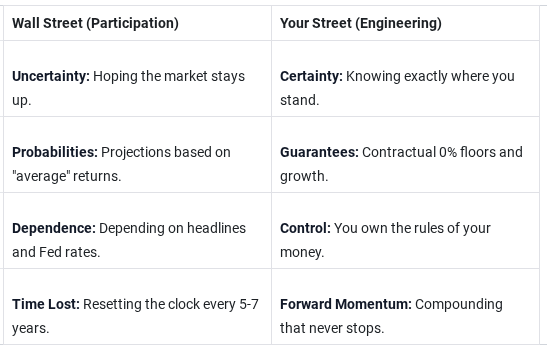
Audit the margin of your life. If you are paying a 1% fee for "Probabilities," you are overpaying. If you are paying a service fee for "Guarantees," you are investing in your future peace of mind.
Stop Guessing. Start Engineering.
Most people unknowingly lose six or seven digits in their lifetime because they don't know the value of what they are losing. They chase "micro-headlines" while ignoring "macro-margins."
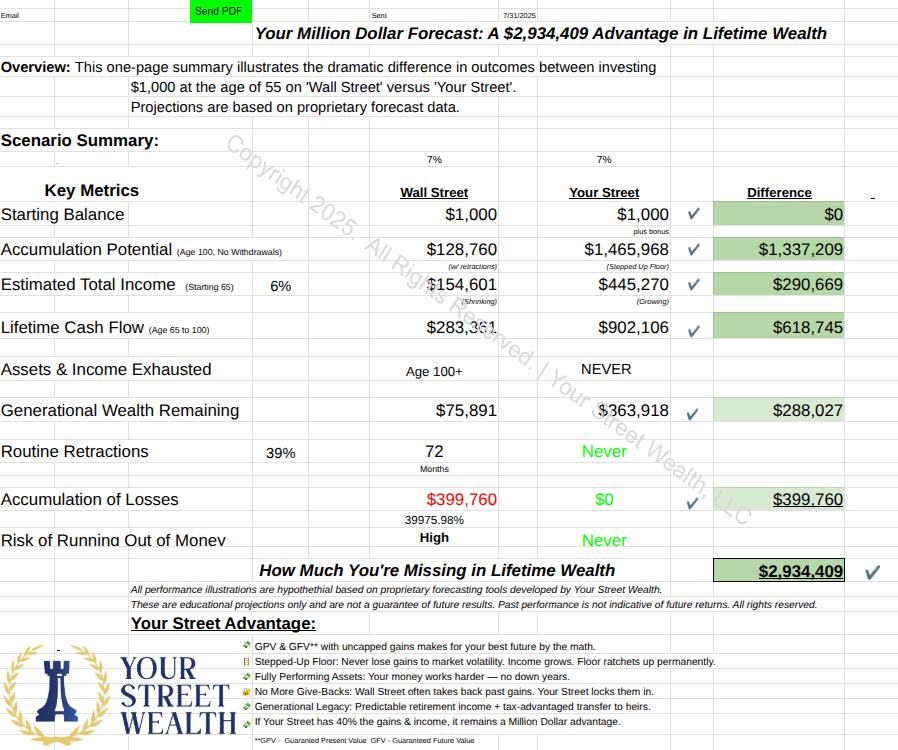
Success on Wall Street is a 3% Success Truth. Only 3% of people succeed through sheer luck or insider skill: a rate most brokers cannot deliver. Why gamble on a 3% chance when you can engineer a 100% certainty?
The Million Dollar Hour™ Forecast is not a "free consultation" designed to sell you a product. It is a $995 institutional-grade Margin Audit. We pull back the curtain on your current plan to show you exactly how many years you've lost to the Wall Street Cycle and how much "Wealth Killer" leakage is occurring in your balance sheet.
We don't want "free cheese" seekers. We want Quiet Builders who understand that true financial architecture requires a professional's touch.
Your Money. Your Rules. In Your Time. On Your Street.
Engineer your outcome. Stop paying for the roller coaster and start paying for the bridge.
Ready for clarity instead of confusion?
The Million Dollar Hour™ is your educational, one-on-one retirement review that reveals where your plan leads : not just where it’s been.
👉 Schedule your session today.
Discover Which Wealth Killers Are Affecting You
Stop Paying Fees Without Value Add — 3rd Wealth Killer
Most people are impacted by 6–9 and don’t realize it
Wealth Killer #1: The Granddaddy : Why Market Volatility is Your Retirement’s Greatest Enemy
Concerned about market losses, taxes, or income reliability?
Take the 7 Question Retirement Stress Test →
You can keep participating… Or you can finally see the outcome. The Million Dollar Hour™ shows you exactly:
✔ Where you are ✔ Where you’re going ✔ How to fix the gaps 👉 Book your session now