401(k) vs IRA: The 40-Year Trap and Hidden Admin Costs
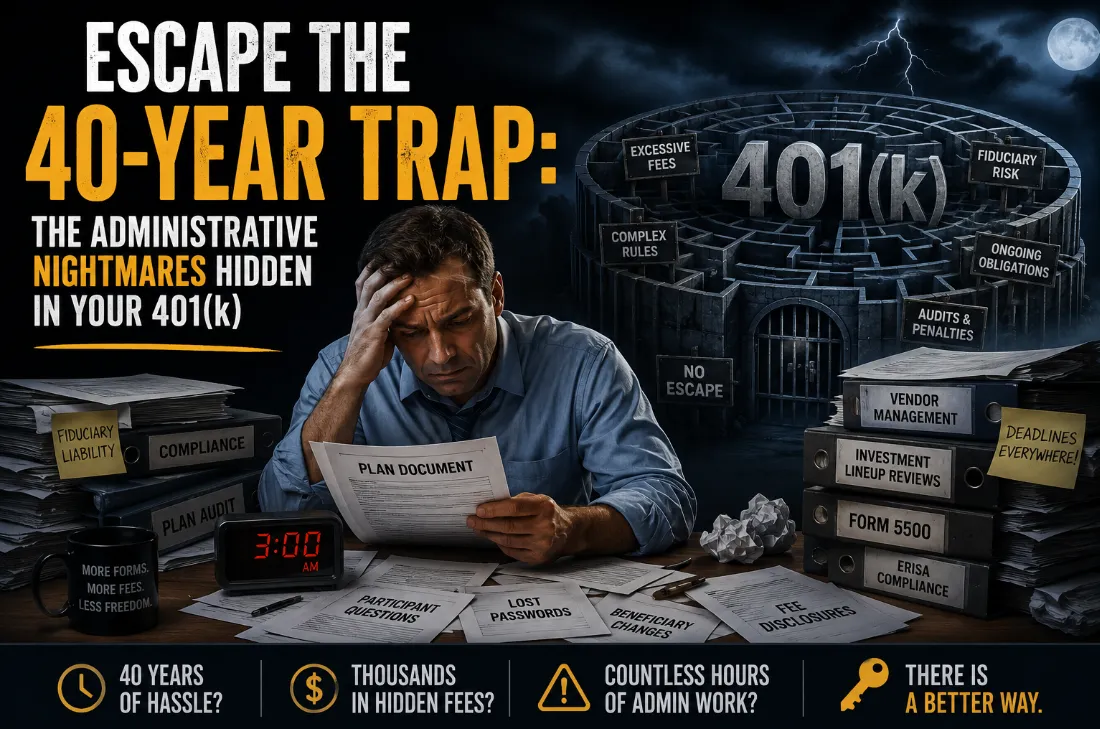
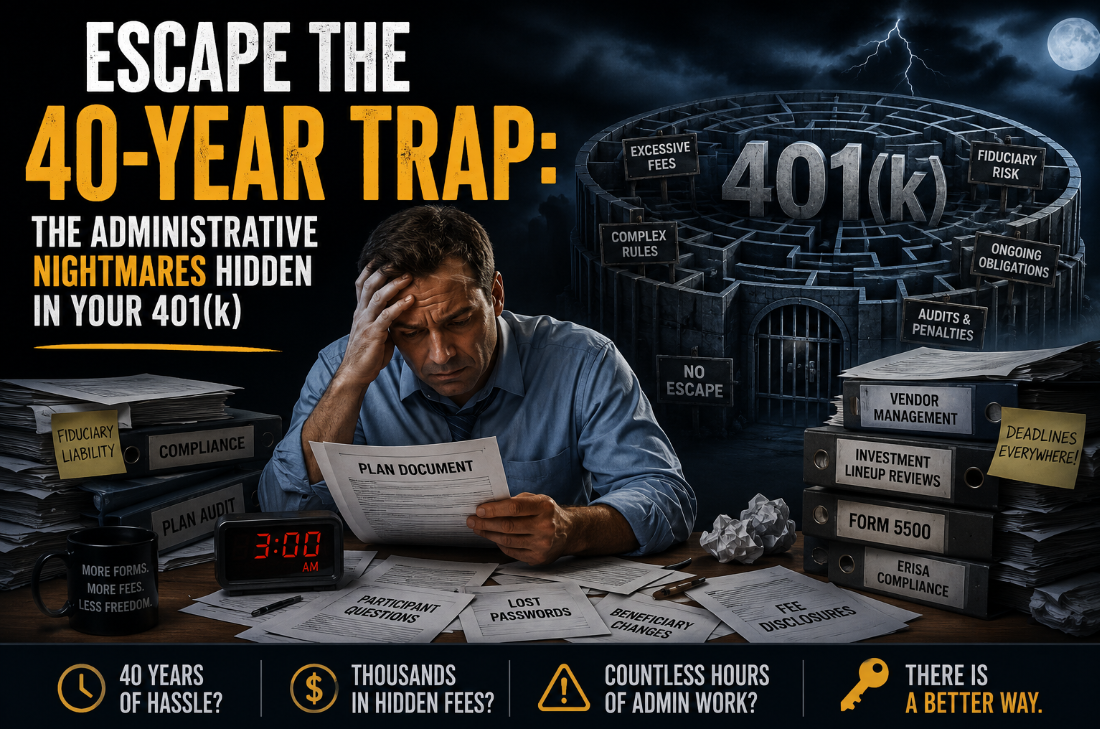
Escape the 40-Year Trap: The Administrative Nightmares Hidden in Your 401(k)
Start here: See what your retirement actually looks like → 👉 Book Your Million Dollar Hour™
One of the fastest ways to uncover hidden risk is to take our 7 Question Retirement Stress Test.
Is Your 401(k) Holding You Hostage? The 40-Year Financial Prison:
Most people treat their 401(k) like a "set it and forget it" machine. You sign a few papers during HR orientation, pick a target-date fund because it sounds safe, and assume that in 30 or 40 years, the "market" will have done its job.
But here is the reality most Quiet Builders don't realize until it’s too late: You didn’t just sign up for a retirement plan. You signed a 40-year administrative commitment that functions more like a locked vault than a wealth-building tool.
In the world of Wall Street, this is called "Participation." They want you to participate in their risks, their fees, and their timelines. At Your Street Wealth, we call it a "False Architecture." It’s a system designed to extract value from your time while leaving you with all the uncertainty.
If you’re feeling financially fatigued by the lack of clarity in your traditional plan, it’s time to audit the margin and look at the "Wealth Killers" hiding in plain sight.
1. The 40-Year Commitment (The Locked Vault)
When you contribute to a traditional 401(k), you are making a multi-decade promise to the IRS and your employer. For most, this is a 40-year lock-in. Unless you change jobs or reach the age of 59.5, your access to your own capital is severely restricted.
Wall Street frames this as "discipline." We frame it as a Single Pillar trap.
In a traditional 401(k) or IRA, your money is essentially a "Single Pillar" asset. It does one thing: it sits there and hopes the market goes up. If you need that capital to pivot into a new business opportunity, cover a family emergency, or engineer a safer path, you are met with red tape and gatekeepers. You are locked in for the long haul, regardless of how the economic landscape shifts.

2. The Tax & Penalty Gauntlet
Try to touch that money before the government says it's okay, and the "Retraction Tax" kicks in.
If you attempt to access your funds early, you aren't just hit with ordinary income tax; you’re slapped with a 10% early withdrawal penalty. But the administrative nightmare goes deeper than that. Consider the Indirect Rollover Trap.
If you change jobs and decide to take a check to move your money yourself, the old plan provider is required to withhold 20% for federal taxes. You then have exactly 60 days to deposit the full amount (including the 20% you don't actually have in your hand) into a new IRA. If you can’t come up with that 20% out of pocket to bridge the gap, that withholding becomes a taxable distribution.
It’s a high-friction system designed to keep you from moving your money to a more efficient "Architecture of Certainty."

3. The Rollover Rut: Moving Problems, Not Solving Them
When people leave a job, they often fall into the "Rollover Rut." They simply move their 401(k) into their new employer's 401(k) or a standard retail IRA.
This is like trading an old Rolodex for a slightly newer Rolodex in a SpaceX world. You are staying within the same "Participation" model. You are moving your money from one "Single Pillar" environment to another, without auditing the margin or checking for Sequence of Return Margin risks.
A rollover is a rare "exit opportunity": a moment where the 40-year vault door swings open. This is the escape hatch most people miss.
Instead of just rolling it over, use that moment to compare two systems clearly: the Architecture of Probability versus the Architecture of Certainty. The traditional 401(k) asks you to accept limited menus, administrative delays, market exposure, and outcome uncertainty. The Million Dollar Hour™ Forecast gives you a personalized engineering review that shows where your current plan leads, calculates your real Compounding Efficiency, measures the drag from volatility, fees, and taxes, and maps a guaranteed path to safer wealth accumulation and lifetime income.
That is the difference between Participation vs. Engineered Performance. One keeps you locked inside employer-sponsored rules and paperwork. The other helps you bypass the administrative headaches, filter through the noise, and move toward a designed solution built around your life instead of your former HR department.
So ask the better question: Do I want to keep participating in a locked system, or do I want to engineer a better one?
Is this asset a Fully Performing Asset (FPA) that provides 5–15 pillars of value (like growth, protection, long-term care leverage, tax-free income, and uncapped gains), or is it just another "Asset at Risk" (AAR) sitting in the middle of a volatility storm?
4. Limited Options: The Wealth Killers
Most 401(k) menus are surprisingly thin. You’re often given a choice between:
Low Growth: Bonds and money markets that lose value to inflation every single day.
High Risk: Equities that expose you to the "Math of Recovery" (where a 30% loss requires a 42% gain just to get back to zero).
There is rarely a middle ground. There is no "Engineered" option.
These are the Wealth Killers. Traditional plans lack the sophistication of Expanded Market Participation (EMP). They don't offer the 110%–200% multipliers on gains that we use to build a foundation of certainty. Instead, you are left spinning sharp knives, hoping you don't get cut by the next interest-rate ripple or market downturn.

5. The Secret Committees (The Transparency Gap)
Did you know your 401(k) investment menu is chosen by a "Secret Committee"?
Usually, this is a group of HR executives and finance officers who meet behind closed doors. They aren't necessarily looking for the best mathematical outcome for your retirement; they are looking for the plan that offers the most administrative ease and the lowest liability for the company.
These committees often keep their activities: and the true costs of the funds they select: hidden. You see an "expense ratio," but you don't see the hidden drag of internal transaction costs, marketing fees (12b-1), or the lost opportunity cost of being stuck in mediocre funds.

They are managing their risk, not yours.
The Shift: From a Rolodex to a Smartphone
Think of your current 401(k) like a 1980s office. You have a filing cabinet for records, a landline for calls, and a map for directions. Each is a "Single Pillar" tool.
A Fully Performing Asset (FPA) is the "Smartphone" of the financial world. It consolidates 5–15 pillars of value: growth, protection, long-term care benefits, and tax-free income: into one engineered vehicle.
Instead of a 40-year trap, you get an Architecture of Certainty.

Audit the Margin with the Million Dollar Hour™
If you are tired of the "False Model" driven by the greed/fear meter of Wall Street, it’s time for a Margin Audit™.
Most people can estimate their income needs, but they cannot predict the future value of their portfolio because they are dealing with uncontrollable leaks (fees/taxes) and losses (volatility).
The Million Dollar Hour™ Forecast is the primary escape hatch from the 40-year 401(k) trap. In one 60-minute session, we move past the "Hoping and Wishing" of participation and into the "Knowing and Engineering" of performance. We run a personalized Volatility Recovery Analysis, measure your Sequence of Return Margin, identify years lost to the Math of Recovery, and show the difference between a plan built on probability and one built on contractual design.
This is not another rollover conversation. It is a rules-based engineering session. We show you how to bypass the locked-in administrative friction and limited-option menu of traditional employer-sponsored plans and move toward a personalized, guaranteed path to safer wealth accumulation and lifetime income.
Wall Street gives you projections. We engineer precision. Wall Street gives you uncertainty. We build certainty. Money can recover. Time never does.
Stop being a "participant" in someone else’s game. Engineer certainty. Protect your time. Start being the architect of your own wealth.
Peace is the path, wisdom is the way.
Your Money, Your Rules, In Your Time, On Your Street.
Ready for clarity instead of confusion?
The Million Dollar Hour™ is your educational, one-on-one retirement review that reveals where your plan leads — not just where it’s been.
👉 Schedule your session today.
Discover Which Wealth Killers Are Affecting You
Most people are impacted by 6–9 and don’t realize it
Wealth Killer #1: The Granddaddy : Why Market Volatility is Your Retirement’s Greatest Enemy
Concerned about market losses, taxes, or income reliability?
Take the 7 Question Retirement Stress Test →
You can keep participating… Or you can finally see the outcome. The Million Dollar Hour™ shows you exactly:
✔ Where you are ✔ Where you’re going ✔ How to fix the gaps 👉 Book your session now