
60/40 Portfolio Myth: Protect Retirement From Market Crash
The Diversification Myth: Why Your 60/40 Portfolio is Still in the Same 'Basket of Risk'
One of the fastest ways to uncover hidden risk is to take our 7 Question Retirement Stress Test.
![[HERO] The Diversification Myth: Why Your 60/40 Portfolio is Still in the Same 'Basket of Risk'](https://cdn.marblism.com/6ag8ofQj958.webp "[HERO] The Diversification Myth: Why Your 60/40 Portfolio is Still in the Same 'Basket of Risk'")
Start here: See what your retirement actually looks like → 👉 Book Your Million Dollar Hour™
Is Your "Diversified" Portfolio a Single Point of Failure?
Wall Street has a favorite lullaby they love to sing to "Quiet Builders." It goes something like this: “Just stay diversified. Buy a mix of stocks and bonds: the classic 60/40 split: and you’ll be fine. When stocks go down, bonds go up. You’re safe.”
It sounds logical. It sounds "balanced." But in today’s economic climate, the 60/40 portfolio isn't a safety net: it’s a Diversification Illusion.
If you are approaching retirement or already in it, relying on this old-school model is like trying to navigate a SpaceX world with a Rolodex. It was a durable idea in the 1980s, but today’s market dynamics have turned that 60/40 split into a single "Basket of Risk."
Let’s run a diagnostic on why your portfolio might be leaking principal, income, and: most importantly: Time (T).
The Peter Pan Mindset: Refusing to Grow Up Your Risk Profile
In the world of "FinanceX" (the flashy, marketing-driven version of finance), many investors fall into what I call the Peter Pan Mindset. This is the belief that your wealth can stay in "growth mode" forever without ever maturing into a "protected mode."
These investors follow the "Rule of 1,000": a metaphorical mindset where they act as if they have a thousand years to recover from a market crash. They ignore the reality of their biological clock and their financial timeline. The Rule of 1,000 does not consider your allocation of risk based on your actual age; it assumes the market will always "bounce back" in time for you to spend it.
But here is the engineering reality: Money can recover. Time never does.
If you are 55, 65, or 75, you don't have the luxury of the Rule of 1,000. You need to be looking at a tighter framework: the Rule of 50, 75, or 100. This means optimizing your benefits by seeding Fully Performing Assets (FPAs) early and allocating your risk away from you as you approach the "Red Zone" of retirement.
When you stay locked into an Asset at Risk (AAR) dominant portfolio, you are essentially betting your lifestyle on the hope that the market won't have a "retraction year" right when you need to draw income.
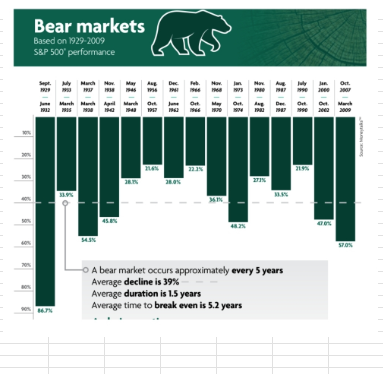
The 60/40 Myth: Different Securities, Same Basket
Why do we call the 60/40 split a myth? Because it creates a false sense of security.
Wall Street induces you to buy hundreds of different securities: different tickers, different sectors, different bond durations: and tells you that you are diversified. But they aren't looking at the quality of the exposure or the pillars supporting those assets.
In reality, most 60/40 portfolios are stuck in the Same Basket of Risk.
Stocks carry the risk of market volatility and principal loss.
Bonds (the "safe" 40%) carry interest rate risk and inflation risk.
In a major market retraction, we often see a "correlation of one." This means that everything goes down at once. Your stocks tank because of a recession, and your bonds tank because the Fed is hiking rates to fight inflation. You didn't have two different baskets; you had one basket with two different labels on it.
This "Diversification Illusion" only serves to lower your returns in the good years (because that 40% in bonds drags down the growth) and compounds your losses in the major retraction years (because the bonds fail to provide the promised floor). You lose principal, you lose the ability to generate reliable income, and you lose the time required to recover.
Engineering Certainty: From AAR to FPA
To protect your retirement savings from a market crash, you have to move beyond "Participation" and move toward "Engineered Performance."
Traditional Wall Street methods are based on Probabilities (we hope the market goes up 7% on average). Your Street Wealth is based on Guarantees (contractual certainties that your floor is 0% and your gains are locked in).
We categorize assets into four buckets:
NPA (Non-Performing Assets): Cash under the mattress. Safe, but losing value to inflation.
UPA (Underperforming Assets): Low-yield accounts or high-fee vehicles.
AAR (Assets at Risk): Your traditional stocks, bonds, and mutual funds. This is where most people are "over-allocated."
FPA (Fully Performing Assets): The "Smartphone" of finance.
Just as your smartphone consolidated your pager, camera, phone, and map into one device, an FPA consolidates 5 to 15 "pillars" of value: such as growth, protection, tax-free income, and long-term care: into one vehicle.
Participation vs. Engineered Performance
When you are in a 60/40 AAR portfolio, you are merely participating in whatever the market decides to do. You are a passenger on a ship you don't control.
When you transition to an FPA-dominant strategy, you are engineering an outcome. You are using a Margin Audit™ to find the leaks in your current plan and a Volatility Recovery Analysis to see just how much a 20% or 30% drop would actually cost you in years of life.

The Math of Recovery: Why 0% is Your Best Friend
Most "Quiet Builders" have been trained to chase the "Macro Headlines." They want the big wins. But wealth isn't built on macro headlines; it’s built on Compounding Efficiency and micro margins.
Consider the Math of Recovery:
If your portfolio loses 10%, you need an 11% gain to get back to even.
If it loses 30%, you need a 42% gain just to break even.
If it loses 50%, you need a 100% gain to recover.
While you are waiting for that 42% or 100% gain, you are losing the most precious asset you have: Time.
A 60/40 portfolio that drops 20% in a bad year doesn't just lose money; it resets your compounding clock. By utilizing Fully Performing Assets with a 0% Floor, you eliminate the "reset." If the market drops 30%, you stay at 0%. Your recovery time is zero days. You start compounding from your highest point, not from a hole.
The Power Pairs: Your Street vs. Wall Street
To get clarity on your best retirement income strategies, you have to choose which side of the "Power Pairs" you want to live on:
Certainty vs. Uncertainty: Do you want to know your income is coming, or hope the market stays up?
Guarantees vs. Probabilities: Do you want a contract or a projection?
Control vs. Dependence: Do you want to control your outcome or depend on the Fed?
Growth Without Loss vs. Growth With Loss: Do you want forward momentum or a resetting clock?
Increasing Income vs. Depleting Assets: Do you want your income to rise over time, or do you want to worry about outliving your money?
Time Compounding vs. Time Lost: Do you want your money working every day, or do you want to spend years "recovering"?
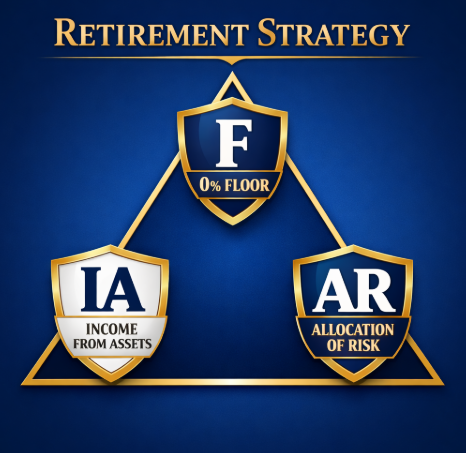
The Margin Audit™: Your Next Step
If you feel "financially fatigued" by the constant noise of the markets, it’s likely because your current plan is built on a False Model driven by fear and greed.
Wall Street wants you to stay in the AAR basket because it generates daily research, addictive buying and selling, and consistent fees for them: regardless of whether you win or lose. They are using hidden complexity to keep you in a state of "Participation."
It is time to unlearn the 60/40 myth. It is time to move from a Rolodex strategy to a SpaceX architecture.
A retirement plan review shouldn't just be a look at your balances; it should be a structural engineering report. Are there leaks? Is the foundation solid? Is your risk allocated based on your age, or are you still playing the Peter Pan game?
The Million Dollar Hour™ is designed to provide this exact clarity. In one 60-minute session, we apply institutional-grade Asset Liability Management (ALM) to your personal balance sheet. We look for the "Sequence of Return Margin" and ensure that your wealth is built on a multi-pillar foundation that respects your time.
Stop guessing with your "diversified" basket. Start engineering with certainty.
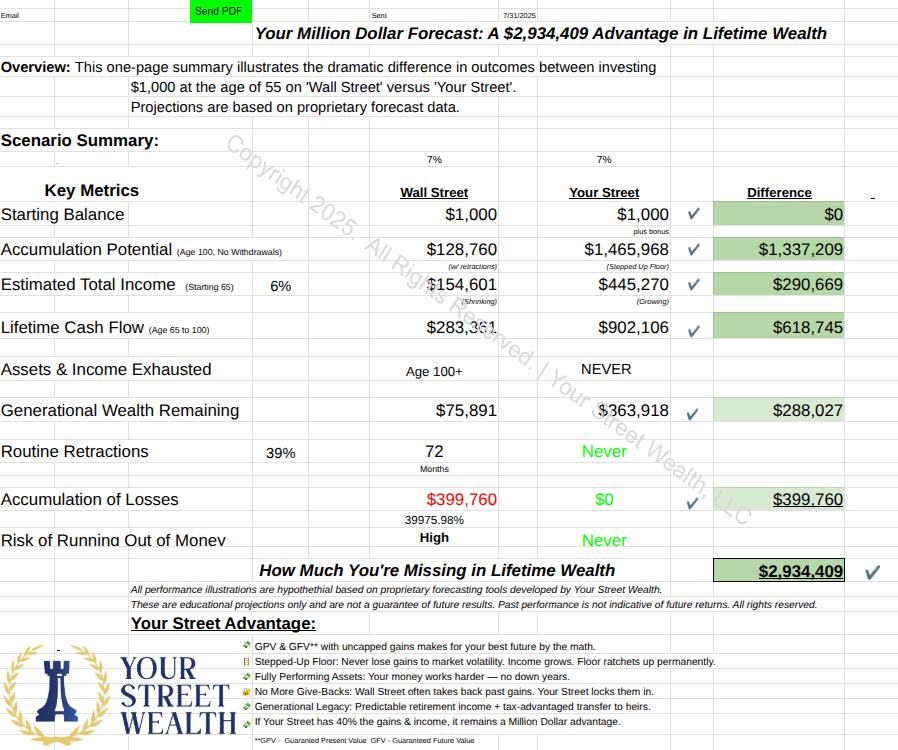
Ready for clarity instead of confusion?
The Million Dollar Hour™ is your educational, one-on-one retirement review that reveals where your plan leads : not just where it’s been.
👉 Schedule your session today.
Discover Which Wealth Killers Are Affecting You
Most people are impacted by 6–9 and don’t realize it
Wealth Killer #1: The Granddaddy : Why Market Volatility is Your Retirement’s Greatest Enemy
Concerned about market losses, taxes, or income reliability?
Take the 7 Question Retirement Stress Test →
You can keep participating… Or you can finally see the outcome. The Million Dollar Hour™ shows you exactly:
✔ Where you are ✔ Where you’re going ✔ How to fix the gaps 👉 Book your session now
Check out the Retirement Blueprint