
7 Retirement Mistakes to Avoid for Guaranteed Income
Wealth Killer Eviction: 7 Mistakes You're Making and How to Evict the 11 Wealth Killers
One of the fastest ways to uncover hidden risk is to take our 7 Question Retirement Stress Test.
![[HERO] Wealth Killer Eviction: 7 Mistakes You're Making and How to Evict the 11 Wealth Killers](https://cdn.marblism.com/dWNTSJ14mu0.webp "[HERO] Wealth Killer Eviction: 7 Mistakes You're Making and How to Evict the 11 Wealth Killers")
Start here: See what your retirement actually looks like → 👉 Book Your Million Dollar Hour™
Retirement Engineering: Is Your Money a Rolodex or a SpaceX Rocket?
You’ve spent the last thirty years as a "Quiet Builder." You worked hard, lived below your means, and watched your accounts grow. But now that you’re looking at the finish line: somewhere between ages 45 and 75: there’s a nagging sense of unease. You have the "Assets at Risk" (AAR), but you don’t have peace.
The reason is simple: You are using a Rolodex in a SpaceX world.
Most traditional retirement plans are "1-Pillar" reports. They focus entirely on the size of your pile (Accumulated Assets). They tell you "how much do i need to retire" based on hypothetical market returns, but they completely ignore the 11 Wealth Killers hiding in the shadows of your balance sheet.
It’s time for a Wealth Killer Eviction. If you want a plan that actually works, you have to stop participating in market noise and start engineering performance.
The 1-Pillar Trap: Participation vs. Performance
When you look at your current brokerage statement, you’re looking at a Single Pillar asset. It does one thing: it goes up or down based on the "participation" of the market. This is the Rolodex model: durable in the 1970s, but inadequate for the speed and volatility of modern finance.
In contrast, Fully Performing Assets (FPA) are the "smartphones" of finance. Just as your phone consolidated your pager, camera, map, and computer into one device, an FPA consolidates 5–15 pillars of value into one vehicle. We’re talking about growth, protection, long-term care benefits, and tax-free income: all working simultaneously.

If your current plan only protects against zero wealth killers, you aren't planning; you're gambling.
The 11 Wealth Killers Hiding in Plain Sight
Before you can evict them, you have to identify them. Traditional Wall Street advisors rarely mention these because their business model depends on you ignoring the leaks.
Market Volatility: The uncontrolled loss cycles that reset your compounding clock.
Taxes: The "Future Lien" the government holds on your qualified accounts.
Inflation: The silent thief eating your purchasing power.
Fees: The dripping faucet draining your growth over decades.
Health Care Costs: The unplanned "carnivore" of retirement capital.
Longevity Risk: The danger of outliving your money (Wealth Killer #9).
Opportunity Cost: The cost of having money "lazy" or stuck in Non-Performing Assets (NPA).
Sequence of Returns Risk: The mathematical nightmare of a market dip early in retirement.
Lawsuits/Liability: The risk of losing your foundation to external claims.
Government Policy: Changes in laws that move the goalposts on your savings.
Time: The only asset you can never recover.
Audit the margin. If your plan doesn't have a contractual answer for at least 5 of these, you are exposed.
7 Mistakes You’re Making (And How to Fix Them)
1. Ignoring the Math of Recovery
Most investors think a 30% loss only requires a 30% gain to break even. This is the "Participation" lie. The reality is the Math of Recovery: A 30% loss requires a 42% gain just to get back to zero. Money can recover; time never does. Stop resetting the clock. Use a Volatility Recovery Analysis to see how much time you’ve already lost.

2. Relying on the "4% Rule" Myth
The 4% rule is a probability, not a guarantee. In a high-inflation, high-tax world, drawing down assets is a race to the bottom. Instead of depleting assets, you should be increasing income. Shift your focus from "how much I have" to "how much is engineered to arrive."
3. Living with "Lazy" NPAs
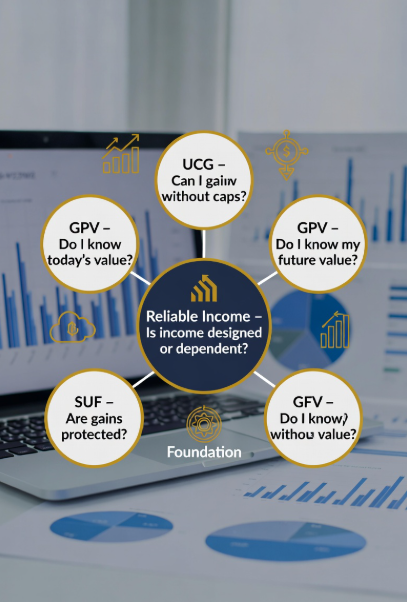
Non-Performing Assets (NPA), like cash in a standard savings account, offer safety but zero protection against inflation or opportunity cost. You need to move from NPA to FPA: assets that provide Uncapped Gains (UCG) and Expanded Market Participation (EMP). Imagine a 10% market gain turning into an 11%–20% gain because of an EMP multiplier. That’s architecture, not luck.
4. Failing to Perform a Margin Audit™
Wall Street loves hidden complexity. They use it to keep you addicted to daily research and macro headlines. A Margin Audit™ strips away the noise. It looks at the micro margins: the fees, the tax drag, and the compounding efficiency. If you don't know your exact Sequence of Return Margin, you don't have a plan.
5. Accepting the "Tax Time Bomb"
If the majority of your wealth is in a 401(k) or IRA, you don't own that money; you're a co-owner with the IRS. As tax rates inevitably rise to cover national debt, your "future lien" grows. You need to engineer a path toward tax-advantaged positioning before the bomb detonates.
6. Overlooking the "Dripping Faucet" of Fees
A 1.5% fee doesn't sound like much until you realize it can consume 30% of your total gains over 20 years due to lost compounding. Stop the leak. Engineered performance focuses on 0% to 1.5% fees with A+ guarantees.

7. Choosing Probabilities Over Guarantees
Wall Street sells "hopes and projections." Your Street Wealth builds on "contracts and guarantees." In the engineering world, we don't "hope" the bridge stays up; we design it to withstand the load. Your retirement income planning should be no different.
The 7-Question Retirement Stress Test
To evict the killers, you need to see them. Ask your current advisor these seven questions. If they start talking about "historical averages" or "staying the course," you’ve found a hole in your architecture.
Do I have a guaranteed retirement income that I cannot outlive?
What is my plan to protect retirement savings from a market crash tomorrow?
How much of my current "wealth" actually belongs to the IRS?
If the market drops 30%, how many years of my life are lost to the Math of Recovery?
Are my assets "Single Pillar" (one benefit) or "Multi-Pillar" (5-15 benefits)?
Am I using a "Rolodex" strategy for a "SpaceX" era of risk?
Do I have a side-by-side forecast showing exactly where this current path leads?
Engineer Your Certainty: The Million Dollar Hour™
The "Quiet Builder" doesn't need more "tips" or "opportunities." You need precision. You need a designed process that grows and heals, rather than a "participation" model that extracts value.
We don't offer "free consultations" because we don't sell "free cheese." We offer the Million Dollar Hour™ Forecast.
For a one-time $995 investment, we conduct a professional Margin Audit™ and a Volatility Recovery Analysis. We look at your current trajectory "forward and back" to see the hidden leaks. In sixty minutes, you’ll unlearn the myths of Wall Street and learn the fundamental financial architecture that protects your time and wealth for life.
Stop spinning sharp knives with your interest-rate ripples. Peace is the path, and wisdom is the way. It’s your money, your rules, in your time, on your street.
Ready to evict the killers?

Ready for clarity instead of confusion?
The Million Dollar Hour™ is your educational, one-on-one retirement review that reveals where your plan leads : not just where it’s been.
👉 Schedule your session today.
Discover Which Wealth Killers Are Affecting You
Most people are impacted by 6–9 and don’t realize it
Wealth Killer #1: The Granddaddy : Why Market Volatility is Your Retirement’s Greatest Enemy
Concerned about market losses, taxes, or income reliability?
Take the 7 Question Retirement Stress Test →
You can keep participating… Or you can finally see the outcome. The Million Dollar Hour™ shows you exactly:
✔ Where you are ✔ Where you’re going ✔ How to fix the gaps 👉 Book your session now
Check out the Retirement Blueprint