
a 90% Success Rate is a 100% Gamble
The Retirement Income Calculator Trap: Why a '90% Success Rate' is a 100% Gamble
One of the fastest ways to uncover hidden risk is to take our 7 Question Retirement Stress Test.

Start here: See what your retirement actually looks like → 👉 Book Your Million Dollar Hour™
You’ve seen the "Magic Box."
It’s that shiny, free online tool on some big-name brokerage site. You plug in your age, your current savings, and a guess at your future spending. You hit "Calculate," and the screen flashes a comforting shade of green: 90% Success Rate.
You breathe a sigh of relief. You think you’re safe. You think you’ve planned.
In reality, you’ve just been handed a loaded gun with one chamber full and told the odds are in your favor.
If you were boarding a plane and the pilot announced there was a 10% chance the engines would fail over the Atlantic, would you stay in your seat? Of course not. You’d be off that plane before the door closed. Yet, for some reason, Wall Street has convinced millions of "Quiet Builders": successful, hard-working people like you: that a 1 in 10 chance of going broke is "success."
At Your Street Wealth, we don’t play with probabilities. We engineer certainty.
The Mirage of Probability vs. The Precision of Engineering
Traditional retirement income planning is built on a "Participation" model. Wall Street wants you to participate in their market, ride their roller coaster, and hope that the "average" return works out in your favor.
They use something called a Monte Carlo simulation. It’s a fancy way of saying they’ve run 1,000 "what if" scenarios. If your money lasts in 900 of them, they call it a win. But here’s what they don’t tell you: the 100 scenarios where you fail aren’t just "minor setbacks." They are catastrophic. They are the years you run out of money at age 78 while your health needs are peaking.

Wall Street uses hidden complexity to drive daily research and addictive buying and selling. They want you focused on the macro headlines while they extract your wealth through micro-margins.
Stop hoping. Start knowing.
The Sequence of Return Margin: The Silent Killer
The biggest flaw in every standard retirement income calculator is how it handles the "order" of your returns. This is known as Sequence of Returns Risk, or what we call the Sequence of Return Margin.
Imagine two retirees, both starting with $1 million and both earning an "average" 6% return over 20 years.
Retiree A sees a flat market for five years, followed by a boom.
Retiree B hits a -20% market drop in year one while they are starting their $50,000 annual withdrawals.
Even if the "average" return is the same at the end of 20 years, Retiree B is broke by year 12. Why? Because when you withdraw money from a falling asset, you aren’t just losing value; you are destroying your "Compounding Efficiency." You are selling shares at a discount that can never recover.
Your calculator doesn't account for the "danger zone": those first five years of retirement where a single market hiccup can reset your financial clock forever.
The Math of Recovery: Why Market "Participation" is a Losing Game
Wall Street loves to talk about "buying the dip." They don't talk about the math of getting back to zero.
If your portfolio takes a 30% hit: which happens more often than the "experts" care to admit: you don't just need a 30% gain to get back to where you started.

Audit the margin. A 30% loss requires a 42% gain just to break even. While you are waiting for that 42% "recovery," time is passing. You are getting older. Your needs are increasing.
This is the "Volatility Recovery Analysis" most calculators ignore. They treat market losses like a temporary weather event. We treat them like structural failures in your financial architecture.
Evidence of Performance: Average by Age Band vs. Engineered Outcomes
Now audit what the "average by age band" story really means in the real world.
On Wall Street, a 25-year-old starting with $25,000 at 5% and making continuous contributions often ends up with only about $200,000 by age 65. Remove the contributions, and the same account can get dragged around by market waves so badly that the original $25,000 may behave more like $20,000 than a retirement engine. That is the hidden cost of Participation vs. Engineered Performance. The headline says "average return." The lived experience says delay, drag, and lost time.
Now compare that to Your Street. The same 25-year-old with $25,000 at 5% and no additional contributions can reach $1,000,000 through engineering principles built on zero losses, stronger compounding efficiency, and rules-based design. That is what happens when you stop resetting the clock every time Wall Street drops the ball.
Look at annual contributions too. If someone adds $1,000 per year, Wall Street may only turn that effort into roughly $40,000 by age 65. On Your Street, that same disciplined behavior can produce a result that is roughly 300% greater because Wall Street quietly gives away around $120,000 in what we call "losses of gains." Not just losses. Lost gains. Lost time. Lost momentum.
And Main Street is not the hero in this story either. Main Street is defined by Non-Performing Assets (NPA) : money parked in places that are inherently unable to produce returns higher than inflation over time. So if Wall Street is gambling, Main Street is slow erosion, and Your Street is engineering, where exactly is your retirement engine supposed to come from?
Here is the blunt truth: Bad news never improves with age. The longer you stay trapped in Wall Street's "Free Cheese" model, the more damage compounds under the surface. A market sitting at an all-time high is not a comfort signal. It means the risk of loss has never been higher. On Your Street, losses are not part of the design.
Single-Pillar Assets vs. Multi-Pillar Architecture
Most retirement plans are built on "Single-Pillar" assets.
Banks: Low risk, but zero growth (NPA - Non-Performing Assets).
Stocks: High growth potential, but high risk of total loss (AAR - Assets at Risk).
Real Estate: High growth and income, but low liquidity (UPA - Under-Performing Assets).
Relying on these is like trying to run your entire life using only a pager from 1988. It was durable then, but it’s inadequate for the speed and risk of modern retirement.
At Your Street Wealth, we focus on Fully Performing Assets (FPA). Think of FPA as the "smartphone" of finance. Just as your phone consolidated your camera, GPS, and computer into one device, FPA consolidates 5–15 "pillars" of value into one vehicle:
Guaranteed Growth
Protection from Market Loss (0% Floor)
Tax-Free Income Potential
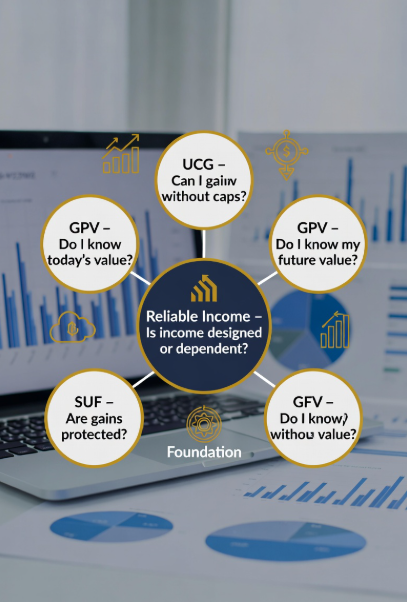
Uncapped Gains (UCG)
Expanded Market Participation (EMP) : allowing for multipliers of 110%–200% on gains.
When you move from "Single-Pillar" products to a "Multi-Pillar" architecture, you move from the uncertainty of Wall Street to the certainty of Your Street.
The Margin Audit™: Finding the Leaks in Your Plan
Before you can build a stable future, you have to find where your current plan is bleeding. This is the Margin Audit™.
Most retirees are losing wealth to three main "leaks":
Fees: The 1%–2% you pay for "management" that doesn't guarantee a single outcome.
Taxes: The ticking time bomb in your 401(k) or IRA.
Volatility: The "Math of Recovery" we just discussed.
A standard retirement income planning session with a broker is usually just a sales pitch for more "Participation." They want you to stay in the game because they get paid regardless of whether you win or lose.
We operate differently. We use institutional-grade Asset Liability Management (ALM) to ensure your assets match your future liabilities (your lifestyle needs). We don't guess. We engineer.
Why You Must Unlearn the "Probability" Myth
Wisdom is actionable. If your current plan is based on a "90% success rate," your primary "action" is waiting and hoping.
Peace is the path, wisdom is the way.
You have spent 30 or 40 years building your wealth. You are a "Quiet Builder." You don't need more "opportunity" language; you need precision. You need to know that your income is designed, not dependent on the whims of the S&P 500.
Wall Street operates on a "False Model" driven by greed and fear. When the greed meter is high, they push you into risk. When the fear meter is high, they tell you to "stay the course."
Ignore the noise. Protect your time. Money can recover; time never does.
The Million Dollar Hour™: Your Flight Plan to Certainty
Stop using calculators that offer weather reports. It’s time for a flight plan.
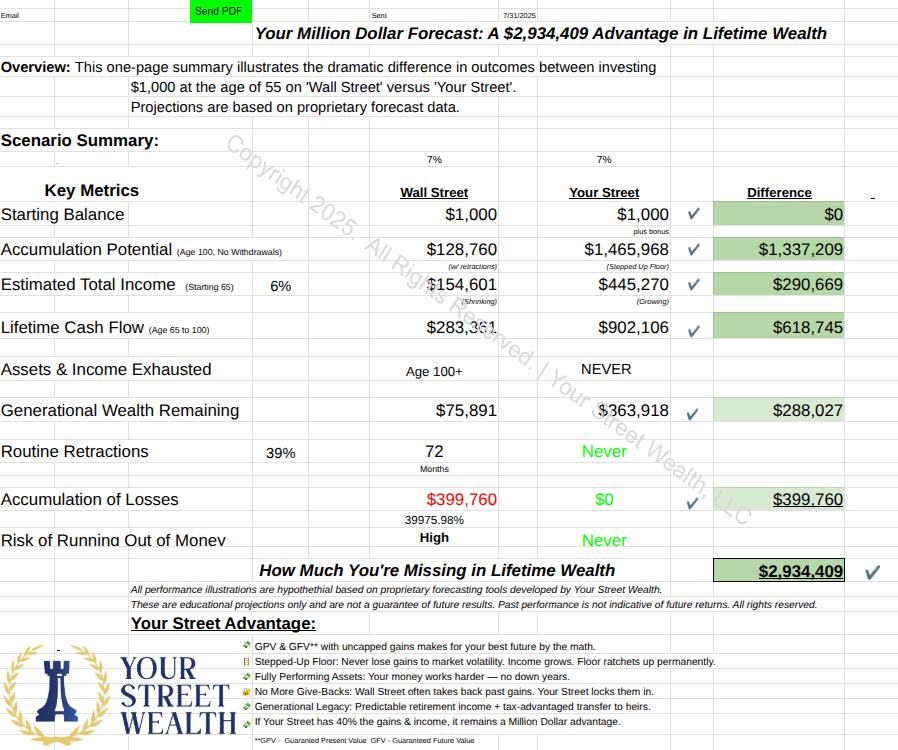
The Million Dollar Hour™ Forecast is our premium, $995 engineering audit designed for those who value scrutinized, certain plans over "free" guesses. In 60 minutes, we do what no online tool can:
Calculate the actual compounded growth you’ve earned versus what you think you have.
Identify the exact years lost to market volatility and hidden fees.
Present a personalized, guaranteed path to wealth accumulation and lifetime income.
We filter for high-intent builders who are ready to move from "Hoping" to "Knowing." We provide the clarity and confidence that comes from a clear, actionable forecast.
Don't settle for a 90% chance of success. In your retirement, 90% is just a slow-motion failure.
Choose certainty. Choose architecture. Choose Your Street.
Use the Million Dollar Hour™ to model your future like an engineer, not a gambler.
Your Money, Your Rules, In Your Time, On Your Street.
Ready for clarity instead of confusion?
The Million Dollar Hour™ is your educational, one-on-one retirement review that reveals where your plan leads : not just where it’s been.
👉 Schedule your session today.
Discover Which Wealth Killers Are Affecting You
Most people are impacted by 6–9 and don’t realize it
Wealth Killer #1: The Granddaddy : Why Market Volatility is Your Retirement’s Greatest Enemy
Concerned about market losses, taxes, or income reliability?
Take the 7 Question Retirement Stress Test →
You can keep participating… Or you can finally see the outcome. The Million Dollar Hour™ shows you exactly:
✔ Where you are ✔ Where you’re going ✔ How to fix the gaps 👉 Book your session now
Check out the Retirement Blueprint