
Best Retirement Income Strategies: Solving the Income Gap
The Disconnect: Why Your Current 'Plan' Might Be a Bridge to Nowhere
One of the fastest ways to uncover hidden risk is to take our 7 Question Retirement Stress Test.

Start here: See what your retirement actually looks like → 👉 Book Your Million Dollar Hour™
The Disconnect: Why Your Current 'Plan' Might Be a Bridge to Nowhere
You’ve spent decades building. You’ve been the "Quiet Builder": the one who worked hard, saved diligently, and mostly ignored the daily noise of the headlines. You’ve followed the traditional rules: contribute to the 401(k), diversify your portfolio, and trust that "the market always goes up in the long run."
But as you approach the finish line, a nagging feeling has started to set in. You look at your statements, and while the numbers might look "good enough," you realize there is a massive disconnect between the pile of money you’ve accumulated and the actual, reliable income you need to live the rest of your life.
This is The Disconnect. It is the gap between accumulation and distribution. And for most people, their current retirement plan isn’t a solid path: it’s a bridge to nowhere.
The Broken Bridge Analogy
Imagine you are building a bridge across a vast canyon. For 30 years, you’ve been focused on the construction: the materials, the labor, the height. You’ve done a great job building it halfway across. But as you step out onto the structure to finally cross to the other side (retirement), you realize the bridge just... stops.

This is what happens when you use an accumulation strategy to solve a distribution problem. Wall Street is great at helping you "participate" in the market to build a pile of money. They are terrible at helping you "perform" so that the money actually lasts as long as you do.
Traditional plans are built on Participation. They want you to stay in the game, keep your money in their products, and hope that the "average returns" work out in your favor. But you can't pay for groceries with "average returns." You pay for them with cash flow.
If your bridge ends in the middle of the canyon, you aren't safe. You’re just high up.
The Age 55 Pivot: Your Critical Crossroads
There is a specific window: usually between the ages of 45 and 75: where the rules of the game change completely. At Your Street Wealth, we call the most critical moment the Age 55 Pivot.
When you are 35, a 30% market drop is a discount; you have time to recover. When you are 55 or 65, a 30% drop is a disaster. It doesn't just take away your money; it steals your time.

At this crossroads, you have two choices:
Stay the Course: Keep playing the Wall Street game of probability, hoping that a Sequence of Returns event doesn't wipe out a decade of progress right as you stop working.
The Engineering Pivot: Shift from "Participation" to "Performance." This is where you stop gambling on market headlines and start auditing your margins.
Why 'Best Retirement Income Strategies' Usually Fail
If you search for the "best retirement income strategies," you’ll find plenty of talk about the "4% Rule" or "Dividend Investing." These are what we call Single-Pillar Assets.
Banks: Provide liquidity but offer near-zero growth and are eroded by inflation.
Stocks/Mutual Funds: Offer growth but come with the "sharp knives" of market volatility and sequence of return risk.
Real Estate: Offers income but is illiquid, high-maintenance, and subject to localized market crashes.
Think of these like a Rolodex in a SpaceX world. They were durable in the 1980s, but they are inadequate for the technical demands of a modern retirement. Using them individually is like carrying a pager, a camera, and a map: it’s clunky, inefficient, and prone to failure.
The Smartphone of Finance: Fully Performing Assets (FPA)
In the same way a smartphone consolidated ten different devices into one, Fully Performing Assets (FPA) consolidate 5 to 15 "pillars" of value into a single vehicle. An FPA isn't just an investment; it's a piece of financial architecture.
While traditional assets give you one or two pillars (like growth or liquidity), an FPA provides:
Uncapped Gains (UCG): You capture the upside of the market.
The 0% Floor: You never lose a penny to market downturns.
Expanded Market Participation (EMP): A multiplier (often 110% to 200%) on those gains.
Tax-Free Income: Strategically positioned to avoid the future liens of the IRS.
Performance vs. Participation: The Math of Recovery
Wall Street loves to talk about "Average Returns." We talk about Compounding Efficiency.
Consider this: If you lose 30% of your portfolio in a market crash, you don't need a 30% gain to get back to even. You need a 42.8% gain just to get back to where you started. That is the "Math of Recovery." While you are waiting for that 42% gain, you aren't just losing money: you are losing the most precious asset you have: Time.
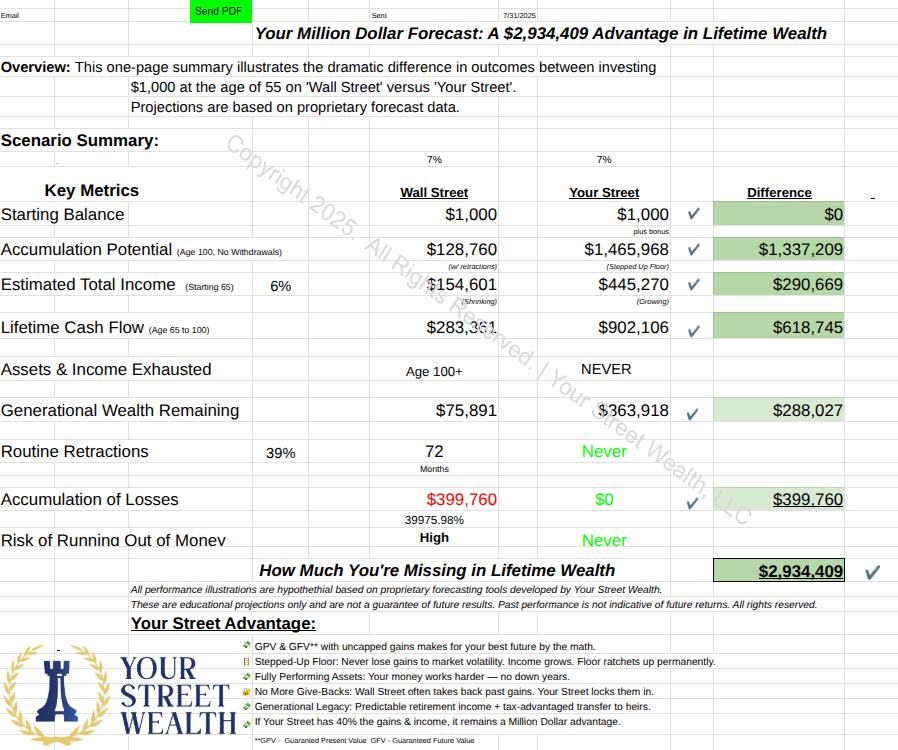
In the Wall Street game, your range of outcomes is typically -30% to +30%. You are spinning sharp knives, hoping you don't get cut.
On Your Street, using FPA, your range of outcomes is 0% to +30%.
When you eliminate the "down," the "up" becomes mathematically superior. This is what we call Engineering Certainty. We don't hope the bridge holds; we design it to withstand the storm.
Mind Your Gap
The disconnect exists because most advisors are "Participation" specialists. They are trained to keep you in the market because that’s how they get paid. They use hidden complexity to drive daily research and keep you addicted to the "buy/sell" cycle.
At Your Street Wealth, we act as the Architects. We don't want you to participate in the noise; we want you to own the outcome. This starts with a Margin Audit™ and a Volatility Recovery Analysis.
We look at your current plan and ask:
How much time have you already lost to "recovery cycles"?
What is your actual Compounding Efficiency?
Do you have a "Sequence of Return Margin" that protects your income if the market drops the day after you retire?

If you can't answer these questions with mathematical precision, you aren't planning: you are hoping. And hope is not a retirement strategy.
Peace is the Path, Wisdom is the Way
Retirement shouldn’t be a time of "unease" or "financial fatigue." For the Quiet Builder, the goal isn't to chase the next hot stock; it's to secure the life you've already earned.
You can estimate your income needs, but you cannot predict future portfolio values when market volatility and fee leaks are outside of your control. You must move from a "False Model" driven by greed and fear to an engineered path that guarantees you won't outlive your money.
Stop building a bridge to nowhere. Start engineering a path to certain wealth.
Audit the margin. Protect your time. Engineer certainty.
Your Money, Your Rules, In Your Time, On Your Street.
Ready for clarity instead of confusion?
The Million Dollar Hour™ is your educational, one-on-one retirement review that reveals where your plan leads : not just where it’s been.
👉 Schedule your session today.
Discover Which Wealth Killers Are Affecting You
Most people are impacted by 6–9 and don’t realize it
Wealth Killer #1: The Granddaddy : Why Market Volatility is Your Retirement’s Greatest Enemy
Concerned about market losses, taxes, or income reliability?
Take the 7 Question Retirement Stress Test →
You can keep participating… Or you can finally see the outcome. The Million Dollar Hour™ shows you exactly:
✔ Where you are ✔ Where you’re going ✔ How to fix the gaps 👉 Book your session now
Check out the Retirement Blueprint