Choosing Peace & Wisdom Over the Wall Street Rollercoaster
Proximity is Power: Choosing Peace & Wisdom Over the Wall Street Rollercoaster
One of the fastest ways to uncover hidden risk is to take our 7 Question Retirement Stress Test.

Start here: See what your retirement actually looks like → 👉 Book Your Million Dollar Hour™
Proximity is Power: Choose Fear & Greed or Peace & Wisdom
If you’ve ever stood on the edge of a high-speed transit platform, you know that proximity matters. Stand too close to the yellow line, and the wind from the passing train will pull at you. Move back toward the structural pillars, and you feel the stillness.
In the world of retirement, Proximity is Power.
Most people spend their entire careers standing dangerously close to the Wall Street "tracks," buffeted by the winds of Fear and Greed. They believe that being close to the "action" is how you build wealth. But they forget that the closer you are to the noise, the less power you have over the outcome.
To find true success in your second act, you must decide what you want to be close to. Do you want to be in proximity to a platform of Fear and Greed, or a foundation of Peace and Wisdom?
The Wall Street Rollercoaster: A Ride Without Rails
Traditional retirement planning is built on a "Participation" model. Wall Street invites you to participate in their markets, their volatility, and their narrative. They describe the stock market as a rollercoaster: an exciting ride that, while scary at times, ultimately ends higher than it started.
But here is the truth they don’t tell you: The Wall Street rollercoaster doesn’t have physical rails.

A real rollercoaster is an engineered system designed to return you safely to the station. Wall Street is a psychological platform designed to extract value from your Time. Its goal isn't to make you wealthy; its goal is to benefit from your participation.
The Math of Accumulated Loss
When you "participate" in the market, you aren't just risking your money; you are risking the compounding efficiency of your life’s work.
Wall Street benefits from your losses. When the market drops 30%, they don’t lose their fees. You, however, lose your most valuable commodity: Time.
Consider the Volatility Recovery Analysis: If your portfolio drops 30%, you don’t need a 30% gain to get back to even. You need a 42% gain just to see the same dollar amount you had before the drop. During that recovery period: which could take years: your money isn't growing. It’s healing.
Over a lifetime, these repeated cycles of "interrupted gains" can equal accumulated losses of 500% to 700% of your total contributions. You put up 100% of the cash, you took 100% of the risk, but the "Participation" model allowed the system to siphon off the majority of the potential wealth through fees, taxes, and the sheer math of recovery.
The 3% Trap: Why Luck is Not a Strategy
Even the greatest titans of the market: the ones who built the very index funds the world relies on: admit the game is rigged against the individual. Data shows that over a 50-year horizon, an investor has only about a 3% chance of beating the market through active timing and picking.
That means 97% of the "power" in the market is actually just luck and timing.
For a "Quiet Builder": the successful business owner or executive who has worked 40 years to secure their future: relying on a 3% probability is not a strategy. It’s a gamble. It is a "Rolodex strategy in a SpaceX world." It worked in the 1980s when interest rate ripples were predictable, but in today’s high-speed, high-volatility environment, it is inadequate.
"Inspect What You Expect": The Tale of Two Savers
Why is it that two people can have identical lifetime incomes, make identical contributions to their 401(k)s, and end up with wildly different retirement results?
One person retires with a guaranteed retirement income that grows every year, while the other lives in constant fear of a market crash.
The difference isn't the amount they saved. The difference is their proximity to principles.
At Your Street Wealth, we teach our clients to "Inspect what you Expect." Most people expect their Wall Street portfolio to provide for them, but they haven't inspected the architecture. They haven't performed a Margin Audit™.
Wall Street expects you to hope.
Your Street Wealth engineers you to know.
When you audit the margins, you realize that wealth isn't built on macro headlines; it’s built on micro-efficiencies. It’s about Compounding Efficiency: ensuring that not a single dollar of your growth is ever "reset" by a market downturn.
The Your Street Alternative: Principles and Pillars
If Wall Street is the "Single Pillar" model: relying on the hope that stocks go up: then Fully Performing Assets (FPA) are the "Smartphone" of finance.
Just as the smartphone consolidated your camera, your phone, and your computer into one high-performing device, an FPA consolidates 5 to 15 pillars of value into one vehicle.

Instead of choosing between growth and safety, an engineered plan provides:
Uncapped Gains (UCG): The ability to capture the upside of the market.
The 0% Floor: A contractual guarantee that you will never lose money due to market volatility.
Expanded Market Participation (EMP): Strategic multipliers that can turn a 10% market gain into a 15% or 20% gain for your bottom line.
This is the shift from Participation (gambling on noise) to Performance (engineering a result).
Your Money, Your Rules, In Your Time
Peace is not the absence of a storm; it’s the presence of a plan. Wisdom is the ability to recognize that your most valuable asset isn't the balance in your account: it's the Time you have left to enjoy it.
Wall Street wastes your time with "recovery years." Protecting your retirement savings from a market crash isn't just about the money; it's about protecting the years you would have spent trying to earn it back.
When you move your proximity away from the Fear and Greed of Wall Street and toward the Peace and Wisdom of Your Street, the priorities shift:
Income becomes the priority (knowing exactly how much you can spend).
Legacy becomes the result (the natural byproduct of a plan that never runs out of money).
Are You Ready to Audit Your Margin?
Success is possible when you stop following the crowd and start following the architecture. If you define success low enough, you can find it on Main Street. If you’re lucky, you might find it on Wall Street. But true, guaranteed lifetime income is only found when you take control of your own street.
It's time to unlearn the myths and learn the fundamental financial architecture that the "Quiet Builders" use to stay calm while the rest of the world panics.

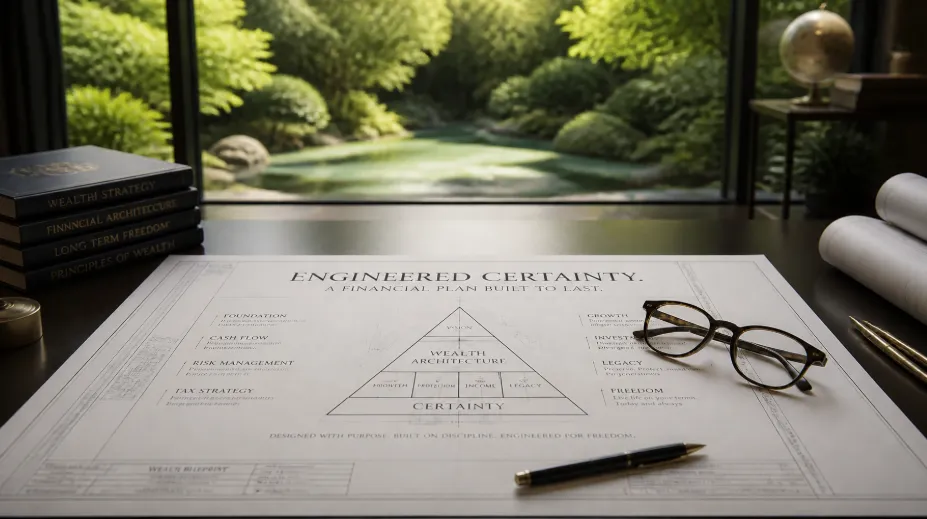
Don't leave your future to a 3% probability. Engineer your certainty.
Ready for clarity instead of confusion?
The Million Dollar Hour™ is your educational, one-on-one retirement review that reveals where your plan leads : not just where it’s been.
👉 Schedule your session today.
Discover Which Wealth Killers Are Affecting You
Most people are impacted by 6–9 and don’t realize it
Wealth Killer #1: The Granddaddy : Why Market Volatility is Your Retirement’s Greatest Enemy
Concerned about market losses, taxes, or income reliability?
Take the 7 Question Retirement Stress Test →
You can keep participating… Or you can finally see the outcome. The Million Dollar Hour™ shows you exactly:
✔ Where you are ✔ Where you’re going ✔ How to fix the gaps 👉 Book your session now