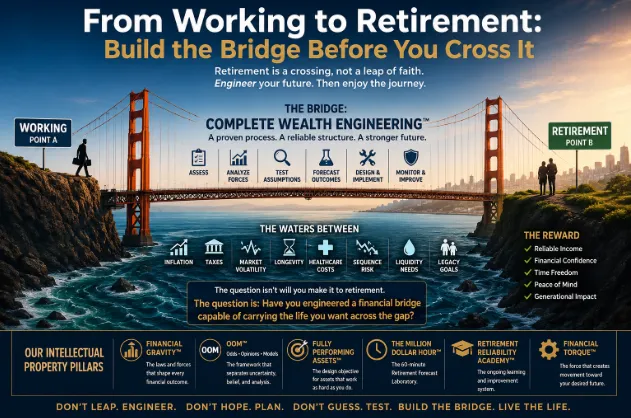
From Working to Retirement: Build the Bridge Before You Cross It
From Working to Retirement: Build Your Bridge First
Start here: See what your retirement actually looks like → 👉 Book Your Million Dollar Hour™

By Frank L. Day, invertor of Million Dollar Hour. One of the fastest ways to uncover hidden risk is to take our 7 Question Retirement Stress Test.
Retirement Is a Crossing: Build the Bridge First
How to Build a Reliable Retirement Income Bridge
1. Disrupt: Retirement Is a Crossing
How difficult is it to move from working to retirement?
You could swim.
You could take a boat.
You could fly.
You could step into the water and hope you make it across.
Or you could build a bridge.
The destination looks simple:
Point A: Working
to
Point B: Retirement
But the distance between the two is not measured in miles. It is measured in time, income, taxes, inflation, risk, longevity, liquidity, market conditions, healthcare, and legacy.
There is something else.
Weight.
Your retirement bridge must carry the financial weight of your life.
So do not ask only, “Can I get to retirement?”
Ask the better question:
> Can the structure I have built reliably carry everything I need across the gap?
Retirement should be based on knowledge, preparation, and reliable strategies: not hope dressed up as a spreadsheet.
2. Protection Creates Necessity—and Opportunity
Retirement capital has a necessary job. It must help fund life, income, healthcare, and legacy.
Protection comes first.
Protection preserves the resource. Preservation creates capacity. Capacity creates opportunity.
That sequence matters.
Protection is not the opposite of growth. It is the foundation that keeps growth useful.
Return without protection can become a temporary number. Growth that can be interrupted by unnecessary loss may never reach its intended purpose.
Connect it back to the bridge.
Protection is both the safety requirement and the load-bearing foundation that makes the crossing possible.
Fully Performing Assets™ are designed with that coordination in mind. They protect against unnecessary loss while aligning growth, income, liquidity, and legacy functions inside one architecture.
3. Reveal Financial Gravity™
A bridge engineer does not assume the weather will always be calm. A retirement engineer should not assume markets, taxes, inflation, health, and income needs will always cooperate.
That is Financial Gravity™: the invisible force created by taxes, fees, inflation, market losses, complexity, delay, and poor income design.
Financial Gravity pulls against your future income before you ever spend it.
Wall Street often displays the Shiny Object:
A 7%–10% average annual return
A rising historical chart
A large future account value
A reassuring projection
But the Dark Object sits behind it:
Market retractions
Sequence-of-return risk
Lost compounding time
Taxes and fees
Inflation
Liquidity needs
Healthcare costs
Withdrawals during downturns
The market is a tool for the institutions that engineer it for their benefit, the unknown 3%, and a destructive storm for the individuals who merely participate in its maelstrom.
Markets rise when stimulated by capital flows, liquidity, incentives, expectations, and institutional activity. Ownership alone does not give you control over those forces.
That is the difference between Participation vs. Engineered Performance.
3. Show the Cost of a Weak Bridge
Consider the familiar retirement formula:
> Current Assets + Contributions × Assumed Rate × Time = Future Value
The formula may calculate correctly.
The bridge may still fail.
What happens if returns are lower? Inflation is higher? Taxes rise? Healthcare costs increase? You live longer? Markets decline just as withdrawals begin?
A spreadsheet can produce a precise answer from unstable assumptions. Precision is not the same as reliability.
The Wall Street Cycle adds another challenge. Market swings of 10%–20% commonly appear about every 18 months, while major retractions averaging around 40% may occur every five to seven years. Over a lifetime, that can mean roughly 14 major retractions.
Each major setback can cost at least 3.3 years of lost time, depending on the size of the decline, the recovery, withdrawals, and your age.
Remember The Math of Recovery:
A 10% loss requires an 11.1% gain to recover.
A 20% loss requires a 25% gain.
A 30% loss requires a 42.9% gain.
A 40% loss requires a 66.7% gain.
This is how the 5x Accumulated Loss Truth can emerge. A person may contribute $100,000 yet experience $500,000 or more in cumulative losses when interrupted compounding, market declines, fees, taxes, and lost time are measured together.
Those losses may remain invisible because account statements show what is left: not what could have been produced under a more efficient design.
Money can recover. Time never does.

4. Introduce Your Street™
Your Street Wealth begins with a different question:
> What is the maximum lifetime income my assets can produce while preserving the greatest amount of generational wealth?
That question shifts attention from account activity to life outcomes.
The Engineered Retirement Blueprint organizes the problem:
The Balance Sheet is the source of funds.
The Income Statement is the use of funds.
Margin is the battleground between positive and negative outcomes.
A $1 million account balance is not automatically a $1 million retirement solution. Its usefulness depends on the income it can produce, the risks it carries, the costs it absorbs, and what remains for your family.
Use the mission:
Some Money, Same Time. Different Rules. On Your Street. Different Outcomes.
5. Give Yourself a New Identity
Stop thinking of yourself as merely an investor.
Become a Retirement Engineer.
Engineers do not hope the bridge holds. They measure the load. They inspect the materials. They account for stress. They plan for changing conditions. They maintain the structure after construction.
That is stewardship: managing what you have been given with wisdom and care.
Keep learning. Unlearn assumptions that no longer serve your future. Seek wisdom before consequences force the lesson.
This is why Discipline 6 of The 7 Disciplines of Retirement Wealth™: Upgrade Your Thinking: matters. Accumulation strategies are not automatically retirement strategies. Retirement requires preservation, income design, efficiency, and legacy planning.
Ask:
> Are you solving retirement with yesterday’s thinking?
6. Explain the Complete Wealth Engineering Journey™
Complete Wealth Engineering™ begins with what the retirement system must accomplish: not with a product or an assumed return.
The process examines:
Financial Gravity™: What forces are pulling down future income?
OOM™: Are you relying on Odds, Opinions, or Models?
The Million Dollar Hour™: Which assumptions survive a personalized forecast laboratory?
Financial Torque™: What decisions can create enough force to move from the current state to the desired state?
Fully Performing Assets™: Which assets can perform multiple coordinated jobs?
The Million Dollar Hour™ does not predict every future event. It tests assumptions, compares possible paths, and helps distinguish contractual guarantees from projections and probabilities.
Confidence comes from preparation. Certainty belongs only to clearly defined contractual guarantees, subject to the specific contract, insurer, suitability, and applicable terms.
7. Show the Architectural Difference
Traditional banks, stocks, and real estate are generally single-pillar assets. They may be useful, but each typically performs one primary function and may carry risk, cost, or limited coordination.
Fully Performing Assets™ are designed as multi-pillar assets. Depending on the specific contract and design, they may coordinate five to fifteen pillars, such as:
Growth
Principal protection
Lifetime income
Long-term-care support
Tax-efficient income
Liquidity
Legacy value
Guaranteed Present Value
Guaranteed Future Value
Think about the Consolidation of Technology. Phones, pagers, cameras, televisions, maps, and music players once occupied separate spaces. The smartphone consolidated many functions into one system.
FPA is the smartphone of financial architecture: not because one vehicle solves every problem automatically, but because coordinated design can create more usefulness than disconnected products.
Some FPA strategies may include Uncapped Gains (UCG) and Expanded Market Participation (EMP). When applicable, EMP may act as a 110%–200% multiplier on UCG. For example, a 10% UCG could become an 11%–20% credited gain, subject to contract terms, index performance, participation rates, and limitations.
Review the contract. Inspect the assumptions. Engineer the outcome.
8. Diagnose Your Bridge
Use the 9 Levels of Retirement Discovery™ to inspect the entire structure:
Outcome: What income, lifestyle, and legacy do you want?
Cost: What are taxes, fees, inflation, volatility, and lost time costing?
Opportunity: Which assets could become Fully Performing Assets?
Barrier: Which beliefs or outdated rules limit your options?
Truth: What are your actual results: not just average returns?
Risk: Where can permanent wealth destruction occur?
Principle: Is your principal protected?
Value: What is the lifetime usefulness and present value of your assets?
Synergy: Do all parts of your strategy work together?
Then apply the first-principles framework of The 7 Disciplines of Retirement Wealth™.
Protect your principal. Protect against unnecessary loss. Protect forward progress. Protect time. Increase efficiency instead of risk. Upgrade your thinking. Preserve every victory.
This article primarily serves:
Discipline 1: Protect the Principal: never spend the engine.
Discipline 3: Protect Forward Progress: never accept unnecessary step-backs.
Discipline 4: Protect Time: money can be recovered; time cannot.
Discipline 5: Increase Efficiency, Not Risk: engineer better outcomes.
Ask:
> How much of your retirement should be insulated from unnecessary loss?
> How many years could your current strategy lose during the next major downturn?
> Can your retirement produce more without increasing your exposure to risk?
Your retirement personality matters, too:
Orange: Reacts to headlines, trades actively, and pays fees for motion.
Red: Leaves assets alone through drawdowns and ignores sequence risk.
Yellow: Takes profits too early and interrupts compounding.
Green: Keeps learning, becomes allocation-aware, and engineers the outcome.
Choose the Green path: continuous learning, measured decisions, and intentional design.
9. Engineer for the Conditions You Cannot Avoid
A bridge is not reliable because engineers hope storms will stay away. It is reliable because the structure accounts for stress.
Your retirement bridge must account for the 10 retracement causes that can appear during a retirement period:
Economic recessions
Interest-rate increases
Inflation surges
Valuation bubbles
Corporate earnings slowdowns
Geopolitical events and wars
Banking or credit crises
Government policy or tax changes
Investor fear and panic selling
Black swan events
The point is not to predict which event will arrive next.
The point is to engineer for the possibility that conditions will change.
That is the purpose of The Margin Audit™, including a Volatility Recovery Analysis, Compounding Efficiency review, and Sequence of Return Margin assessment.
The Million Dollar Hour™ Income Analysis Comparison helps place the Shiny Object and Dark Object side by side. It allows you to examine how different retraction impacts could affect your income, time, principal, and legacy.
Do not build a bridge that works only in perfect weather.
10. Keep Inspecting the Bridge
Retirement does not end the engineering process.
Life changes. Markets change. Laws change. Health changes. Spending changes. Assumptions change.
That is why the Retirement Reliability Academy™ exists as an ongoing inspection and improvement process.
Its cycle is simple:
Recognize the myths and wealth killers.
Replace them with stronger disciplines and wealth-building principles.
Repeat the learning until wisdom becomes behavior.
A reliable strategy requires continuous attention. Those using Fully Performing Assets should continue learning and review their architecture regularly so they do not drift back into Assets at Risk.
Traditional retirement planning can feel like a Rolodex in a SpaceX world: durable in its era, but inadequate for the speed, complexity, and technical demands of modern retirement.
Choose Your Street Wealth’s Engineering of Certainty instead.
Retirement is not merely a destination.
Retirement is a crossing.
Do not discover whether your bridge works after you are halfway across. Build it before you need it. Test the load. Protect the margin. Maintain the structure.
Read The Impossible Monetary Force: Retirement Margin Audit Explained to see how a focused Margin Audit can expose hidden losses, time leaks, and income gaps.
Your Next Move
The Million Dollar Hour™ Forecast is a paid, one-on-one retirement review for high-intent Quiet Builders who want precision instead of free opinions.
Bring your statements. Bring your questions. Bring your willingness to unlearn.
Review the assumptions. Test the math. Engineer the bridge.
Peace is the path, wisdom is the way.
Your Money, Your Rules, In Your Time, On Your Street.
Ready for clarity instead of confusion?
The Million Dollar Hour™ is your educational, one-on-one retirement review that reveals where your plan leads : not just where it’s been.
👉 Schedule your session today.

Discover Which Wealth Killers Are Affecting You
Most people are impacted by 6–9 and don’t realize it
Wealth Killer #1: The Granddaddy : Why Market Volatility is Your Retirement’s Greatest Enemy
Concerned about market losses, taxes, or income reliability?
Take the 7 Question Retirement Stress Test →
You can keep participating… Or you can finally see the outcome. The Million Dollar Hour™ shows you exactly:
✔ Where you are ✔ Where you’re going ✔ How to fix the gaps 👉 Book your session now