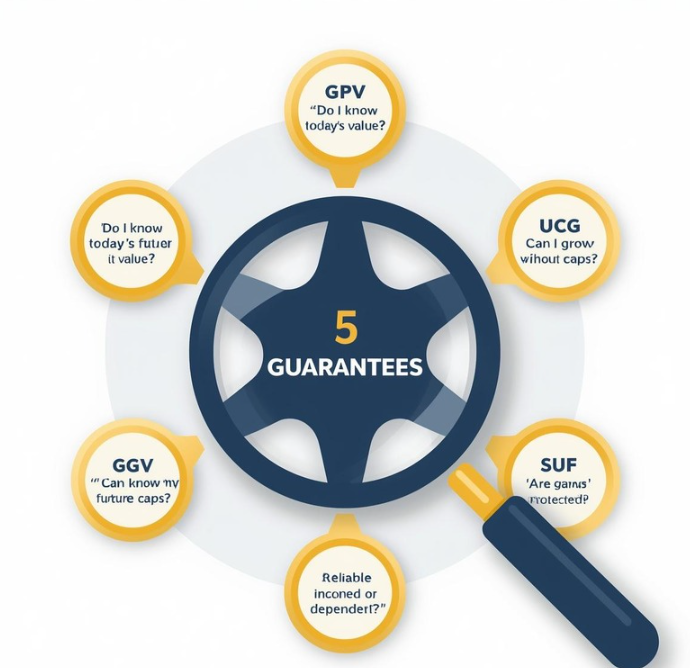
How to Choose the Best Retirement Strategy: 6 Power Pairs
How to Choose the Best Retirement Strategy: The 6 Power Pairs (Compared)
Start here: See what your retirement actually looks like → 👉 Book Your Million Dollar Hour™

One of the fastest ways to uncover hidden risk is to take our 7 Question Retirement Stress Test.
Stop Guessing, Start Engineering: The 6 Power Pairs for a Reliable Retirement
Most retirement plans are built on a foundation of "Participation." You participate in the market, you participate in the risk, and you participate in the hope that everything works out. But hope is not a strategy. For the "Quiet Builder": the successful professional or business owner between 45 and 75: retirement shouldn't be a gamble. It should be an engineered outcome.
In our anchor guide, The Architect’s Toolbox, we introduced the core instruments needed to build a durable financial future. Today, we’re going deeper. To choose the best retirement income strategies, you must move past the noise of Wall Street and evaluate your portfolio through the lens of The 6 Power Pairs.
These aren't just comparison points; they are binary choices between "Architecture" and "Participation." Use this guide to perform your own Margin Audit™ and see if your current path leads to peace or persistent fatigue.
1. Certainty vs. Uncertainty (Knowing vs. Hoping)
Wall Street thrives on uncertainty. They use hidden complexity to keep you addicted to daily research and market headlines. When you operate in the "Uncertainty" lane, you’re essentially guessing your future portfolio value based on projections that may or may not happen.
Engineered Performance is different. It’s about "Knowing." You shouldn't have to hope the market hits a certain percentage for you to eat; you should know exactly where your income is coming from.
How to Audit: Look at your last statement. If your retirement date depends on a "target return" that hasn't happened yet, you are in the Uncertainty lane.
Takeaway: Audit the margin. If you can’t calculate your guaranteed floor, your strategy is built on sand.
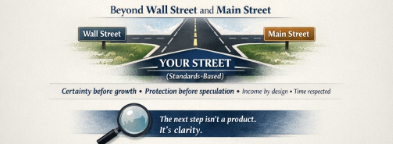
2. Guarantees vs. Probabilities (Contractual vs. Projections)
Most retirement income planning relies on probabilities: like the "4% Rule." These are historical averages that suggest your money should last. But in a SpaceX world, using a Rolodex-era probability model is dangerous.
When you shift to Guarantees, you move into the realm of contractual obligations. We use Fully Performing Assets (FPA) that offer A+ guarantees. This isn't about "annuities pros and cons" in the traditional sense; it’s about institutional-grade engineering that provides a multi-pillar foundation.
How to Audit: Ask your advisor: "What percentage of my retirement income is contractually guaranteed, regardless of what the S&P 500 does tomorrow?"
Takeaway: Replace projections with protections. If it isn't in the contract, it isn't a plan.
3. Control vs. Dependence (Your Rules vs. Market Rules)
Are you in the driver’s seat, or are you a passenger on the Wall Street rollercoaster? Dependence means your lifestyle is subject to market downturns, interest-rate ripples, and the "spinning sharp knives" of global volatility.
Control means you set the terms. We call this "Your Money, Your Rules, In Your Time, On Your Street." By using a Margin Audit™, we identify where you've lost control to fees, taxes, and market "leaks."
How to Audit: Check your liquidity. If you have to sell assets in a down market to generate cash, you have high sequence of returns risk.
Takeaway: Engineer certainty by decoupling your lifestyle from market mood swings.

4. Growth Without Loss vs. Growth With Loss (No Setbacks vs. Interrupted Gains)
This is where the Math of Recovery becomes your best friend. Wall Street tells you that "you haven't lost anything until you sell." That’s a myth. Every 1% lost is time you can never get back.
Consider this: A 30% market loss requires a 42% gain just to get back to zero. That is the definition of Compounding Efficiency being destroyed. We prioritize the 0% Floor. When the market drops, you stay level. When it rises, you achieve Uncapped Gains (UCG) and Expanded Market Participation (EMP).
How to Audit: Calculate your "Lost Time." How many years did it take your portfolio to recover from 2008 or 2022?
Takeaway: Protect your time. Money can recover; time never does.
5. Increasing Income vs. Depleting Assets (Rising Income vs. Drawing Down)
The "Single Pillar" model (traditional stocks or real estate) often forces you to deplete the very assets you spent decades building. It’s like using a 1980s brick phone.
Fully Performing Assets (FPA) are the "smartphone" of finance. They consolidate 5–15 pillars of value: including growth, protection, and tax-free income: into one vehicle. Instead of drawing down your principal, you engineer an increasing income stream that can actually grow over time, protecting your Sequence of Return Margin.
How to Audit: Is your plan designed to end at zero, or is it designed to provide a perpetual harvest?
Takeaway: Switch from a "Single-Pillar" mindset to a "Multi-Pillar" architecture.
6. Time Compounding vs. Time Lost (Forward Momentum vs. Resetting the Clock)
The ultimate goal of any retirement plan review should be to ensure forward momentum. Traditional "Participation" models frequently reset your compounding clock due to market volatility.
By using Level Yield Amortization and institutional-grade architecture, we ensure your wealth continues to heal and grow, even during market stagnation. We move from "Participation" (gambling) to "Performance" (design).
How to Audit: Does your portfolio have a "reset button" that gets pushed every time there’s a correction?
Takeaway: Peace is the path, wisdom is the way. Stop resetting the clock and start compounding for real.
The Quiet Builder’s Strategy Scorecard
Take a moment to audit your current retirement strategy. For each pair, check which side you currently land on:
If you checked more than two boxes in the "Wall Street" column, you don't have a plan: you have a participation agreement. It’s time to move toward the Engineering of Certainty.
The Path to Precision
Choosing the best retirement income strategies isn't about finding a "hot" new product. It’s about fundamental financial architecture. It’s about unlearning the myths that keep you tethered to risk and learning the rules that allow you to build on your own street.
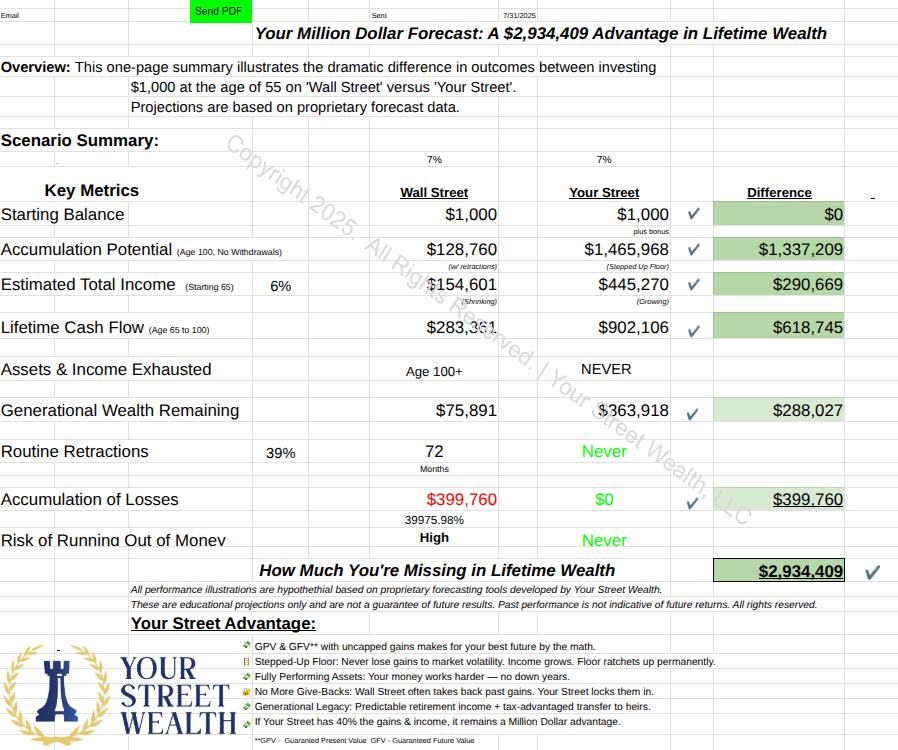
At Your Street Wealth, we don't just give you a "second opinion." We perform a scrutinized, mathematical audit of your current trajectory. We call it the Million Dollar Hour™ Forecast. It’s a $995 professional engineering session designed for those who value wisdom over "free" noise.
Ready for clarity instead of confusion?
The Million Dollar Hour™ is your educational, one-on-one retirement review that reveals where your plan leads : not just where it’s been.
👉 Schedule your session today.
Discover Which Wealth Killers Are Affecting You
Most people are impacted by 6–9 and don’t realize it
Wealth Killer #1: The Granddaddy : Why Market Volatility is Your Retirement’s Greatest Enemy
Concerned about market losses, taxes, or income reliability?
Take the 7 Question Retirement Stress Test →
You can keep participating… Or you can finally see the outcome. The Million Dollar Hour™ shows you exactly:
✔ Where you are ✔ Where you’re going ✔ How to fix the gaps 👉 Book your session now