
How to Protect Retirement Savings After 60
How to Protect Retirement Savings After 60
![[HERO] How to Protect Retirement Savings After 60](https://cdn.marblism.com/78rKNb43PBH.webp "[HERO] How to Protect Retirement Savings After 60")
Start here: See what your retirement actually looks like → 👉 Book Your Million Dollar Hour™
If you’ve crossed the threshold of 60, congratulations. You are officially in the "Red Zone."
In football, the Red Zone is the last 20 yards before the end zone. It’s where the game is won or lost. It’s where the field gets smaller, the pressure gets higher, and a single mistake can wipe out four quarters of hard work.
For the Quiet Builder: the engineer, architect, executive, or business owner: the Red Zone is the five years before and the five years after you stop working. During this decade, the rules of money completely change. For forty years, your job was accumulation. You could afford more fluctuation because you still had time, income, and recovery runway on your side. After 60, the job shifts to preservation. Now the goal is not to win the most points on a statement. The goal is to protect time, protect principal, and create reliable income without letting one bad market cycle undo decades of disciplined work.
That’s why Participation vs. Engineered Performance matters so much. Wall Street still sells the accumulation mindset: stay invested, ride the waves, trust the averages, and hope time bails you out. But after 60, hope is not a strategy. If the market cuts your account at the exact moment you need to start taking income, the damage is not just emotional. It is mathematical.
When you’re 35, a 30% market correction can feel like a clearance sale. When you’re 65, a 30% correction can become a structural failure that delays retirement, reduces income, or forces withdrawals from a shrinking pool of money.
This is the moment to move from chasing upside to protecting outcomes. In plain English: from accumulation to preservation. And one of the clearest ways to understand that transition is the 0% floor strategy. Instead of accepting the Wall Street trade-off of -30% to +30%, preservation-minded planning asks a better question: why accept downside you can no longer afford if a properly engineered strategy can target 0% to +30% instead?
That is the difference between noise and design. Between traditional risk products and retirement architecture. Between Wall Street’s false model and the Engineering of Certainty at Your Street.
The Myth of "Market Participation"
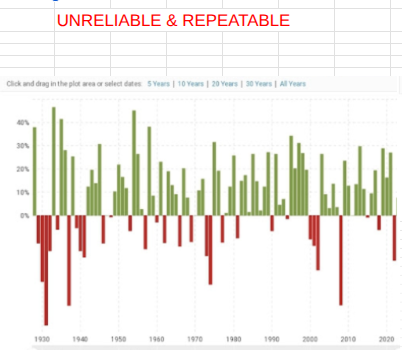
Wall Street has a very successful business model. It’s built on hidden complexity and the "Participation Myth." They want you to believe that the only way to grow wealth is to keep your money exposed to the "sharp knives" of market volatility. They use fancy charts and historical "averages" to keep you in the game.
But averages are a lie. If you lose 50% one year and make 50% the next, your "average" return is 0%. But your actual account balance is down 25%. You can’t spend an average; you can only spend what’s left after the math does its work.

In your 60s, "participating" in the market is like building a bridge with toothpicks and Elmer’s glue while hoping there’s no wind. Real engineering doesn't rely on hope. It relies on structural integrity. We call this Engineered Performance.
The Math of Recovery: Why Losses are More Expensive Than You Think
Most people think that if the market drops 20%, they just need a 20% gain to get back to even. This is the first thing we have to "unlearn."
Let’s look at the Volatility Recovery Analysis:
A 10% loss requires an 11.1% gain to recover.
A 30% loss requires a 42.8% gain to recover.
A 50% loss requires a 100% gain just to get back to where you started.
Time is your most precious non-renewable resource. If you are 62 and you lose 30% of your portfolio, you don’t just lose the money: you lose the time it takes to recover that money. While you are waiting for the market to "bounce back" just to reach break-even, inflation is eating your purchasing power and your stress levels are red-lining.
This is what we call the Sequence of Return Margin. When you start taking withdrawals from a shrinking pot of money, you are essentially "bleeding out" your retirement architecture.
If this concerns you, you’re not alone. Most people have never actually seen what their money is doing — or where it leads. 👉 In the Million Dollar Hour™, we map your exact outcome:
• Today’s value • Future income • Hidden risks • What it should be doing instead Book your session here →
The Asset Pyramid: From Infants to Foundations
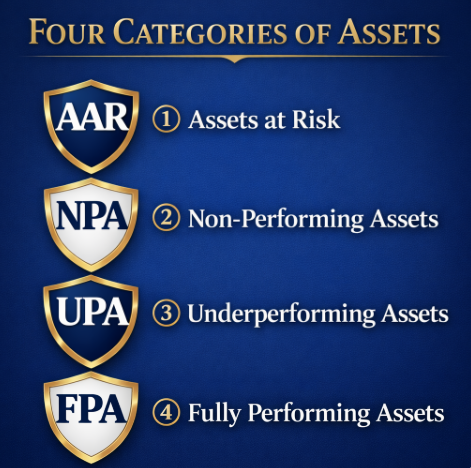
To protect your savings after 60, we have to look at how your assets are actually performing. We categorize assets into four buckets:
NPA (Non-Performing Assets): These are the "Infants." Think of cash under the mattress or a checking account earning 0.01%. They are safe, but they aren't working.
AAR (Assets at Risk): These are the "Teens." This is your traditional Wall Street portfolio: stocks, mutual funds, variable annuities. They have potential, but they are volatile, unpredictable, and often come with high fees and "participation" risks.
UPA (Underperforming Assets): These are the assets stuck in old models: low-yield bonds or real estate with high maintenance and tax drag.
FPA (Fully Performing Assets): This is the Foundation. These are assets engineered with "Multi-Pillar" functionality.
The "Smartphone" of Finance: Moving to Fully Performing Assets (FPA)
Think about the consolidation of technology. What used to require a camera, a pager, a GPS, a TV, a music player, and a phone now lives in one smartphone. Retirement planning has gone through the same kind of evolution, but much of Wall Street still acts like it hasn’t noticed.
Traditional retirement planning is often a collection of single-pillar products. A bank account gives you liquidity but little growth. Stocks and mutual funds may offer upside but expose you to loss. Real estate can create income but also brings taxes, management, and maintenance drag. Each product does one job, maybe two, but rarely works together as a unified system. It’s a Rolodex in a SpaceX world.
Fully Performing Assets (FPA) are the smartphone of finance. Instead of forcing your money to live in separate silos, an FPA can consolidate 5 to 15 pillars of value into one engineered vehicle using institutional-grade banking architecture principles.
What does an FPA look like in the Red Zone, especially for someone moving from accumulation to preservation?
0% Floor: This is the heart of the preservation shift. You still have the ability to participate in market-linked gains, but you are contractually protected from market losses. If the market drops 30%, your statement is credited 0%, not -30%. That means your principal and prior locked-in gains are protected from being handed back to Wall Street.
Uncapped Gains (UCG): Many people have been told these strategies are limited by old "3% cap" myths. That is outdated broker talk. Modern designs can include Uncapped Gains and Expanded Market Participation (EMP).
Expanded Market Participation (EMP): EMP means a positive market result can be multiplied, often in the 110% to 200% range. So if the underlying measured gain is 10%, the credited result could be 11% to 20%, depending on the design.
Tax Efficiency: Some FPAs can be designed to support tax-advantaged growth and tax-free income distribution, reducing the hidden leak that taxes create in traditional qualified plans.
Long-Term Care (LTC) Pillars: Some structures include health-related protection features, helping prevent one care event from draining the rest of your retirement architecture.
Low Internal Drag: Properly designed FPAs can operate with roughly 0% to 1.5% fees, a sharp contrast to many traditional risk products layered with management fees, internal expenses, and advisory drag.
This is why the transition after 60 is so important. During accumulation, many people tolerate volatility because they believe more risk automatically means more reward. During preservation, that logic breaks down. Once retirement is close, the first rule becomes: do not destroy what took four decades to build. The 0% floor strategy helps solve that by changing the range of outcomes. Wall Street asks you to accept losses in exchange for possible gains. Engineered Performance asks why that bargain still makes sense when your paycheck is ending and your withdrawals are beginning.
The Margin Audit™: Finding the Leaks
Most retirement plans fail not because of a lack of opportunity, but because of poor Compounding Efficiency. In other words, too much of the growth gets lost to leaks: market losses, fees, taxes, and bad timing.
When we perform The Margin Audit™ for a client, we are not hunting for the next hot stock or asking you to become a full-time market spectator. We are measuring where your current plan is silently giving away time and money. We look at hidden fees, tax drag, exposure to unnecessary market loss, and what we call the Volatility Tax. We also evaluate your Sequence of Return Margin: the danger that losses show up at exactly the wrong time, right as retirement income begins.
This is where the accumulation-to-preservation transition becomes practical, not theoretical. In accumulation mode, people often accept Wall Street risk products because they believe future gains will eventually heal present losses. Sometimes they do. Sometimes they don’t. But after 60, "eventually" is a dangerous word. You can estimate income needs, but you cannot predict future portfolio value when losses and leaks are uncontrollable.
By moving the right assets from the Assets at Risk (AAR) category into Fully Performing Assets (FPA), we shift the math from Participation to Engineered Performance. From gambling on headlines to using rules-based architecture. From hoping recovery happens to designing an outcome where severe market loss is removed from the equation.
That is the real appeal of the 0% floor strategy. It is not about chasing excitement. It is about safety, certainty, and preserving the usefulness of every dollar you have already built. For the over-60 reader, that kind of clarity matters more than market theater.
Imagine the peace of mind that comes from knowing your worst-case market credit is 0% while your upside remains linked to growth. That is not magic. It is not hype. It is simply better engineering.
Why Most "Financial Advice" Fails the Quiet Builder
Success in your 60s is about Outcome over Activity. Wall Street wants to keep you busy. They want you checking apps, reading headlines, and worrying about interest rate ripples. Why? Because activity generates fees.
Quiet Builders don't want activity. They want a design that works.
If you were building a house, you wouldn't just "participate" in a pile of lumber and hope it turned into a kitchen. You would hire an architect. You would demand a blueprint. You would want to see the load-bearing calculations.
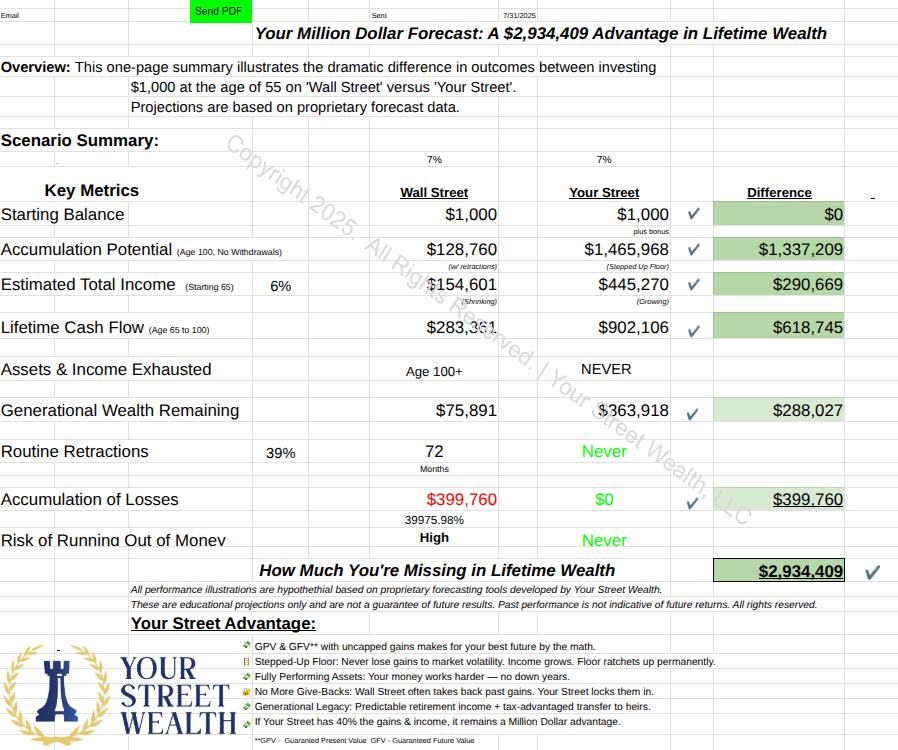
Your retirement deserves the same level of engineering. You can estimate your income needs, but you cannot predict future portfolio value when losses and leaks are uncontrollable. The only way to win is to change the environment where your money lives.
The Million Dollar Hour™: Your Engineering Blueprint
You’ve spent 40 years building your wealth. Does it make sense to spend 60 minutes making sure a false model driven by fear and greed doesn’t take a chunk of it back?
The Million Dollar Hour™ Forecast is the logical next step for readers who want more than general education. It is a paid, high-clarity engineering session for serious people who want the math, the design, and the truth about where their current strategy is leading. At $995, it is intentionally built for high-intent Quiet Builders, not for people chasing free entertainment or generic market commentary.
In this 60-minute session, we apply institutional-grade Asset Liability Management thinking to your personal retirement architecture. We perform The Margin Audit™ and The Math of Recovery through a personalized Volatility Recovery Analysis. We look at your current single-pillar assets: bank products, Wall Street risk products, and other underperforming holdings: then show you what changes when you move toward a multi-pillar design rooted in preservation, protection, and income reliability.
We address five core outcomes:
GPV: Knowing today’s actual value.
UCG: Growing without arbitrary caps.
SUF: Protecting every gain you’ve ever made.
GFV: Knowing the future value of your strategy.
Reliable Income: Ensuring your income is designed, not dependent.
For many readers over 60, this is the moment where the light bulb turns on. You realize retirement is no longer about trying to beat the market. It is about creating a structure that lets you stop worrying about it. That is why the Million Dollar Hour™ Forecast is such a powerful next step: it helps you unlearn the old accumulation script and replace it with a preservation blueprint designed to last for life.
Peace is the Path, Wisdom is the Way
Protecting your retirement after 60 is not about being lucky. It is about making wiser decisions with less guesswork. It is about moving from Wall Street, where hidden complexity often benefits the house, to Your Street, where design, safety, and certainty take the lead.
Wall Street asks you to tolerate spinning sharp knives in hopes of a better outcome. Engineered Performance asks a calmer question: what if your retirement plan was built to avoid unnecessary damage in the first place?
Peace is the path, wisdom is the way.
Your Money, Your Rules, In Your Time, On Your Street.
Ready for clarity instead of confusion?
The Million Dollar Hour™ is your educational, one-on-one retirement review that reveals where your plan leads — not just where it’s been.
👉 Schedule your session today
.
You can keep participating… Or you can finally see the outcome. The Million Dollar Hour™ shows you exactly:
✔ Where you are ✔ Where you’re going ✔ How to fix the gaps 👉 Book your session now
Check out the Retirement Blueprint
Most people are impacted by 6–9 and don’t realize it
Wealth Killer #1: The Granddaddy : Why Market Volatility is Your Retirement’s Greatest Enemy
Concerned about market losses, taxes, or income reliability?
Take the 7 Question Retirement Stress Test →
You can keep participating… Or you can finally see the outcome. The Million Dollar Hour™ shows you exactly:
✔ Where you are ✔ Where you’re going ✔ How to fix the gaps 👉 Book your session now