
Inspect What you Expect 10 Brutal Questions You Need to Ask
Inspect What You Expect: The 10 Brutal Questions Your Broker Hopes You Never Ask
Start here: See what your retirement actually looks like → 👉 Book Your Million Dollar Hour™

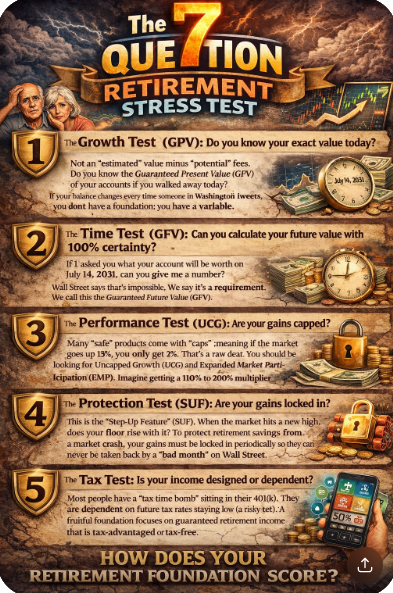
One of the fastest ways to uncover hidden risk is to take our 7 Question Retirement Stress Test.
Will these Questions Offend anyone in your Circle?
In the world of finance, loyalty is often a trap.
Most people are loyal to their broker, their banker, or a brand name they’ve seen on a stadium. But in a 60-year retirement plan, that loyalty can become a barrier to the healthy scrutiny required to keep your wealth from leaking away.
At Your Street Wealth, we operate on a different frequency. We believe in the "Inspect What You Expect" (IWYE) framework. If you expect your money to be there when you stop working, you must inspect the architecture of the system holding it.
Wall Street thrives on "Participation": the idea that you should just throw your money into the market and hope for the best. We advocate for Engineered Performance. This is the difference between gambling on the weather and building a climate-controlled house.
Are you ready to audit the margin? Here are the ten brutal questions your broker is hoping you never ask.
The Loyalty Trap: Who Are You Really Protecting?
Before we dive into the math, we have to address the psychology. Many "Quiet Builders": successful professionals aged 45–75: feel a sense of obligation to their financial advisors. Maybe you’ve played golf together. Maybe they helped you 20 years ago.
But ask yourself: Is your broker’s primary loyalty to your family’s generational wealth, or to the institutional machine that pays their commission?
When you stop inspecting, you start accepting. And in Wall Street’s "False Model," acceptance usually means accepting unnecessary risk and hidden fees. It’s time to shift your loyalty back to your own balance sheet.
Pillar 1: Inspect Your Time (The Invisible Theft)
Wall Street never promotes the inspection of Time. They talk about "long-term averages," but they never talk about Retractions.
1. Is my time being interrupted by market retractions?
When the market drops 30%, you haven't just lost money. You’ve lost the time it takes to get back to zero. Money can recover. Time never does. If your portfolio resets every five to seven years, you aren't compounding; you're just treading water.
2. How many years have I actually lost to "The Math of Recovery"?
This is where the math gets brutal. To recover from a 30% loss, you don't need a 30% gain. You need a 42.9% gain just to get back to where you started. If that takes three years to achieve, those are three years of your life you will never get back. That is the real damage behind sequence of returns risk: not just the loss itself, but the clock it resets.

3. Why does Wall Street avoid the topic of lost compounding?
Because if you realized that your "forward momentum" was being reset every decade, you’d stop paying them to manage the chaos. Real wealth is built on Compounding Efficiency: uninterrupted growth that never has to look back.
Pillar 2: Inspect Your Rate (The Math of Illusion)
Brokers love to talk about "Average Annual Returns." It’s a vanity metric designed to keep you in the game.
4. What is my actual CAGR, not my "average" rate?
The Compound Annual Growth Rate (CAGR) is the only number that matters. If you lose 50% one year and gain 50% the next, your "average" return is 0%. But your actual account balance is down 25%. You can’t eat an average; you can only spend the actual value.
5. Do I have a 0% Floor?
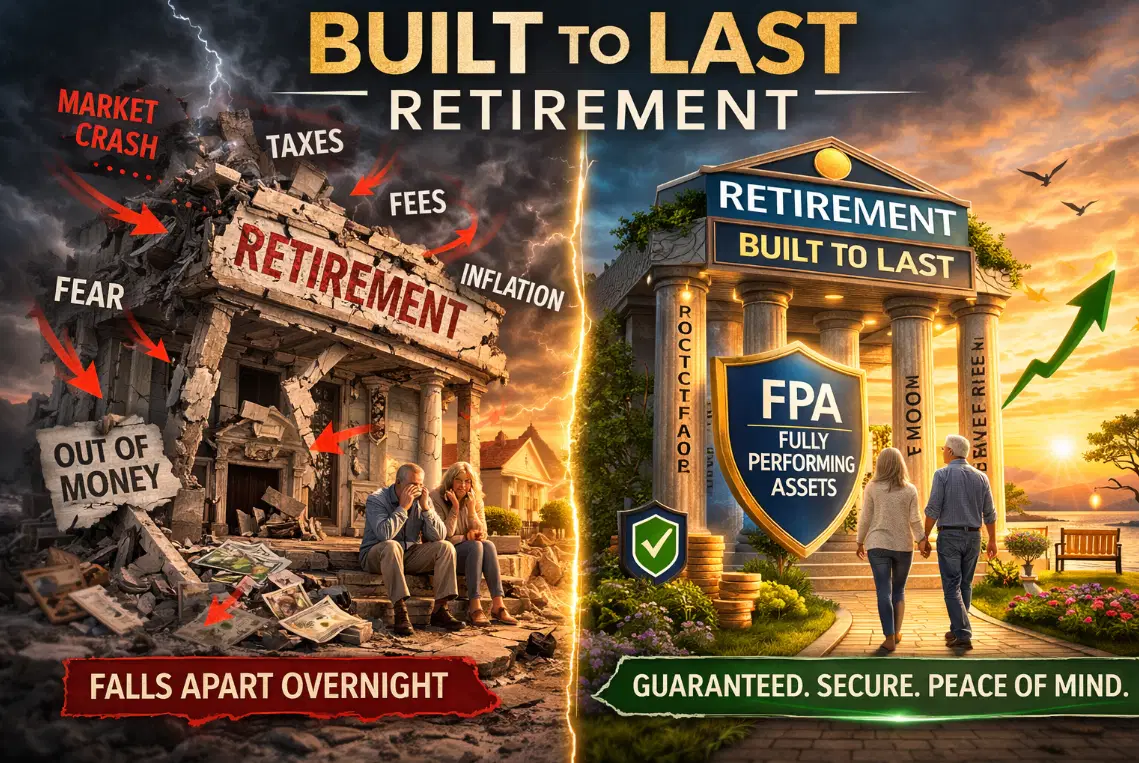
In a "Single Pillar" traditional asset (like stocks), your floor is -100%. You can lose it all. In a Fully Performing Asset (FPA), we engineer a 0% floor. This means when the market tanks, your balance stays exactly where it is. You participate in the upside but opt-out of the downside.
6. Am I benefiting from Expanded Market Participation (EMP)?
Wall Street tells you that index caps are a dealbreaker. What they don't tell you is that with Expanded Market Participation, you can achieve 110% to 200% multipliers on uncapped gains. A 10% market move can become a 20% gain in an engineered environment.

Pillar 3: Inspect Your Principal (The Foundation)
Traditional Wall Street methods operate on a "False Architecture" driven by fear and greed. When the greed meter is high, they push risk. When fear hits, they tell you to "stay the course" while your principal evaporates.
7. Do I have a Stepped-Up Floor?
A Stepped-Up Floor (SUF) means that once you lock in a gain, that new high becomes your new floor. You aren't just protecting what you started with; you are protecting the growth you’ve already earned. Does your current plan do that, or are your gains "at risk" every single day?
8. Does my contract guarantee I will never run out of money?
Most Wall Street plans are based on "probabilities." They use Monte Carlo simulations to tell you there’s an 80% chance you won't go broke. At Your Street Wealth, we don't play with percentages. We use contractual guarantees built to support guaranteed retirement income.
9. Why does my statement have a disclaimer saying I could "lose all my money"?
If you see that disclaimer, you are in a "Single Pillar" asset. You are carrying the weight of the market on your own shoulders. Compare this to a Multi-Pillar FPA that provides growth, protection, and tax-free income: all within a single, engineered vehicle.
11. Am I being forced into the Longevity Guessing Game?
This is one of the strangest habits in traditional retirement planning. Your broker asks you what age you think you’ll die so they can make the math work on paper. But if your broker is asking you what age you plan to die, they are trying to solve for a failure point. We solve for an infinite horizon.
That is the difference between The Finite Model and The Infinite Process. The Finite Model needs an expiration date to justify why it is "okay" to run out of money. The Infinite Process engineers a system that can still work if you live to 100 or feel like you live forever. Audit that assumption. Protect your time. Engineer income that does not depend on guessing your last birthday correctly.
Pillar 4: The Transport Metaphor (How are you riding?)
How are you getting to your retirement destination? Most people are using outdated tools for a modern, high-speed world.
The Taxi: High fees, someone else is driving, and the meter never stops running.
The Bus: You’re going where everyone else is going, on a schedule you don't control, stopping at every market retraction.
The Car: You have some control, but you’re still subject to the traffic (volatility) and you’re responsible for all the maintenance (risk).
SpaceX: This is Your Street Wealth. It’s institutional-grade engineering. It’s designed for reusability, precision, and escaping the gravity of traditional market losses.
10. How do I know the difference?
If your plan feels like "Participation" (hoping and praying), you’re on the bus. If your plan feels like "Architecture" (designed, scrutinized, and certain), you’re on the rocket.
Wealth is built on micro-margins, not macro-headlines. Wall Street uses hidden complexity to drive daily research and addictive buying/selling. We use institutional-grade Asset Liability Management (ALM) to heal your balance sheet and ensure you never outlive your money.
The Margin Audit™: Your Path to Clarity
You can estimate your income needs, but you cannot predict your future portfolio value when losses and "leaks" (fees and taxes) are uncontrollable. This is why the Million Dollar Hour™ Forecast exists.

This isn't a "free consultation" for people chasing cheese. This is a $995 high-friction, high-clarity Engineering Audit designed for "Quiet Builders" who are tired of the noise. In one 60-minute session, we do a Volatility Recovery Analysis and a Sequence of Return Margin check to help protect retirement savings from market crash conditions and chronic balance-sheet leaks.
We unlearn the myths of the "Single Pillar" world and install a "Category of One" architecture.
Peace is the path, wisdom is the way.
Your Money, Your Rules, In Your Time, On Your Street.
Ready for clarity instead of confusion?
The Million Dollar Hour™ is your educational, one-on-one retirement review that reveals where your plan leads : not just where it’s been.
👉 Schedule your session today.
Discover Which Wealth Killers Are Affecting You
Most people are impacted by 6–9 and don’t realize it
Wealth Killer #1: The Granddaddy : Why Market Volatility is Your Retirement’s Greatest Enemy
Concerned about market losses, taxes, or income reliability?
Take the 7 Question Retirement Stress Test →
You can keep participating… Or you can finally see the outcome. The Million Dollar Hour™ shows you exactly:
✔ Where you are ✔ Where you’re going ✔ How to fix the gaps 👉 Book your session now