
Is Your Retirement Built on Non-Performing Ground
The Asset Literacy Test: Is Your Retirement Built on Non-Performing Ground?
One of the fastest ways to uncover hidden risk is to take our 7 Question Retirement Stress Test.
![[HERO] The Asset Literacy Test: Is Your Retirement Built on Non-Performing Ground?](https://cdn.marblism.com/W2ADX-J5qvy.webp "[HERO] The Asset Literacy Test: Is Your Retirement Built on Non-Performing Ground?")
Start here: See what your retirement actually looks like → 👉 Book Your Million Dollar Hour™
Most people look at their bank statement or brokerage portal and see a single number. They call it their "Net Worth." They see a big bucket of "Assets" and assume that because the number is large, the foundation is solid.
But here is the hard truth that Wall Street doesn't want you to know: A balance sheet is often a masterclass in deception.
If you can’t distinguish between an asset that is actually working for you and one that is just "squatting" on your balance sheet, you aren’t planning a retirement: you’re participating in a gamble. In the world of institutional-grade engineering, we don't look at the size of the bucket; we look at the integrity of the material.
Are your assets "Fully Performing," or are they "Non-Performing" ground disguised as growth? It’s time for an Asset Literacy Test.
The Deception of the Traditional Balance Sheet
Wall Street thrives on hidden complexity. They want you to believe that "diversification" (buying a lot of different things that all crash at the same time) is the same thing as "safety." It’s not.
Traditional assets: like stocks, bonds, and even most real estate: are what we call Single-Pillar Assets. They do one thing. A stock might grow (if the wind blows the right way), but it doesn’t provide a floor. A bank account provides liquidity, but it loses to inflation every single day.
Relying on these is like trying to build a skyscraper using a Rolodex in a SpaceX world. It was a fine tool for the 1970s, but today’s market demands a more sophisticated architecture.
The Four Categories of Truth
To understand where you actually stand, you have to categorize your holdings into one of four buckets. If you don't know which is which, you’re spinning sharp knives in the dark.
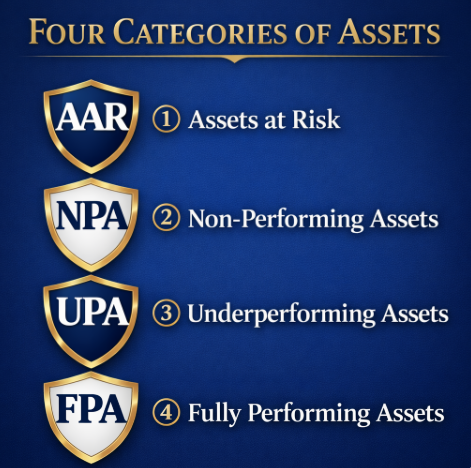
1. Assets at Risk (AAR)
These are the "heart attack" assets. These are positions that might go down more in a single day than they could possibly earn back in an entire year. This is where most "Quiet Builders" have the bulk of their wealth. When the market drops 30%, you don’t just need a 30% gain to get back to even; you need a 42% gain. That’s the Math of Recovery, and it is the silent killer of retirement dreams.
But the real damage is deeper than the headline loss. A negative year doesn’t just shrink your balance once. It breaks the compounding engine. The dollars that disappeared can no longer earn future gains, which means one bad year can reduce not just total principal, but the lifetime retirement income that principal was supposed to create. That is why Assets at Risk are so dangerous: they don’t just lose money, they lose time, momentum, and future income all at once.
2. Non-Performing Assets (NPA)
These assets aren't necessarily "losing" money in the traditional sense, but they are losing the war. If your money is sitting in a vehicle earning 1% while real-world inflation is at 4%, you are effectively becoming poorer every day. These are "Infant Assets": they require constant care and provide zero protection for your future purchasing power.
3. Under-Performing Assets (UPA)
These are the assets that barely keep pace with inflation. They are the "treadmill" of finance. You’re running hard, the numbers are moving, but you aren’t actually getting anywhere. You’re staying in place while the world gets more expensive.
4. Fully Performing Assets (FPA)
This is the gold standard. These are Multi-Pillar Assets. Imagine a "smartphone" for your money. Just as your phone consolidated your pager, camera, map, and computer into one device, an FPA consolidates 5 to 15 "pillars" of value into one vehicle.
FPAs offer:
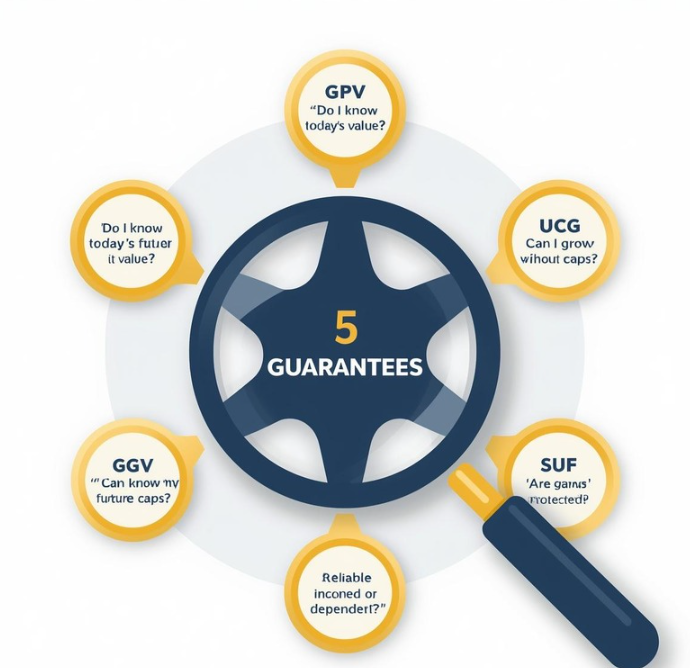
GPV (Gross Present Value): Knowing exactly what it’s worth today.
GFV (Gross Future Value): A predictable path for tomorrow.
UCG (Uncapped Growth): The ability to capture market upside without a "ceiling."
EMP (Expanded Market Participation): This is the secret sauce. Instead of just getting 100% of a market move, EMP can act as a 110% to 200% multiplier. If the market moves 10%, your EMP could potentially capture 11% to 20%, all while maintaining a 0% floor.
The Full Spectrum: Are You Being Deceived?
Beyond those four main buckets, your balance sheet is likely cluttered with other terms you haven't been taught to scrutinize. Without understanding these, you are flying blind:
Amortized vs. Depreciating Assets: Is the asset "healing" your balance sheet over time, or is it a car-like stone sinking in a lake?
Fictitious Assets: Paper gains that disappear the moment you try to liquidate.
Maturing Assets: The key to the FIAAR strategy. These must produce predictable income.
Indebted vs. Pledged Assets: Who really owns the asset? If it's pledged, you're just the tenant.
Liquid vs. Restricted Assets: If you can’t touch it when the "Sequence of Returns" risk hits, it’s not an asset: it’s a cage.
The FIAAR Strategy: Engineering Your Certainty
At Your Street Wealth, we don’t "participate" in the market noise. We use Engineering of Certainty. We apply the FIAAR Strategy to ensure your assets are actually performing.

F – 0% Floor
The first rule of wealth is protection. You cannot afford to play the "Math of Recovery" game when you are 55 or 65. We build a 0% floor into the foundation. When the market goes -30%, your floor keeps you at 0%. When the market goes +30%, you capture the growth.
This is the key differentiator in Participation vs. Engineered Performance. With a 0% floor, compounding never stops because you never experience a loss. Your growth engine stays on 24/7. Wall Street’s model is different. One negative year doesn’t just lower the account value for a season; it kills the compounding momentum forever because all future gains now start from a smaller base. That loss of compounding is a long-term disaster, not a short-term inconvenience.
That is why Fully Performing Assets matter so much. They are designed to keep the compounding engine running, while Assets at Risk interrupt it, damage principal, and permanently reduce the income that money could have produced over a lifetime.
IA – Income from Maturing Assets
In retirement, your "Net Worth" is a vanity metric. What matters is Cash Flow. We ensure that every maturing asset is engineered to produce reliable, designed income. If an asset doesn't produce income, it's just a hobby.
AR – Allocation of Risk (The Rule of 100)
Wall Street loves to keep you "aggressive" because they get paid on the size of your "at-risk" pot. We use a logical, math-based approach: 100 minus your age.
If you are 60 years old, the maximum percentage of your wealth that should be "At Risk" is 40%. As you age, your risk allocation declines by 1% per year. This isn't a suggestion; it's a structural requirement to protect your time and your peace.
The Choice: Wall Street vs. Your Street
Wall Street operates on a "False Model" driven by the Greed/Fear meter. When greed is high, they push you into "Participation" (gambling). When fear is high, they lock you into "Non-Performing" boxes.
We choose a different path. We choose Architecture.
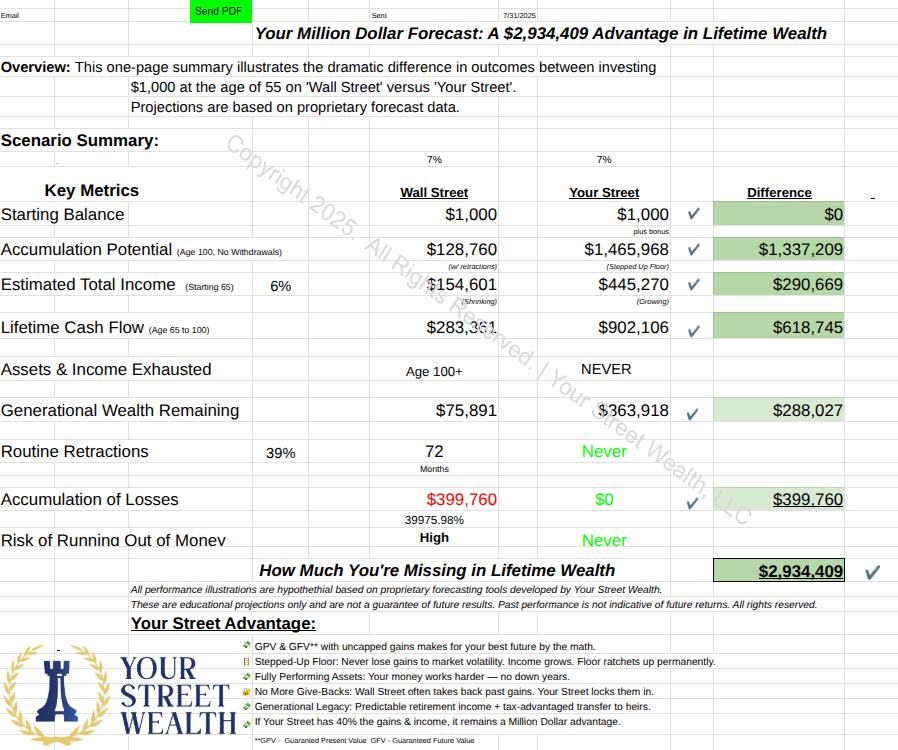
Think about the difference between a pile of bricks and a finished home. A pile of bricks is "Participation." It's heavy, it's messy, and it doesn't protect you from the rain. A finished home is "Performance." It is engineered, designed, and provides a lifetime of security.
Wall Street asks you to accept interrupted compounding as normal. Your Street Wealth does not. In a traditional at-risk portfolio, a down year creates a permanent scar because compounding has to restart from a lower number. In a properly engineered structure with a 0% floor, the engine keeps running because there is no negative year to claw back from. That one design difference can mean a massive spread in ending wealth and in the retirement income your assets can support.
Most people spend 40 years collecting bricks, only to realize on the day they retire that they never actually hired an architect to build the house.
The Asset Audit: Moving to Firm Ground
If you are a "Quiet Builder": someone who has worked hard, stayed under the radar, and accumulated success: you likely feel a sense of "financial fatigue." You’re tired of the macro headlines and the constant volatility.
You don't need more "opportunities." You need Engineering.
You need to know if your retirement is built on "Non-Performing Ground" or if you have the Multi-Pillar strength of Fully Performing Assets. You need to move from the uncertainty of -30%/+30% to the certainty of 0%/+30%.
Peace is the path, wisdom is the way. It’s time to stop chasing the "mice" of free advice and start investing in true financial architecture.
The first step to unlearning the myths of the Reagan-era banking models and embracing modern Asset Liability Management is a deep dive into your own numbers. We call it the Margin Audit™. We look at the "leaks" in your current plan: the fees, the taxes, and the sequence of return risks: and we engineer them out of existence.
Your money. Your rules. In your time. On your street.
Ready for clarity instead of confusion?
The Million Dollar Hour™ is your educational, one-on-one retirement review that reveals where your plan leads : not just where it’s been.
👉 Schedule your session today.
Discover Which Wealth Killers Are Affecting You
Most people are impacted by 6–9 and don’t realize it
Wealth Killer #1: The Granddaddy : Why Market Volatility is Your Retirement’s Greatest Enemy
Concerned about market losses, taxes, or income reliability?
Take the 7 Question Retirement Stress Test →
You can keep participating… Or you can finally see the outcome. The Million Dollar Hour™ shows you exactly:
✔ Where you are ✔ Where you’re going ✔ How to fix the gaps 👉 Book your session now