
Protect Retirement Savings from Market Crash & Volatility
The Summit Trap: Why Your Retirement Shouldn't Have a Downside
One of the fastest ways to uncover hidden risk is to take our 7 Question Retirement Stress Test.
![[HERO] The Summit Trap: Why Your Retirement Shouldn't Have a Downside](https://cdn.marblism.com/lUulli0NiPM.webp "[HERO] The Summit Trap: Why Your Retirement Shouldn't Have a Downside")
Start here: See what your retirement actually looks like → 👉 Book Your Million Dollar Hour™
Why Scaling the Retirement Mountain is a Death Trap (And How to Stay at the Peak)
In the world of mountaineering, reaching the summit is only half the battle. In fact, most accidents happen on the way down. The oxygen is thin, your legs are like jelly, the footing is slippery, and one wrong step means a fall of thousands of feet.
For decades, Wall Street has sold us the "Mountain Metaphor." They tell you that your working life is the climb. You pack your bags (your 401k), you hike up the trail (the S&P 500), and you hope to reach the "Summit" (retirement) with enough supplies to survive.
But here is the cold, hard truth: The peak is not the dream.
If your retirement plan is designed like a mountain, you have no choice but to go down the other side. And as any experienced climber will tell you, the descent is where the real danger lives. In financial terms, we call this the "Descent Risk": or more formally, Sequence of Returns Risk.
At Your Street Wealth, we think climbing financial peaks that have the same architecture as mountains is a fundamental flaw. You shouldn't have to worry about "slipping" back down to the bottom just because the market had a bad day.
It’s time to stop climbing and start building.
The Physics of the Fall: The Math of Recovery
Wall Street loves to talk about "average returns." They’ll tell you the market averages 7% or 10% over time. But you don't eat "averages." You eat real dollars.
When you are in the "climbing" phase, a 20% drop is a setback. When you are on the "descent" (withdrawing money), a 20% drop is a catastrophe. This is where the Math of Recovery becomes a cruel teacher.
If your portfolio takes a 30% hit, you don't need a 30% gain to get back to even. You need a 42.8% gain just to see the same number you had before the fall.
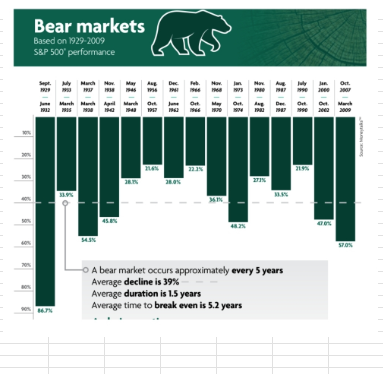
The "Titans of Wall Street" will tell you that the market is "unreliable and repeatable." History shows we face roughly 14 major retractions in a lifetime, with 10–20% drops occurring every 18 months on average. Include 4-6 of the major retractions on the down side. That is not "bad luck." It is the built-in rhythm of the Wall Street game.
If you are "participating" in the market, you are essentially spinning sharp knives. You might catch the handle ten times in a row, but you only have to catch the blade once during your retirement descent to ruin the next twenty years.
The Ghost of the $500,000 Loss
I once had someone ask me a fascinating question: "How could I lose $500,000 in an account that only had $100,000 in it?"
It sounds like a riddle, but it’s actually a masterclass in Compounding Efficiency.
Imagine your $100,000 account grows to $200,000. Then, a "routine retraction" takes it back down to $150,000. You didn't just lose $50,000 of "house money." You lost the future compounding power of that $50,000. Over the next 15 to 20 years, that missing $50,000: had it stayed protected and continued to grow: could have represented a $500,000 difference in your ultimate wealth. In plain English, you are losing the "miracle of compounding" before it ever gets a chance to happen.
When the market "takes back" your profits, it isn't just taking today's dollars. It’s stealing your time. Money can recover; time never does.
Stop accepting these "killers" as a normal part of the process. If you believe in using the market as an engine, you must take the profits out when you earn them before the market takes them back.
The Stepped UP Floor: Architecture Over Participation
Most retirement plans are built on "Participation." You participate in the upside, but you also participate in the bloodletting on the downside.
We propose a different architecture: The Stepped UP Floor.
Imagine a staircase instead of a mountain. You go up. When the market hits a peak, your "floor" steps up to meet that new high. If the market falls 20% the next month, you don't go down. You stay on your new floor. You keep your oxygen. You keep your footing.
This isn't a "product." It’s an engineered strategy we call (FIAAR) using Fully Performing Assets (FPA).
While traditional "Single-Pillar" assets: like a basic stock portfolio or a savings account: are like using a Rolodex in a SpaceX world, FPAs are the "smartphone" of finance. They consolidate 5 to 15 pillars of value (growth, protection, tax-free income, LTC) into one vehicle.

Suggested image: A visual of a "Stepped UP Floor" vs a volatile mountain peak chart.
By eradicating "Wealth Killers" (market volatility, sequence of returns risk, and hidden fees) and replacing them with "Wealth Builders," you get more than double the benefit. You get the growth, but you also get the compounding efficiency of never having to reset the clock to zero.
Protect Retirement Savings from Market Crash
Traditional retirement planning is a high-stress, unpaid internship as a market analyst. You spend your time monitoring charts, worrying about "the big one," and hoping your "probabilities" hold up.
But hope is not a strategy. Risk is for business, not retirement.
When we conduct a Margin Audit™ during a Million Dollar Hour™ Forecast, we look at your four categories of assets:
Assets at Risk (AAR): Your "Teens": wild, unpredictable, and prone to losing your money.
Non-Performing Assets (NPA): Your "Infants": lazy cash sitting in a bank doing nothing.
Underperforming Assets (UPA): The "Sleepwalkers": assets that have high fees or low utility.
Fully Performing Assets (FPA): The "Adults": the foundation that provides guaranteed retirement income and 0% floors.
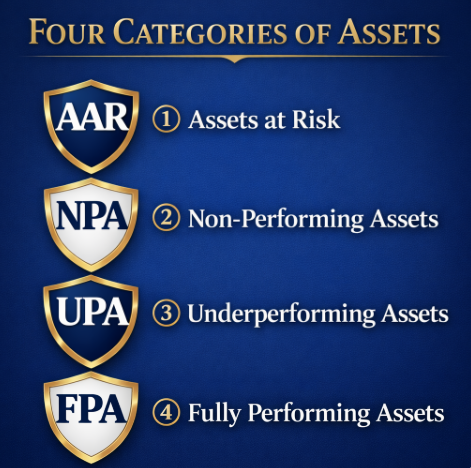
The goal is to move your wealth from the "Mountain" architecture (AAR) to the "Stepped UP Floor" architecture (FPA). We want your outcome to be greater than your contributions and the growth of compounding combined. This is the "miracle" so few experience because they are too busy recovering from the 14 retractions.
Your Money, Your Rules
You have a choice. You can continue to climb the mountain, praying the weather stays clear and your footing stays dry. Or, you can break from the limitations of a physical foundation and implement a design that prioritizes certainty before growth.
You don't have to deploy these builders, but you have the option to learn them. Why accept a system where you can lose half a million dollars of future wealth in a single "correction"?
Stop being a participant in Wall Street’s "False Model" of fear and greed. Become the architect of your own street.
If you want to use the market as an engine, great. But make sure you have a chassis that can handle the bumps without falling off the cliff. Engineer your certainty. Protect your time. And remember: Peace is the path, wisdom is the way.
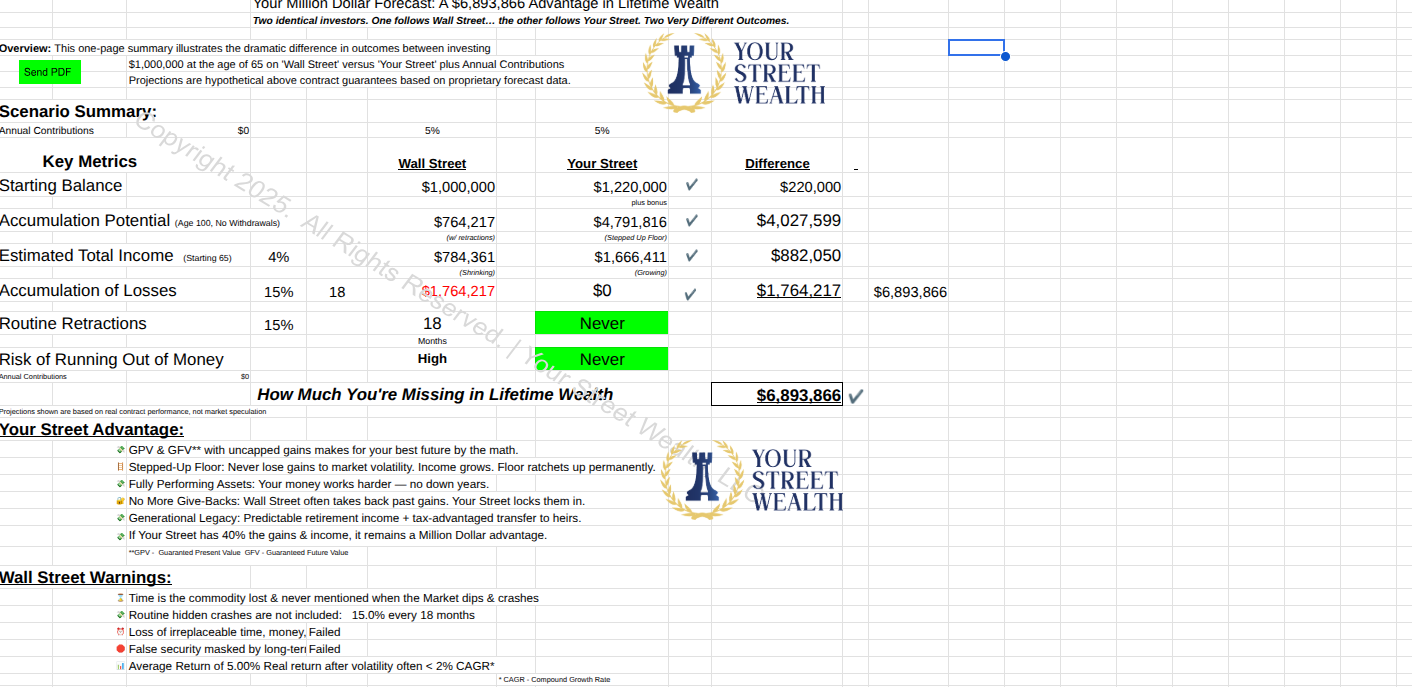
The peak is a nice view, but the "Stepped UP Floor" is where you actually get to live. Turns out retirement is a lot more enjoyable when your view comes from a floor instead of a cliff.
Ready for clarity instead of confusion?
The Million Dollar Hour™ is your educational, one-on-one retirement review that reveals where your plan leads : not just where it’s been.
👉 Schedule your session today.
Discover Which Wealth Killers Are Affecting You
Most people are impacted by 6–9 and don’t realize it
Wealth Killer #1: The Granddaddy : Why Market Volatility is Your Retirement’s Greatest Enemy
Concerned about market losses, taxes, or income reliability?
Take the 7 Question Retirement Stress Test →
You can keep participating… Or you can finally see the outcome. The Million Dollar Hour™ shows you exactly:
✔ Where you are ✔ Where you’re going ✔ How to fix the gaps 👉 Book your session now
Check out the Retirement Blueprint