
Risk is for Business, Not Retirement: Protect Your Savings
Risk is for Business, Not Retirement: Why Your Strategy Must Shift
One of the fastest ways to uncover hidden risk is to take our 7 Question Retirement Stress Test.
Start here: See what your retirement actually looks like → 👉 Book Your Million Dollar Hour™
The Entrepreneur’s Final Pivot: Why the "Growth Mindset" Kills Retirement
If you’ve spent the last thirty years building a business, climbing the corporate ladder, or engineering complex systems, you know one thing to be true: Risk is where the reward lives.
In the world of business, risk can make sense because you can mitigate it with skill, talent, leadership, and solid processes. You can hire better. Sell better. Adapt faster. If something breaks, you can usually out-think it or out-work it. This "Accumulator Mindset" is exactly what made you successful. It’s the engine that built your wealth.
But here is the hard truth that Wall Street won’t tell you: The engine that got you here will not get you there.
Retirement is not a business. It is math. And in the market, you have zero control over the "talent" of the ticker tape. You cannot coach the S&P 500. You cannot manage a bear market into better behavior. You cannot out-work a crash after you stop working.
When you cross the threshold into retirement, the rules of math change. What was once a "healthy correction" in your 40s becomes a catastrophic "sequence of returns" failure in your 60s. In retirement, risk isn't a lever: it's a leak. And if you don't shift from "Participation" to "Engineered Performance," you are essentially spinning sharp knives in a hurricane.
Peace is the path, wisdom is the way. Let’s look at why your strategy must shift from market gambling to institutional-grade architecture.
The "Participation" Trap vs. Engineered Performance
Most retirees are stuck in a model of Participation. They own a basket of stocks, bonds, and mutual funds and "participate" in whatever the market decides to do. If the market goes up, they feel like geniuses. If it goes down, their advisor tells them to "stay the course."
This is a false architecture. It’s like building a skyscraper on a foundation of shifting sand and hoping the weather stays nice.
At Your Street Wealth, we don't "participate." We engineer.
Traditional Wall Street methods rely on probabilities: the hope that the next decade looks like the last one. We focus on Certainty over Probability. We shift your capital from Assets at Risk (AAR): where your principal can vanish overnight: into Fully Performing Assets (FPA).
Think of FPA as the "smartphone" of finance. Just as your iPhone consolidated your camera, pager, phone, and map into one device, an FPA consolidates up to 15 pillars of value: including growth, protection, and tax-free income: into a single, engineered vehicle. It’s a SpaceX-level solution for a world that’s still trying to use a 1980s Rolodex.
The Math of Recovery: Why -30% is a 42% Problem
Wall Street loves to talk about "average returns." They’ll tell you the market averages 7–10% over time. But you can’t eat an average. You eat actual dollars.
This is where the Math of Recovery comes in. If you have $1,000,000 and the market drops 30%, you now have $700,000. To get back to your original million, you don’t need a 30% gain. You need a 42.8% gain just to break even.

Now, factor in your retirement withdrawals. If you are taking out 4% for living expenses while the market is down 30%, you aren't just losing value; you are cannibalizing your seed corn. This creates a "Volatility Recovery Analysis" nightmare. And here is Frank’s point in plain English: when you lose money in retirement, you are not just losing dollars. You are losing the one asset you can never replace: time. A business owner may be able to out-work a mistake. A retiree cannot out-live a market crash. While money can recover, time never does. Every year you spend waiting to "break even" is a year of compounding you will never get back.
Sequence of Returns Risk: The Retirement Silent Killer
The most dangerous period of your financial life is the "Red Zone": the five years before and the five years after you stop working. During this window, you are susceptible to Sequence of Returns Risk.
If you hit a market crash in the first few years of retirement, the math becomes terminal. Because you are withdrawing money from a shrinking pool, you are effectively locking in those losses. It doesn’t matter if the market recovers ten years later; your "Sequence of Return Margin" has been evaporated. In business, you might recover from a bad quarter with better execution. In retirement, there is no extra decade of labor waiting in the wings. You do not get to re-earn lost compounding by trying harder.
Contrast this with an engineered path:
Wall Street: -30% to +30% (Pure uncertainty).
Your Street (FPA): 0% to +30% (The "Floor" is your foundation).
By using a 0% Floor, we ensure that your compounding is never reset to zero. You capture market upside without the downside risk. This isn't magic; it’s ALM (Asset Liability Management) engineering.
Single-Pillar Assets vs. Multi-Pillar Architecture
Most "Quiet Builders" have their wealth tied up in "Single-Pillar" assets:
Banks (NPA - Non-Performing Assets): High safety, but 0% growth and high "inflation leak."
Stocks/Mutual Funds (AAR - Assets at Risk): High potential, but high fee and high risk of loss.
Real Estate (UPA - Under-Performing Assets): Great for growth, but low liquidity and high "management friction."
In retirement, you need more than one pillar. You need Fully Performing Assets (FPA) that provide:
Uncapped Gains (UCG): The ability to grow with the market.
Expanded Market Participation (EMP): A multiplier (often 110%–200%) on those gains.
Contractual Guarantees: Knowing your income is a "Must-Pay" obligation, not a "Hope-it-Works" projection.
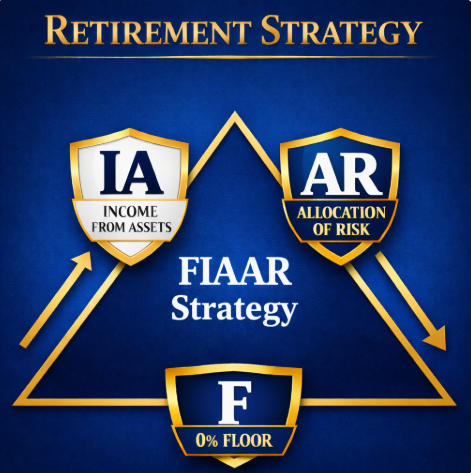
We use the FIAAR Strategy (Floor, Income, Allocation, and Assets at Risk) to create a blueprint that prioritizes Guarantees vs. Probabilities.
Audit the Margin: The Million Dollar Hour™
You’ve spent your life being the Architect of your business or career. Why would you stop now and become a "Participant" in someone else’s casino?
The shift from "Risk for Business" to "Certainty for Retirement" requires a Margin Audit™. You need to know exactly how many years of your life have been lost to market volatility and hidden fees. You need to see the "Future Liens" that taxes and inflation have placed on your net worth.
The Million Dollar Hour™ Forecast is a $995 professional engineering session designed for the "Quiet Builder" who is tired of the noise. We don't do "free consultations" because we don't sell "free cheese." We provide high-friction, high-clarity financial architecture.
In 60 minutes, we will:
Calculate your actual compounded growth (not the "average" your broker quotes).
Identify the "Wealth Killers" currently draining your tank.
Present a personalized, guaranteed path to lifetime income that you can never outlive.
Stop playing the market's game. Start playing yours.
Your Money, Your Rules, In Your Time, On Your Street.
Ready for clarity instead of confusion?
The Million Dollar Hour™ is your educational, one-on-one retirement review that reveals where your plan leads : not just where it’s been.
👉 Schedule your session today.
Discover Which Wealth Killers Are Affecting You
Most people are impacted by 6–9 and don’t realize it
Wealth Killer #1: The Granddaddy : Why Market Volatility is Your Retirement’s Greatest Enemy
Concerned about market losses, taxes, or income reliability?
Take the 7 Question Retirement Stress Test →
You can keep participating… Or you can finally see the outcome. The Million Dollar Hour™ shows you exactly:
✔ Where you are ✔ Where you’re going ✔ How to fix the gaps 👉 Book your session now