
Sequence of Returns Risk: Protecting Your Retirement Savings
Forensic Audit: The Sequence of Returns 'Stress Test' That Exposes Fragile Retirement Plans
One of the fastest ways to uncover hidden risk is to take our 7 Question Retirement Stress Test.
![[HERO] Forensic Audit: The Sequence of Returns 'Stress Test' That Exposes Fragile Retirement Plans](https://cdn.marblism.com/uh5ZCeJ2qCb.png "[HERO] Forensic Audit: The Sequence of Returns 'Stress Test' That Exposes Fragile Retirement Plans")
Start here: See what your retirement actually looks like → 👉 Book Your Million Dollar Hour™
Most retirement plans aren’t built; they’re assembled from a collection of "best guesses" and broker slogans. But when you’re within five years of retirement, you don't need a guess. You need a Diagnostic.
Welcome to the desk of the Forensic Architect.
We don't look at "average returns" or "market potential." We look for the structural cracks that cause plans to collapse under pressure. And the deepest, most dangerous crack we find? Sequence of Returns Risk.
In this diagnostic report, we’re going to run a stress test on the "average" retirement model and show you exactly where the leaks are hiding.
The Structural Failure: Why 'Average' is a 2D Lie
Wall Street loves 2D math. They show you a straight line on a graph that averages 8% and tell you everything is fine.
But retirement doesn't happen in a straight line. It happens in a sequence.
The Forensic Reality: A bad year at the wrong time, especially in the first 24 months of retirement, is a structural failure. It doesn’t matter if the market averages 10% over thirty years if you lose 20% in Year 1 while withdrawing income. You are selling assets at the bottom, amputating your future compounding, and locking in a wealth-killing trap.
This is the difference between Participation vs. Engineered Performance.
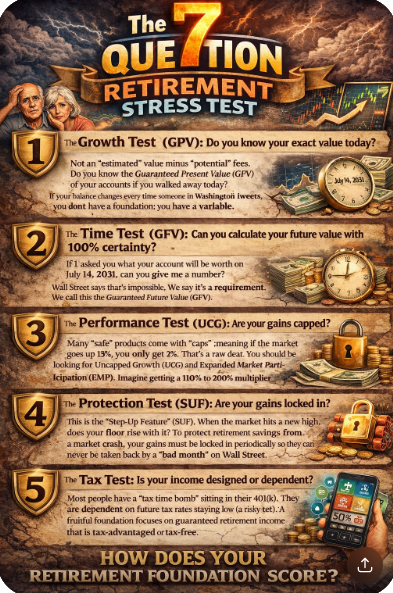
The 7-Question Retirement Stress Test™
If your current advisor hasn't run these diagnostics, your plan is likely built on a single pillar of hope. A forensic audit asks:
The Growth Test: Is your growth guaranteed, or is it dependent on a market mood?
The Time Test: How many years of your life are you trading to recover from a 20% loss?
The Performance Test: Are you settling for brochure averages or engineered outcomes?
The Protection Test: Do you have a contractual 0% floor, or is your floor the bottom of the ocean?
The Tax Test: Is your income being siphoned off by the largest hidden fee in history?
The Cost Test: Are you paying for management that doesn't provide a guarantee?
The Certainty Test: Can you calculate your exact income for the next 20 years, or are you just projecting?
The Math of Recovery: Forensic Evidence
Losses are not symmetrical. This is the math Wall Street skips in the sales meeting:
A 10% loss requires an 11% gain to break even.
A 30% loss requires a 43% gain to break even.
A 50% loss requires a 100% gain just to get back to zero.
When you are in the Fragile Decade — the five years before and after retirement — you do not have the time to wait for the math of recovery to do its job. Every dollar lost to market volatility is a dollar that stops working for you forever.
It’s like trying to build a skyscraper on a foundation of sand. It looks great until the wind blows.

The Wealth Assassin: How the Sequence Destroys Portfolios
Imagine two retirees: Investor A and Investor B. Both start with $1,000,000. Both average a 7% return over 20 years. Both withdraw $50,000 a year for living expenses.
On paper, they are identical. In reality, one might end up with $2 million, while the other goes broke in year 14.
The difference? The Sequence of Returns.
If Investor A sees a 15% market drop in Year 1, they aren't just losing 15% of their principal. They are losing 15% plus the $50,000 they had to withdraw to pay for groceries and property taxes. They are selling shares at the bottom. Those shares are gone forever. They can’t participate in the eventual recovery.
This is the Volatility Recovery Analysis in action. When you pull money out of a declining asset, you are effectively "locking in" the loss and amputating your portfolio's ability to grow in the future. Wall Street calls this "market participation." I call it a wealth-killing trap.
That’s the heart of this ultimate guide: sequence risk is not one isolated problem. It is what happens when multiple mistakes stack on top of each other. Bad assumptions. Weak allocation. False confidence. Single-pillar design.
So don’t just ask, “What return do I need?”
Ask better questions:
What happens if the bad years come first?
How much recovery math is hidden inside my plan?
How much of my income depends on market behavior I cannot control?
How many pillars are actually inside the assets I’m using?
What is my real Sequence of Return Margin once fees, taxes, and withdrawals show up?
That is how Quiet Builders stop reacting and start engineering.
The Forensic Solution: Multi-Pillar Allocation
The only way to eliminate Sequence of Returns Risk is to change the Architecture of the asset.
Traditional assets — stocks, bonds, mutual funds — are Single-Pillar Assets. They do one thing, and they do it with high risk. Banks, stocks, and real estate are durable in their own lanes, but in retirement they can become a Rolodex in a SpaceX world when you need precision, protection, and income to work together.
A Fully Performing Asset (FPA) is the smartphone of finance. It uses the Consolidation of Technology model: one vehicle, multiple jobs, fewer leaks. Instead of stitching together isolated products, you build on a multi-pillar structure that can deliver 5–15 pillars of value, such as:
0% Floor: No more unnecessary recovery math from market losses.
Uncapped Gains (UCG): Benefit from market upside without direct downside exposure.
Expanded Market Participation (EMP): A 110%–200% multiplier on UCG, so a 10% UCG can become an 11%–20% gain.
Tax-Free Income: Because what you keep matters more than what you make.
Contractual Guarantees: Move from probabilities to paychecks.
This is not about chasing opportunity. It is about engineering certainty.
Participation vs. Engineered Performance
Most people are taught to be "Participants." You buy a fund, you pay a fee, and you hope for the best. You are a passenger on a ship you don’t control, steered by people who get paid whether you hit an iceberg or not.
At Your Street Wealth, we don’t do "Participation." We do Engineered Performance.
Think about the consolidation of technology. You used to carry a pager, a camera, a map, and a phone. Now, you have a smartphone. It’s a "multi-pillar" tool that does everything.
Traditional assets: stocks, bonds, real estate: are "single-pillar" assets. They do one thing, usually at high risk or high cost. A Fully Performing Asset (FPA) is the "smartphone" of the financial world. It’s an institutional-grade architecture that provides 5–15 pillars of value, including:
Guaranteed Growth: No more "Math of Recovery" because you never lose principal to market volatility.
Uncapped Gains (UCG): You still get to benefit from the upside.
Expanded Market Participation (EMP): Often providing 110%–200% multipliers on growth.
Tax-Free Income: Because what you keep matters more than what you make.
Protection: Contractual guarantees that replace Wall Street's "projections."
When you move from a "Participation" model to an "Engineered" model, you solve the Sequence of Returns Risk by removing the possibility of a negative year. If your floor is 0%, the "sequence" no longer has the power to destroy you.
Pillar 4: ALLOCATION — The Missing Sequence of Returns Defense
This is where most retirement articles stop too early. They talk about returns. They talk about diversification. They talk about liquidity. But they skip the architecture.
Let’s fix that.
Liquidity means how quickly you can get to your money.
Allocation means where your money is structurally placed and how many pillars of performance are built into that placement.
Those are not the same thing.
Wall Street loves to talk about liquidity because it keeps you in motion. It keeps you trading, rotating, reacting, and "staying flexible." But liquidity alone does not protect retirement income. In many cases, it simply gives you faster access to a bad system.
Allocation is different. Allocation is design.
If your retirement assets are allocated mostly to single-pillar vehicles, your sequence risk is high even if your statements look "diversified." Why? Because a portfolio made of assets that can all drop, stall, or get interrupted under pressure is still fragile. Different labels do not create different pillars.
This is why Pillar 4: ALLOCATION matters so much. The number of pillars inside the asset composition is what protects against Sequence of Returns Risk.
And this is where the seven mistakes start getting fixed.
Mistake 1 gets fixed when you stop chasing average returns and start measuring real-world income durability.
Mistake 2 gets fixed when you respect The Math of Recovery and refuse unnecessary losses.
Mistake 3 gets fixed when you stop confusing diversification with design.
Mistake 4 gets fixed when you prioritize architecture over convenience.
Mistake 5 gets fixed when you shift from accumulation thinking to retirement income engineering.
Mistake 6 gets fixed when you choose guarantees over guesses where income reliability matters most.
Mistake 7 gets fixed when you run The Margin Audit™ and expose every leak.
A single-pillar asset may give you growth. Another may give you liquidity. Another may give you income. Another may give you tax treatment. But when retirement depends on stitching together separate tools, every gap becomes a leak. Every leak becomes lost time. And sequence risk rushes through those cracks.
A multi-pillar asset, by contrast, is designed to do more than one job at the same time. That is the protection. That is the engineering.
Think of it this way:
Liquidity asks: "Can I reach the money?"
Allocation asks: "What happens to the money while I’m reaching for it?"
Liquidity is access.
Allocation is architecture.
If the asset is liquid but exposed to a -30% hit, that liquidity can force you to sell low. That is not safety. That is convenience inside a trap.
If the asset is allocated into a multi-pillar structure with a 0% floor and upside participation, the sequence changes completely. Now you are operating in a 0% to +30% design instead of a -30% to +30% gamble. That changes the Sequence of Return Margin. That improves Compounding Efficiency. That protects time.
This is the real authority point most advisors miss: Sequence of Returns Risk is not just a withdrawal problem. It is an allocation architecture problem.
The question is not, "How liquid is your portfolio?"
The better question is, "How many pillars are inside the assets producing your retirement income?"
That is the difference between a Rolodex in a SpaceX world and modern financial architecture.
Audit the pillars. Not just the balance.
Protect the time. Not just the statement.
Audit the Margin, Protect the Time
The problem with most retirement plans isn't the investments; it's the architecture. It’s a "False Model" driven by the greed and fear of the big banks. When the greed meter is high, they sell you on "opportunity." When the fear meter is high, they sell you on "security." Both are designed to keep you dependent on their research and their daily noise.
You don't need more research. You need a Margin Audit™.
You need to know exactly how much of your wealth is "at risk" and how much of it is "performing." Most people are surprised to find that their current plan is leaking money through hidden fees, unnecessary taxes, and the massive, uncalculated risk of a market downturn early in retirement.
A real Margin Audit™ should answer:
Where are the single-pillar weak spots?
Where would a first-decade downturn do the most damage?
How much time would be lost to recovery?
Which assets create income, and which assets force liquidation?
What parts of the plan are based on guarantees, and what parts are still based on hope?
That is how you move from participation to performance.
That is how you protect Pillar 4: Allocation.
That is how you turn a fragile retirement plan into engineered architecture.
Audit the margin. Engineer the certainty. Stop playing the "Average" game.

The Lifetime ICA™ Analysis: Your Executive Diagnostic
You’ve spent decades building your wealth. You shouldn't spend retirement worrying if it will last.
We are currently opening ten spots for our Lifetime ICA™ Analysis (Institutional Capacity Audit). This is not a free consultation. It is a $20,000-value forensic diagnostic performed by our team of architects.
We will run your current plan through a Volatility Recovery Analysis, perform The Margin Audit™, identify the exact structural leaks, and present you with a clearer blueprint for a safer, more certain future.
The Executive Special:
The next 10 people to book their analysis can secure this $20,000 diagnostic for just $10.
Once those 10 spots are gone, the price returns to the standard $995 investment.
[Schedule Your $10 Forensic Diagnostic Here]
Stop being a participant in Wall Street's casino. Become the architect of your own Street.
Your Money, Your Rules, In Your Time, On Your Street
Wall Street still runs on a False Model driven by fear and greed. High greed usually signals higher risk of loss. High fear usually signals lower risk of loss. But either way, the game is built to keep you dependent on complexity, headlines, and daily noise.
Your Street Wealth takes a different path. We use rules-based planning, institutional-grade ALM thinking, and modern banking architecture to translate complexity into decisions. Audit the margin. Protect your time. Engineer certainty.
Sequence of Returns Risk is only a threat when your retirement plan is fragile by design. Fix the design. Move from single-pillar participation to multi-pillar performance. Replace uncertainty with clarity. Replace projections with architecture.
Your Money, Your Rules, In Your Time, On Your Street.
Ready for clarity instead of confusion?
The Million Dollar Hour™ is your educational, one-on-one retirement review that reveals where your plan leads — not just where it’s been.
👉 Schedule your session today.
Discover Which Wealth Killers Are Affecting You
Most people are impacted by 6–9 and don’t realize it
Wealth Killer #1: The Granddaddy : Why Market Volatility is Your Retirement’s Greatest Enemy
Concerned about market losses, taxes, or income reliability?
Take the 7 Question Retirement Stress Test →
You can keep participating… Or you can finally see the outcome. The Million Dollar Hour™ shows you exactly:
✔ Where you are ✔ Where you’re going ✔ How to fix the gaps 👉 Book your session now
Check out the Retirement Blueprint