
'Stay the Course' is a Retirement Death Trap
Why 'Stay the Course' is a Retirement Death Trap (and the Math That Proves It)
One of the fastest ways to uncover hidden risk is to take our 7 Question Retirement Stress Test.

Start here: See what your retirement actually looks like → 👉 Book Your Million Dollar Hour™
How to Protect Retirement Savings From a Market Crash
For most high-achievers, there is a recurring nightmare that begins about five years before they plan to walk away from their business or career. It’s the feeling of being on a high-speed train where you can’t see the tracks ahead. You’ve done everything right: maxed out the accounts, listened to the "diversification" sermons, and built a substantial nest egg.
Yet, every time the market wobbles, that pit in your stomach returns.
Wall Street’s answer to your anxiety is always the same: "Stay the course. It’s just volatility. The market always comes back."
But here is the truth that Wall Street won't tell you: While money can eventually recover, time never does.
If you are a "Quiet Builder": successful, financially fatigued, and looking for certainty: you don’t need more "participation" in a broken system. You need financial architecture. You need to understand the Math of Recovery and how to engineer a plan where a market crash is no longer a threat to your lifestyle, but a non-event for your balance sheet.
The 'Stay the Course' Lie: Why Your Portfolio is a Rolodex in a SpaceX World
Traditional retirement planning is still running on a Reagan-era framework. It’s a "Single Pillar" model that relies almost entirely on market participation. You are told to put your money into a bucket (stocks/bonds) and hope that when you need to pull it out, the bucket isn't leaking.
This is like trying to navigate a SpaceX-level financial landscape using a 1980s Rolodex. It was durable for its time, but it’s dangerously inadequate for today’s speed and risk.

When you "participate" in the market, you are essentially gambling that the timing of the next crash won't coincide with your need for income. This is not a plan; it’s a prayer. At Your Street Wealth, we shift the conversation from Participation to Engineered Performance.
The Math of Recovery: The Hidden Asymmetry of Loss
Wall Street likes to talk in "average returns." They’ll tell you that if you lose 30% one year and gain 30% the next, you’ve "broken even" on average.
The math says they are lying.
If you have $1,000,000 and lose 30%, you now have $700,000. To get back to your original $1,000,000, you don't need a 30% gain: you need a 42.9% gain just to get back to zero.
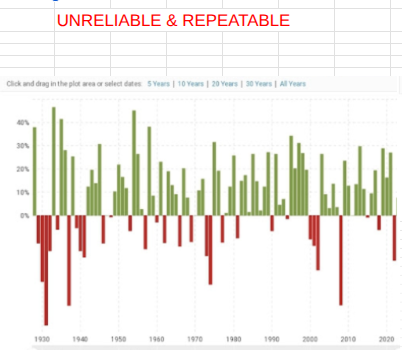
Take a look at the actual math of loss:
A 10% loss requires an 11.1% gain to recover.
A 20% loss requires a 25% gain to recover.
A 30% loss requires a 42.9% gain to recover.
A 50% loss requires a 100% gain just to see your original dollar again.
When you lose value, you don't just lose money; you lose the time it takes to earn that recovery percentage. For someone at age 60, losing three to five years to "recovery math" isn't just an inconvenience: it’s a theft of your most precious resource.
Sequence of Return Margin: Why Retirement Changes the Rules
The Math of Recovery becomes even more lethal when you enter the "Distribution Phase" of life. When you are working, a market crash is an "opportunity" to buy low. But once you start taking income, a crash becomes a Wealth Killer.
If the market drops 30% and you also need to withdraw 5% for your living expenses, your portfolio has effectively shrunk by 35%. Now, the mountain you have to climb to recover is even steeper. This is known as Sequence of Returns Risk, and it is the primary reason why traditional Wall Street strategies fail people in the "Red Zone" (the five years before and after retirement).

At Your Street Wealth, we perform a Margin Audit™ to identify exactly how much "Sequence of Return Margin" you currently have. Most people discover they have zero margin: meaning one bad year could reset their retirement clock by a decade.
The Solution: Shift to Fully Performing Assets (FPA)
In the 10 Rules for a Retirement That Actually Works, we discuss the importance of asset architecture. We categorize assets into four categories:
NPA (Non-Performing Assets): Cash and emergency funds (The Infants).
AAR (Assets at Risk): Your typical Wall Street portfolio (The Teens - volatile and unpredictable).
UPA (Underperforming Assets): Low-yield, high-fee vehicles.
FPA (Fully Performing Assets): The Foundation.
An FPA is a "Multi-Pillar" asset. While a stock is a single-pillar asset (it only does one thing: hopefully go up), an FPA provides 5 to 15 pillars of value, including protection, tax-free income, and: most importantly: the 0% Floor.

The Power of the 0% Floor: Engineering Certainty
Imagine a scenario where the S&P 500 drops 20%. In a traditional "Participation" model, your statement shows a 20% loss. You are now a victim of the Math of Recovery.
In an Engineered Performance model using FPAs, your statement shows 0.0%. You didn't gain, but you didn't lose a single penny of your principal or your previous gains.
When the market eventually recovers and goes up 10%, the "Participant" is still struggling to get back to even. But the "Architect": the one with the FPA: starts growing from their highest point. This is Compounding Efficiency. You never have to "reset the clock."
Uncapped Gains with a Safety Net
One of the biggest myths in finance is that you have to accept massive risk to get decent growth. Wall Street brokers often claim that safe vehicles are "capped" at 3%.
This is outdated thinking. Through Expanded Market Participation (EMP), we can show you how to achieve Uncapped Gains (UCG). We use multipliers that can turn a 10% market gain into an 11% or even 20% gain for your portfolio: all while maintaining that contractual 0% floor.
It’s the financial equivalent of the "Consolidation of Technology." Just as your smartphone replaced your camera, pager, and map, the FPA replaces the fragmented, high-risk pieces of your old portfolio with one engineered vehicle designed for your street, not Wall Street.

Protect Your Time. Audit Your Margin.
If you are feeling financially fatigued, it’s likely because you are tired of being a "Participant" in someone else's game. You are tired of the noise, the daily research, and the hidden complexity Wall Street uses to keep you addicted to buying and selling.
It is time to unlearn the myths and start building on a foundation of Guarantees vs. Probabilities.
You can estimate your income needs, but you can never predict the future value of a portfolio where losses are uncontrollable. You can, however, engineer a path where those losses are mathematically impossible.
Peace is the path, wisdom is the way.
Ready for clarity instead of confusion?
The Million Dollar Hour™ is your educational, one-on-one retirement review that reveals where your plan leads : not just where it’s been.
👉 Schedule your session today.
Discover Which Wealth Killers Are Affecting You
Most people are impacted by 6–9 and don’t realize it
Wealth Killer #1: The Granddaddy : Why Market Volatility is Your Retirement’s Greatest Enemy
Concerned about market losses, taxes, or income reliability?
Take the 7 Question Retirement Stress Test →
You can keep participating… Or you can finally see the outcome. The Million Dollar Hour™ shows you exactly:
✔ Where you are ✔ Where you’re going ✔ How to fix the gaps 👉 Book your session now