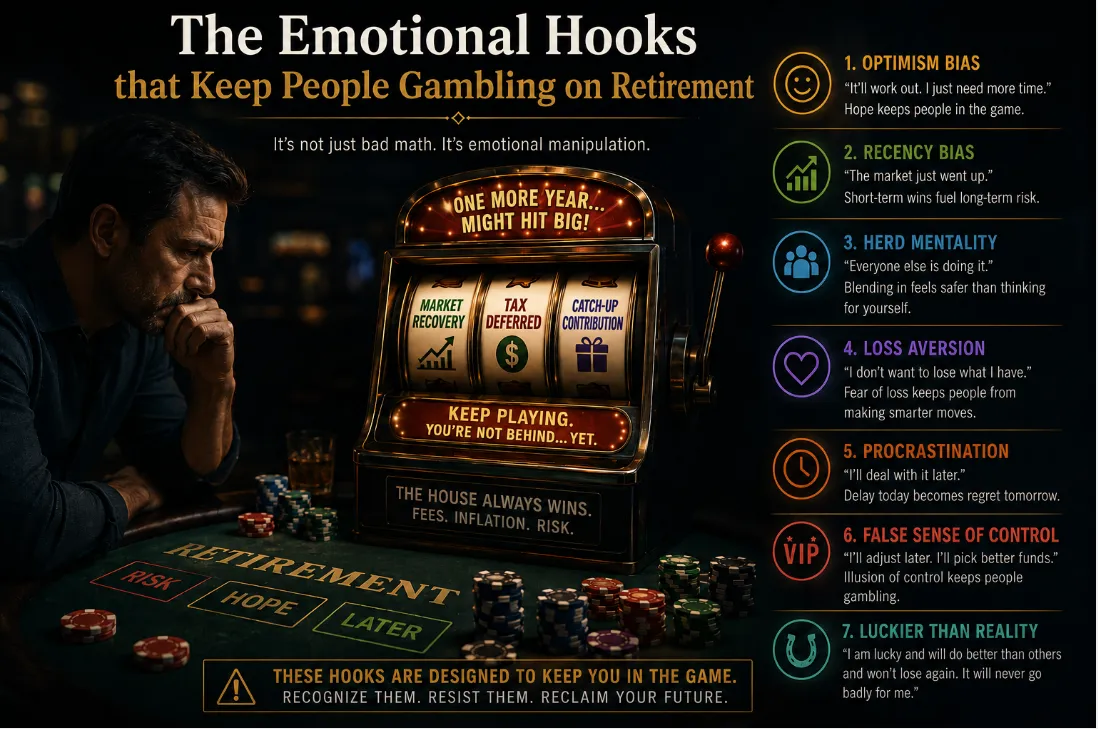
The 7 Emotional Hooks Keeping You Tethered to Wall St Gamble
The 7 Emotional Hooks Keeping You Tethered to Wall Street’s Gamble
One of the fastest ways to uncover hidden risk is to take our 7 Question Retirement Stress Test.
Start here: See what your retirement actually looks like → 👉 Book Your Million Dollar Hour™
You’ve spent thirty years building. You’ve survived the dot-com bubble, the 2008 crash, and the recent whipsaws of a post-pandemic economy. By most measures, you are a success: a "Quiet Builder" who has done the work, saved the money, and played by the rules.
But there is a nagging unease.
Every time the market stutters, you feel it. That tightness in your chest isn't about greed; it’s about the awareness that you no longer have another thirty years to "wait for the recovery." You aren't interested in "participation" anymore; you want performance. You want certainty.
So why, despite your logic and your success, do you continue to leave your entire future exposed to the volatility of Wall Street?
The answer isn't mathematical. It’s psychological. Wall Street doesn't just sell stocks; they sell emotional hooks designed to keep you tethered to a high-risk, high-fee environment. To move from Participation to Engineered Performance, you must first identify the seven hooks keeping you in the gamble.
1. FOMO (Fear of Missing Out)
We’ve all seen it: the neighbor who made a killing on a tech stock or the headlines screaming about the next bull run. FOMO is the Greed/Fear meter in action. When greed is high, you feel like you're losing by staying safe.
In the Wall Street "False Model," you are conditioned to watch paper gains while ignoring the underlying risk. But paper gains are a ghost. Real wealth is built on Compounding Efficiency, not chasing the next high. Chasing the market is like spinning sharp knives: it feels exhilarating until the momentum shifts, and you're left holding the blade.
2. The Sunk Cost Fallacy
"I've been with this firm for 20 years. My advisor is a nice guy; we play golf together."
This is the most dangerous relational hook. You feel a sense of loyalty to a strategy or a person, even if the math no longer supports the outcome. You treat your past time and fees as a reason to stay, rather than a reason to audit.
Remember: Money can recover. Time never does. If your current plan hasn't protected you from the Math of Recovery (where a 30% loss requires a massive 42% gain just to break even), then your loyalty is being used against you.
3. The Herd Mentality (The "Safety in Numbers" Trap)
If 90% of employees are in a 401(k), it must be the right way to retire, right?
Wall Street relies on the "Rolodex in a SpaceX world" analogy. Traditional 401(k)s and IRAs were durable in the Reagan era, but they are inadequate for the speed and risk of modern planning. These are Single-Pillar assets: they do one thing (market participation) and leave you exposed to five others (taxes, fees, volatility, sequence of return risk, and longevity risk).
Just because everyone is standing on the same shaky bridge doesn't mean the bridge is safe.
4. The Illusion of Control
Many Quiet Builders believe that by "watching the market," "rebalancing," or "diversifying," they are managing risk.
This is a fallacy. You can estimate your income needs, but you cannot predict or control future portfolio value when market volatility and fee "leaks" are uncontrollable. Rebalancing during a crash is simply moving deck chairs on the Titanic. Real control comes from Engineering Certainty: using a Margin Audit™ to identify exactly where your wealth is leaking and plugging the holes with contractual guarantees.
5. Authority Bias
We are taught to trust the "Big Box" brand names. If the building has marble pillars and the advisor wears a bespoke suit, they must know what they’re doing.
Wall Street uses hidden complexity to drive daily research and addictive buying/selling. They want you to believe that retirement is too complex for you to understand, so you must defer to their "authority." At Your Street Wealth, we strip away the jargon. We use institutional-grade engineering metaphors because math doesn't need a suit to be true.
6. The "Average Return" Sedation
This is the most surgical hook of all. Your advisor tells you that the market "averages" 8% or 10%. This number is a sedative.
"Average" returns do not exist in your bank account. If you lose 30% one year and gain 30% the next, your "average" return is 0%, but your actual account is down 9%. This is the Volatility Recovery Analysis Wall Street won't show you. They use averages to hide the Sequence of Return Margin: the reality that a few bad years at the start of retirement can bankrupt a plan that looked perfect on paper.

7. Hope as a Strategy
This is the quiet, desperate belief that "it will just work out" because you've worked hard and lived a good life.
Hope is a beautiful virtue, but it is a terrible financial strategy. Retirement requires Architecture, not hope. You wouldn't build a house based on the "hope" that gravity stays consistent; you build it based on engineering principles that account for the weight and the wind.
Your retirement should be no different. You need a path that is engineered to grow and heal, not one that requires the market to "behave" for the next 30 years.
From Single-Pillar to Multi-Pillar: The "Smartphone" of Finance
Think about the technology in your pocket. It’s no longer just a phone; it’s a camera, a GPS, a computer, and a library. It is a consolidation of technology.
Traditional assets: Banks, Stocks, and Real Estate: are Single-Pillar. They are the "pagers" and "landlines" of finance. They serve one purpose and carry high individual risk.
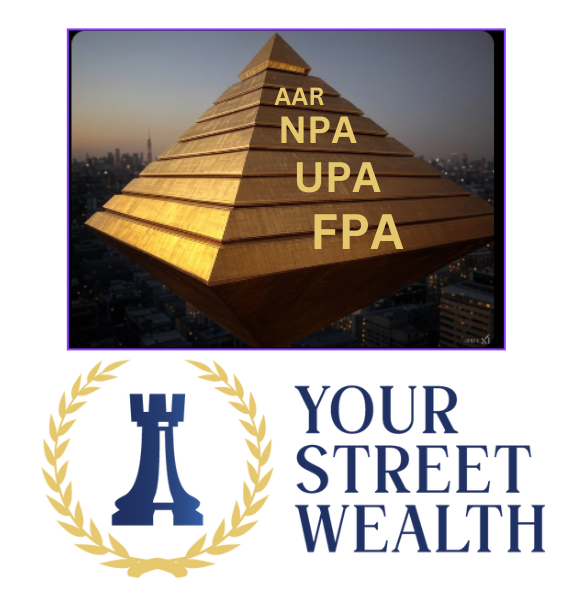
A Fully Performing Asset (FPA) is the "smartphone" of your portfolio. It consolidates 5 to 15 "pillars" of value: such as growth, protection, tax-free income, and long-term care: into one engineered vehicle. With Uncapped Gains (UCG) and Expanded Market Participation (EMP), you can capture the upside of the market (often with a 110%–200% multiplier) while maintaining a contractual floor of 0%.
When the market is up, you win. When the market is down, you stay level. No "Math of Recovery" required. No more gambling.
Unlearn the Myths. Engineer the Truth.
The unease you feel is your wisdom trying to tell you that the Wall Street model is broken. It’s time to stop "participating" in a system designed to extract your wealth through fees and volatility.
It’s time to audit the margin. It’s time to protect your time.
The Million Dollar Hour™ Forecast is not a sales pitch; it is a $995 forensic engineering session for high-intent Quiet Builders. In 60 minutes, we provide the clarity that Wall Street spends decades trying to obscure. We show you exactly where your current plan leads: not just where it’s been: and present a guaranteed path to safer wealth accumulation.
Peace is the path, wisdom is the way.
Your Money, Your Rules, In Your Time, On Your Street.
Ready for clarity instead of confusion?
The Million Dollar Hour™ is your educational, one-on-one retirement review that reveals where your plan leads : not just where it’s been.
👉 Schedule your session today.
Discover Which Wealth Killers Are Affecting You
Most people are impacted by 6–9 and don’t realize it
Wealth Killer #1: The Granddaddy : Why Market Volatility is Your Retirement’s Greatest Enemy
Concerned about market losses, taxes, or income reliability?
Take the 7 Question Retirement Stress Test →
You can keep participating… Or you can finally see the outcome. The Million Dollar Hour™ shows you exactly:
✔ Where you are ✔ Where you’re going ✔ How to fix the gaps 👉 Book your session now