The Compounding Lie: Why Your Nest Egg Isn't Growing
The Compounding Lie: Why Your Nest Egg Isn't Growing Like You Think
Start here: See what your retirement actually looks like → 👉 Book Your Million Dollar Hour™

One of the fastest ways to uncover hidden risk is to take our 7 Question Retirement Stress Test.
Why "Gains on Gains" in the Market is the Greatest Fairytale in Finance
If you’ve spent the last twenty years diligently "participating" in the market, you’ve likely been fed a steady diet of the same Wall Street gospel: “Just stay the course. Compounding will do the heavy lifting.”
It sounds poetic. It sounds like physics. But for most "Quiet Builders": the successful, weary professionals nearing the retirement finish line: it hasn't actually happened.
We’ve been taught that compounding is a magical snowball that grows indefinitely. In reality, for most traditional portfolios, that snowball is being hit with a flamethrower every few years. The result isn't a mountain of wealth; it’s a puddle of "lost time."
At Your Street Wealth, we don't look at "hopeful" projections. We look at the Math of Recovery. And the math tells us that the "Gains on Gains" dream is currently an architectural nightmare.
The Myth of "Gains on Gains"
Wall Street loves to show you average returns. If the market is up 10% one year and down 10% the next, they’ll tell you your average return is 0%.
The math says you’re actually down.
If you start with $100,000 and lose 10%, you have $90,000. To get back to $100,000, you don't need a 10% gain. You need an 11.1% gain. If you lose 30%, you don’t need a 30% rally to break even: you need a 42% gain just to get back to where you started.
This is the Volatility Recovery Analysis that your broker rarely mentions. Every time the market takes a "routine" dip, your compounding doesn't just pause; it resets the clock. You aren't earning gains on gains; you are spending your life’s most valuable asset: time: trying to earn back what you already had.

The 18/60 Cycle: A Century of Interruption
Wall Street treats market crashes like "black swans": rare, unpredictable events. But if you look at the last 100 years of data through an institutional-grade lens, a different pattern emerges.
On average, the market experiences a significant "hiccup" every 18 months and a major wealth-shattering event every 60 months.
These aren't anomalies; they are the rhythm of a False Model driven by greed and fear. The larger the gain, the larger the subsequent loss. It’s like a rubber band being stretched to its limit: eventually, it snaps back, and it usually takes a chunk of your retirement peace with it.
2000–2020: The Silent Wealth Crater
We are approaching the 100-year anniversary of the 1929 crash, a period synonymous with financial ruin. Yet, if you look at the cumulative wealth destruction between 2000 and 2020, it actually surpassed the devastation of '29 for the modern retiree.
Between the Dot-Com bust, the 2008 Financial Crisis, and the 2020 volatility, the "lost decades" have created a sequence of return margin that is impossible to ignore. Most traditional retirement solutions have experienced 5 to 10 times more accumulated losses than actual gains over a lifetime.
When you strip away the flashy marketing, many portfolios have a real growth rate of less than 1–2%. At that point, you aren't "investing" for a better life; you’re effectively running a very expensive, high-stress savings account that isn't even guaranteed to beat a basic bank.
Architecture vs. Participation
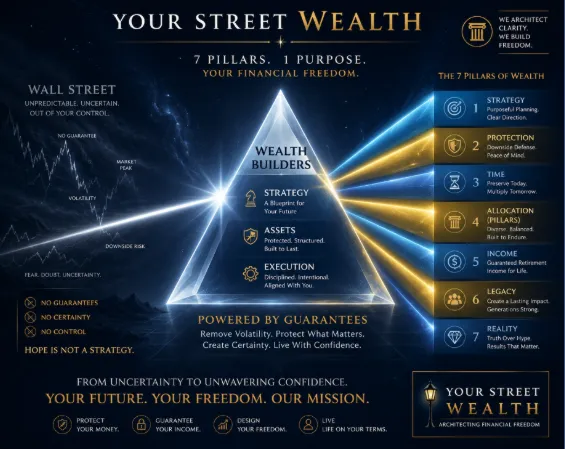
Why does this stay hidden? Because Wall Street relies on "Participation." They want you to participate in the noise, the daily research, and the addictive cycle of buying and selling. It’s a "Single Pillar" model where you are entirely dependent on the market’s mood.
At Your Street Wealth, we advocate for Engineered Performance.
Think of it like the "Consolidation of Technology." In the 90s, you had a pager, a camera, and a phone. Today, you have a smartphone that does it all, better and faster. Traditional assets (Stocks, Real Estate, Banks) are single-pillar products: they are "a Rolodex in a SpaceX world."
We focus on Fully Performing Assets (FPA). These are "multi-pillar" assets that provide 5–15 pillars of value: including growth, protection, and tax-free income: with a floor of 0%.
Instead of a -30% to +30% rollercoaster, an FPA offers a 0% to +30% framework. When the market loses, you stay at zero. You don't lose money, and more importantly, you don't lose time.

The Psychology of the Lie: Hope vs. Truth
Why do so many Quiet Builders stay in the "Assets at Risk" (AAR) category long after they should have moved to a foundation of certainty?
Because they want to believe the lie.
"Hope" is a powerful drug. Wall Street sells the probability of a windfall. We provide the contractual guarantee of a path. Many people stop looking for the truth because the truth requires unlearning decades of "Reagan-era" banking myths. It requires admitting that their current allocation: often a 60/40 split that serves the broker’s fees more than the builder’s future: is a plan for 100% risk.
We use the Rule of 100 or 75. It’s a simple, rules-based planning frame: as you age, you systematically reduce risk and increase your percentage of Fully Performing Assets. You stop gambling with the money you need to live on.
Stop Guessing. Start Engineering.
You cannot predict future portfolio value when the leaks (fees and taxes) and the losses (market volatility) are uncontrollable. You can, however, engineer a guaranteed outcome.
The Million Dollar Hour™ Forecast is a $995 professional Margin Audit™. It’s not a "free" sales pitch for the curious; it’s a deep-dive engineering session for the serious.
We precisely calculate:
How much time and wealth you’ve already lost to the 18/60 cycle.
Your actual Compounding Efficiency.
A personalized path to Uncapped Gains without the fear of running out of money.
Peace is the path, and wisdom is the way. It’s time to move your money off of Wall Street and onto Your Street.

Ready for clarity instead of confusion?
The Million Dollar Hour™ is your educational, one-on-one retirement review that reveals where your plan leads : not just where it’s been.
👉 Schedule your session today.
Discover Which Wealth Killers Are Affecting You
Most people are impacted by 6–9 and don’t realize it
Wealth Killer #1: The Granddaddy : Why Market Volatility is Your Retirement’s Greatest Enemy
Concerned about market losses, taxes, or income reliability?
Take the 7 Question Retirement Stress Test →
You can keep participating… Or you can finally see the outcome. The Million Dollar Hour™ shows you exactly:
✔ Where you are ✔ Where you’re going ✔ How to fix the gaps 👉 Book your session now