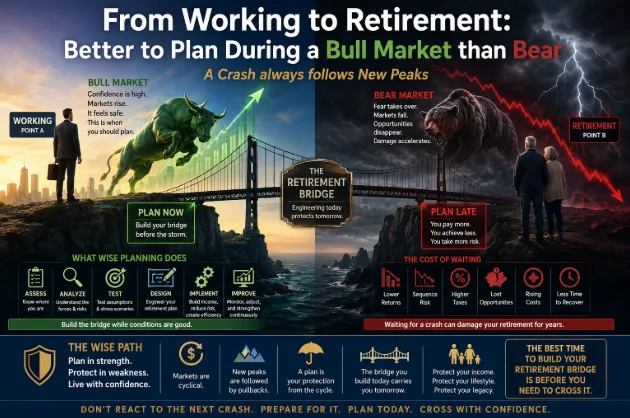
When Should You Plan for Retirement? Before the Bear
Better to Plan During A Bull Market, Not the Bear
Start here: See what your retirement actually looks like → 👉 Book Your Million Dollar Hour™

By Frank L. Day, invertor of Million Dollar Hour. One of the fastest ways to uncover hidden risk
is to take our 7 Question Retirement Stress Test.
Build the Bridge Before the Flood - A Crash Always Follows New Peaks
A bear market is a terrible time to discover that your retirement plan was mostly a hope with good branding.
When fear arrives, people rarely make their best financial decisions. They delay retirement, sell at depressed prices, cut spending, or cling to a strategy they no longer trust. The plan is no longer being designed: it is being defended.
That is why you should plan during a bull market, not a bear market.
Plan in the calm. Protect before the storm.
This article serves Discipline 2 : Protect Against Unnecessary Loss, Discipline 3 : Protect Forward Progress, and Discipline 4 : Protect Time from The 7 Disciplines of Retirement Wealth™.
Ask the guiding questions:
How much of your retirement should be insulated from unnecessary loss?
How many years could your current strategy lose during the next major downturn?
How much future income is lost when time is lost?
1. Disrupt: Rising balances can create dangerous confidence
During a bull market, your statements look reassuring. Account values rise. Headlines celebrate new highs. Friends talk about their latest gains over dinner.
That is precisely when many people stop questioning their assumptions.
They assume:
The market will continue rising.
Their recent return is a reasonable future return.
Their current allocation will work just as well during retirement.
A broker, target-date fund, or “stay the course” strategy will automatically protect their income.
But a rising balance is not the same as a reliable retirement plan.
A bull market can make a fragile bridge look structurally sound. The bridge still needs inspection, load testing, and reinforcement before the flood.
2. Reveal Financial Gravity: Your balance is not your retirement outcome
Your retirement plan has two sides:
The Balance Sheet: the source of funds.
The Income Statement: the use of funds.
Margin: the battleground between positive and negative outcomes.
A portfolio can show growth while its future income capacity quietly deteriorates. Taxes, fees, inflation, market losses, sequence-of-returns risk, and interrupted compounding all create financial gravity.
Sequence-of-returns risk matters most when withdrawals begin. If a bear market arrives during the first years of retirement, you may be selling assets while prices are down. You then have fewer assets available when the market eventually recovers.
That is not merely a temporary decline. It can permanently reduce your income engine.
The market is a tool engineered largely for institutions and the unknown 3% who succeed through unusual skill, access, or luck. For an individual withdrawing from retirement assets, the same market can become a destructive storm.
Markets rise when stimulated by earnings, capital, policy, and demand: not simply because time passes. Do not confuse participation with engineering.

3. Show the Cost: The Math of Recovery does not negotiate
The math is simple, but it is not gentle.
A 30% loss requires a gain of approximately 42.9% just to return to the starting point.
A 50% loss requires a 100% gain.
That recovery period is the hidden liability known as Assets at Risk (AAR). AAR is not just money exposed to fluctuation. It is the accumulation of lost money and lost time that creates negative margin.
Your Street Wealth’s planning model highlights The Wall Street Cycle:
Routine 10%–20% swings may appear about every 18 months.
Major retractions of roughly 40% may occur every 5–7 years.
Each major retraction can cost at least 3.3 years of lost time.
Over a lifetime, those setbacks can compound into a 5x Accumulated Loss. For example, $100,000 in contributions can be associated with $500,000 in cumulative losses across repeated cycles, depending on timing, withdrawals, and recovery periods.
The point is not that every investor experiences the exact same result. The point is that a statement showing “average returns” may not show the total cost of all the negatives.
That is the Shiny Object versus Dark Object problem.
Shiny Object: the 7%–10% average annual return story.
Dark Object: market retractions, recovery time, fees, taxes, inflation, and sequence risk.
Average returns are “rogue” numbers when they conceal the full face of the account. No one can prove that future Wall Street gains will exceed future losses for your specific retirement timeline.
4. Introduce Your Street: Engineer before you participate
Traditional retirement planning can feel like using a Rolodex in a SpaceX world. The old tools were durable in their era, but retirement today requires more speed, coordination, and technical precision.
Your Street Wealth approaches retirement through Participation vs. Engineered Performance.
Participation says:
> Hope the market cooperates.
Engineered performance says:
> Define the outcome, identify the risks, and build rules that protect the margin.
This is not a prediction that the market will be up or down next year. It is a decision to stop making your lifetime income dependent on one uncertain path.
Your Money, Your Rules, In Your Time, On Your Street.
5. Identity: Become the Quiet Builder who plans early
Quiet Builders do not wait for a machine to fail before reading the maintenance manual.
They inspect while conditions are favorable.
During a bull market, you may have more options:
Reposition gains.
Reconsider unnecessary exposure.
Improve tax efficiency.
Coordinate income sources.
Protect essential retirement income.
Test whether your plan can survive a downturn.
Do not let rising markets turn you into an Orange or Red retirement personality.
Orange reacts to headlines and actively trades.
Red leaves everything alone and ignores sequence risk.
Yellow takes profits too early and weakens compounding.
Green keeps learning, becomes allocation-aware, and engineers the outcome.
Discipline 6: Upgrade Your Thinking: requires you to recognize that accumulation strategies are not retirement strategies.
Keep learning. Unlearn what no longer serves you. Steward what you have been given.
6. Journey: Examine the entire retirement system
A serious review should move through the 9 Levels of Retirement Discovery™:
Outcome: What income, lifestyle, and legacy do you want?
Cost: What are taxes, fees, inflation, volatility, and lost time costing?
Opportunity: Which assets could become Fully Performing Assets™?
Barrier: Which outdated beliefs are limiting your choices?
Truth: What is your actual return compared with the projected average?
Risk: Where could permanent wealth destruction occur?
Principle: Is your principal protected from unnecessary loss?
Value: What is your wealth worth in lifetime usefulness and present value?
Synergy: Do all parts of your plan work together?
Use this sequence before the next downturn forces the conversation.
7. Difference: Build with multiple pillars, not one fragile assumption
Banks, stocks, and real estate are traditional single-pillar assets. Each may serve a purpose, but each generally performs a limited job and may carry risk, fees, or operational demands.
A Fully Performing Asset (FPA) is designed as a multi-pillar asset. Depending on the specific contract and strategy, it may coordinate five to fifteen pillars, including:
Growth
Principal protection
Lifetime income
Long-term-care benefits
Tax-efficient income
Legacy value
Uncapped Gains (UCG) and Expanded Market Participation (EMP) may be included in certain designs. EMP can act as a 110%–200% multiplier on UCG: for example, a 10% UCG could become an 11%–20% credited gain under applicable terms.
Those features are not automatic promises. Review the actual contract, fees, caps, participation rates, guarantees, insurer strength, and limitations. A contractual guarantee is different from a projection, illustration, or probability.
That distinction matters.
8. Self-Diagnosis: Inspect the bridge before the flood
Ask yourself:
Is my retirement plan designed to preserve my wealth engine?
How much of my retirement is exposed to unnecessary loss?
What happens if a major decline arrives during my first five years of withdrawals?
How many years would I need to recover from a 30% or 40% loss?
Does my plan produce income, or does it require me to sell assets?
Which fees provide actual protection or engineering value?
What part of my future is contractual, and what part is merely projected?
Can I state my rules before fear takes over?
If you cannot answer these questions during a bull market, answering them during a bear market will be harder.
9. Hope: Test the plan while choices are available
Hope is not the enemy. Unexamined hope is.
The Engineered Retirement Blueprint gives you a better process:
Define the maximum lifetime income your assets can produce.
Preserve the principal that creates that income.
Protect forward progress.
Reduce avoidable losses.
Improve compounding efficiency.
Preserve gains for your family and future.
The Million Dollar Hour™ Income Analysis Comparison allows you to see both the Shiny Object and Dark Object at the same time. It helps you examine the retraction impact you are willing to design for rather than discovering it after the market chooses for you.
The session is a paid, premium $995 Engineering/Margin Audit for high-intent Quiet Builders who want scrutiny, precision, and a plan built to last: not another generic conversation about averages.
Peace is the path, wisdom is the way.
10. CTA: Build before you need the bridge
You do not build a bridge during the flood.
You build it in calm weather. You test the materials. You calculate the load. You reinforce the weak points. Then, when the water rises, you do not have to improvise.
Plan during the bull market, when your emotions may be high but your options are still wide.
Protect before the storm.
For the next step in building a retirement bridge, read From Working to Retirement: Build Your Bridge First.
Then use the Million Dollar Hour™ Forecast to test your assumptions before a downturn forces the decision.
Ready for clarity instead of confusion?
The Million Dollar Hour™ is your educational, one-on-one retirement review that reveals where your plan leads : not just where it’s been.
👉 Schedule your session today.

Discover Which Wealth Killers Are Affecting You
Most people are impacted by 6–9 and don’t realize it
Wealth Killer #1: The Granddaddy : Why Market Volatility is Your Retirement’s Greatest Enemy
Concerned about market losses, taxes, or income reliability?
Take the 7 Question Retirement Stress Test →
You can keep participating… Or you can finally see the outcome. The Million Dollar Hour™ shows you exactly:
✔ Where you are ✔ Where you’re going ✔ How to fix the gaps 👉 Book your session now