
Your Average Return is an Engineering Fail
The Engineer’s Dilemma: Why Your 'Math-Proven' Portfolio is Leaking Efficiency
Start here: See what your retirement actually looks like → 👉 Book Your Million Dollar Hour™

One of the fastest ways to uncover hidden risk is to take our 7 Question Retirement Stress Test.
The Math of Misery: Why Your ‘Average’ Return is an Engineering Failure
If you are an engineer, a former corporate executive, or a business owner, you live by a simple creed: Efficiency is the elimination of waste.
In your professional life, if a system has a 10% friction loss, you don't call it "successful": you call it a design flaw. You audit the margins. You tighten the tolerances. You ensure the output matches the input.
Yet, when it comes to retirement planning, most "Quiet Builders" are sold a model that would be laughed out of any engineering firm. They are told to trust "Average Returns." They are told to tolerate "Market Volatility" as a necessary evil.
This is the Engineer’s Dilemma: You’ve applied logic to every part of your life except the one that funds your future. You are operating on a False Model driven by Wall Street’s need for your participation, not your performance.
It’s time for a Margin Audit™.
The Arithmetic Lie: Average vs. Actual Returns
Wall Street loves the word "average." It’s a clean, safe-sounding number. But in the world of compounding, "average" is a mathematical ghost.
Consider a simple system:
Year 1: +20% gain
Year 2: -10% loss
An advisor will tell you your "average return" was 5%.
But as an engineer, you know the truth is found in the Geometric Mean (CAGR). If you started with $100,000:
Year 1 (+20%) = $120,000
Year 2 (-10%) = $108,000
Your actual compounded growth was 3.92%. The "Average" was 5%, but your "Actual" was significantly lower. This gap is known as Volatility Drag. In a "Participation" model (gambling on market swings), you are paying a hidden tax to volatility that never shows up on your statement.

The Math of Recovery: Why Losses are Asymmetric
In structural engineering, if a beam loses 30% of its integrity, you don't just add 30% more material to fix it; the physics of the failure often require a complete redesign.
The Math of Recovery in finance is equally brutal and non-linear. Most retirees don't realize that losses and gains are not created equal.
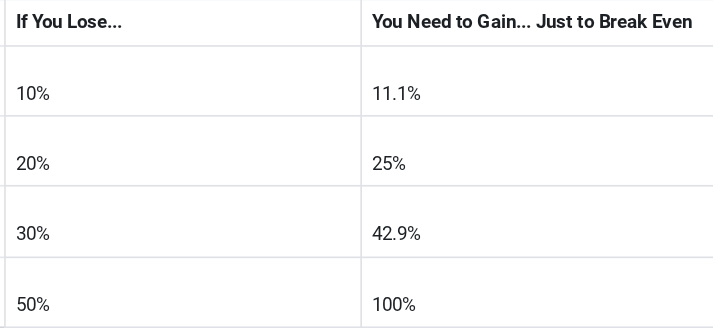
When you suffer a 30% market correction: something Wall Street treats as a "routine retraction": you don't just lose money. You lose time. To recover that 30% loss, your remaining capital must perform nearly 43% better just to get back to zero.
Money can recover. Time never does.
At Your Street Wealth, we perform a Volatility Recovery Analysis to show you exactly how many years of your life have been sacrificed to "buy and hold" strategies that failed to protect your principal.
Market Friction: The Silent Efficiency Leaks
An engineer hates a leaky valve. In your portfolio, there are three primary leaks that Wall Street hopes you never audit:
1. Fees (The Friction Coefficient)
Wall Street uses hidden complexity to drive daily research and addictive buying/selling. Between expense ratios, advisory fees, and "hidden" internal costs, many portfolios leak 1.5% to 3% annually. Over a 20-year retirement, that isn't just a small fee; it’s a massive portion of your potential compounding efficiency.
2. Taxes (The Exhaust Gas)
If you are withdrawing from a traditional 401(k) or IRA, you aren't just withdrawing your money: you are withdrawing the government’s money, too. Most "math-proven" plans fail to account for the Sequence of Return Margin when taxes are rising.
3. The 4% Rule Myth
For decades, the "4% Rule" was the gold standard. But in a high-volatility, low-yield SpaceX world, relying on a Reagan-era rule of thumb is like using a Rolodex to manage a global supply chain. It’s a single-pillar strategy that is crumbling under the weight of modern market dynamics.

From Single Pillar to Multi-Pillar: The "Smartphone" of Finance
Think about the technology you use today. In the 1990s, you carried a cell phone, a pager, a camera, and a GPS. These were Single Pillar tools: one tool for one job. Today, you have a smartphone that consolidates 5–15 pillars of technology into one efficient device.
Traditional assets: Banks, Stocks, and Real Estate: are Single Pillar assets. They do one thing (and often with high risk or high fees).
Fully Performing Assets (FPA) are the "smartphones" of financial architecture. An FPA is an engineered vehicle that provides 5–15 pillars of value in a single structure:
Guaranteed Growth (0% floor, uncapped gains)
Tax-Free Income
Long-Term Care Protection
Asset Protection from Creditors
0% to 1.5% Total Fees
By shifting from "Participation" (hoping the market goes up) to "Performance" (contractual engineering), you move from a -30% to +30% volatility window to a 0% to +30% stability window.
The Margin Audit™: Engineering Certainty
The path to peace isn't found in a better "prediction" of the market; it’s found in better Financial Architecture.
We use Asset Liability Management (ALM): the same institutional-grade engineering used by major banks: to ensure your assets are perfectly matched to your future income needs. We don't guess. We engineer.
We contrast the "False Model" of Wall Street (driven by greed and fear) with the Your Street model:
Certainty vs. Uncertainty: Knowing your path vs. hoping for a rally.
Guarantees vs. Probabilities: Contractual promises vs. historical projections.
Control vs. Dependence: You own the rules vs. the market owns your mood.
Our Million Dollar Hour™ Forecast is the primary tool for the "Architect" persona. It is not a "free consultation" for tire-kickers. It is a $995 professional Engineering and Margin Audit designed for Quiet Builders who value precision over noise.

Peace is the Path, Wisdom is the Way
If your current plan requires you to check the "Greed/Fear meter" every morning, it isn't a plan: it’s a job you didn't apply for.
You’ve spent your career building things that last. Why should your retirement plan be any different? It's time to unlearn the myths of "Average Returns" and learn the fundamental laws of financial engineering.
Stop participating in the noise. Start performing with precision.
Audit the margin. Protect your time. Engineer certainty.
Your Money, Your Rules, In Your Time, On Your Street.
Ready for clarity instead of confusion?
The Million Dollar Hour™ is your educational, one-on-one retirement review that reveals where your plan leads : not just where it’s been.
👉 Schedule your session today.
Discover Which Wealth Killers Are Affecting You
Most people are impacted by 6–9 and don’t realize it
Wealth Killer #1: The Granddaddy : Why Market Volatility is Your Retirement’s Greatest Enemy
Concerned about market losses, taxes, or income reliability?
Take the 7 Question Retirement Stress Test →
You can keep participating… Or you can finally see the outcome. The Million Dollar Hour™ shows you exactly:
✔ Where you are ✔ Where you’re going ✔ How to fix the gaps 👉 Book your session now