
Retirement Strategies That Maximize Income, Eliminate Risk, and Help Ensure You Never Run Out of Money How to Achieve The Retirement Future Everyone Seeks
Most retirement plans are built on assumptions that no longer hold up—market averages, predictable tax rates, and the belief that time will always recover losses. But as you approach or enter retirement, the rules change. What worked during your accumulation years can become a liability during the withdrawal phase.
This blog is designed to help you rethink traditional strategies and discover a more engineered approach to retirement income—one focused on certainty, efficiency, and control.
Here, you’ll learn how to reduce or eliminate the biggest threats to your financial future, including market losses, rising taxes, hidden fees, and the silent erosion caused by lost time. We break down complex financial concepts into clear, actionable insights so you can make better decisions about your 401(k), IRA, and retirement income strategy.
You’ll also discover why many conventional approaches—like relying on average returns or the 4% rule—can expose you to unnecessary risk, especially when withdrawals begin. Instead, we explore strategies designed to protect your principal, improve compounding efficiency, and create predictable income streams that last.
Our focus is on helping you transition from “assets at risk” to a more stable and structured approach using fully performing assets—where growth, income, and protection work together instead of against each other.
Whether you’re still working or already retired, the goal is simple:
help you keep more of what you earn, generate more reliable income, and build a plan that doesn’t depend on hope, timing, or market luck.
If you’ve ever wondered:
* How to create tax-efficient retirement income
* How to avoid sequence of returns risk
* How to reduce fees and increase net returns
* How to design income that doesn’t run out
—you’re in the right place.
Explore the articles below and start building a retirement strategy based on engineering, not guesswork.

The Average Return Lie in Retirement
Wealth Killer #3: The Average Return Lie, Why You Can’t Eat an Average
One of the fastest ways to uncover hidden risk is to take our 7 Question Retirement Stress Test.
![[HERO] Wealth Killer #3: The Average Return Lie, Why You Can’t Eat an Average](https://cdn.marblism.com/DSjeJGrpY6u.webp "[HERO] Wealth Killer #3: The Average Return Lie, Why You Can’t Eat an Average")
Start here: See what your retirement actually looks like → 👉 Book Your Million Dollar Hour™
Your Statement Says 7%. So Why Does Your Balance Feel Stuck?
Have you ever seen a 7% average return on your statement, but somehow felt like your balance wasn't moving?
That gut feeling is usually right.
Wall Street loves averages. Your bank account does not. Your retirement income definitely does not. The market can brag about a nice clean average all day long, but your money lives in actual math, actual losses, and actual years of your life.
At Your Street Wealth, we call this Wealth Killer #3: The Average Return Lie.
And for people nearing retirement, this lie is expensive.
If you are a Quiet Builder — a business owner, engineer, executive, or pre-retiree who is tired of noise and wants clarity — this is one of the biggest myths to unlearn. Because you cannot spend an average. You can only spend what actually remains.
And this is exactly where the Graduation Framework matters:
Money — what dollars actually remain after losses, fees, and taxes.
Rules — whether your plan runs on discipline and architecture or on guesswork and headlines.
Time — how many years volatility steals from compounding and recovery.
Street — whose system you are really on: Wall Street’s false model or Your Street’s engineered model.
Averages are a Wall Street tactic because they blur all four. They hide Money volatility, ignore Time Theft, avoid real Rules, and keep you stuck on the wrong Street.
Participation vs. Engineered Performance
This is where the difference between Participation vs. Engineered Performance really matters.
Wall Street sells participation. That sounds harmless until you remember what participation actually means. If the market goes up, you participate. If the market falls, you participate in that too. If your advisor tells you to "zoom out" while your account gets cut in half, congratulations — you are fully participating.
That is not financial architecture. That is exposure dressed up as a plan.
And exposure is a dangerous substitute for design.
At Your Street Wealth, we use rules-based planning and institutional-grade ALM thinking to focus on engineered outcomes, not emotional market theater. We are less interested in what the market might average and more interested in what your retirement system is actually built to do.
Because in retirement, a setback is not just a number. It is lost time. It is lost compounding. It is lost options.

The Math of Recovery
This is the part most people never get shown clearly.
Let’s keep it simple.
If you have $100 and lose 50%, you now have $50.
If you then gain 50%, you do not get back to $100.
You only get back to $75.
So what happened?
Your average return over those two periods is 0%. One year down 50%. One year up 50%. Average equals zero.
But your actual result is not zero.
Your actual result is a 25% loss of your life’s work.
That is The Math of Recovery.
And this is why averages lie. They flatten out the pain. They smooth over the damage. They make a broken result sound normal.
A 50% loss requires a 100% gain just to get back to even.
A 30% loss requires roughly a 42% gain to recover.
That is not opinion. That is math.
⚠️ If this applies to you… your retirement may already be at risk.

The problem is not just the loss. The problem is the years required to heal from the loss. That is why we say retirement planning is about protecting time and wealth, not just chasing returns.
The Participation Paradox
Here is the trap: people are told that "being in the market" is how you win.
But participation comes with a hidden invoice.
When you participate in the upside, you also participate in the setbacks. You participate in the drawdowns. You participate in the recovery period. You participate in the stress. You participate in the years it takes to get back to where you already were.
That is the Participation Paradox.
It is sold as progress, but too often it behaves like delay.
And when you are 35, delay is annoying.
When you are 65, delay is expensive.
A market setback in retirement is not just a red number on a statement. It can mean postponed income, reduced withdrawals, changed lifestyle choices, and years of compounding that never come back. Peace is the path, wisdom is the way.
Why Averages Lie
Averages are tidy. Real life is not.
Averages smooth out spikes and dips, but you do not live in an average. You live through the dips. You feel the timing. You absorb the losses in real dollars.
That is why average return is often a terrible way to judge whether a retirement strategy is working.
It ignores volatility drag.
It hides compounding inefficiency.
It skips over the damage caused by losses.
And it works hand in hand with Sequence of Returns Risk — its quiet partner in crime.
If losses show up early in retirement, while you are taking income, the damage multiplies. Now your portfolio is not just trying to recover from market declines. It is trying to recover while money is also being pulled out to live on. That is how people can have a portfolio that looked good "on average" and still end up with a retirement engine that sputters out.
This is why the old Wall Street model is a Rolodex in a SpaceX world. Durable in its era, maybe. But not precise enough for modern retirement engineering.
Single-Pillar Thinking vs. Multi-Pillar Design
Traditional retirement planning still leans heavily on single-pillar assets.
Banks are single-pillar: safe-ish, but often weak on growth.
Stocks are single-pillar: growth potential, but full participation in losses.
Real Estate is single-pillar: useful in some cases, but often high-friction and fee-heavy.
Those are separate tools doing separate jobs. It is like carrying a pager, a camera, a GPS, a TV, and a phone around in a backpack.
Modern engineering moved on.
The Consolidation of Technology gave us the smartphone. In the same way, modern retirement architecture uses Fully Performing Assets (FPA) as a multi-pillar design. Instead of one job, one product, one leak, an FPA can bring together 5–15 pillars of value inside one system — growth, protection, tax advantages, lifetime income options, long-term care features, and A+ guarantees, often with 0%–1.5% fees.
That is the difference between single-use tools and financial architecture.
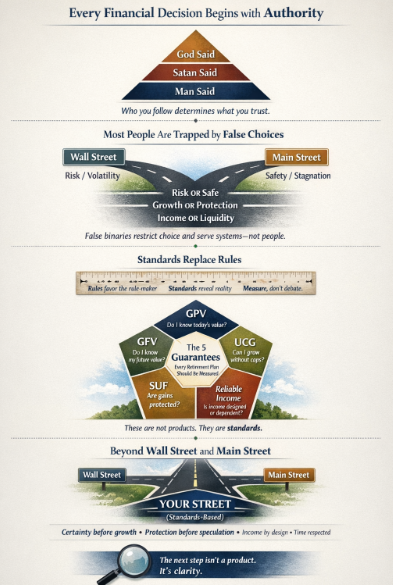
The Margin Audit™: Finding the Lost Years
This is where our process gets very different from typical retirement planning.
We do not start with average returns.
We start with outcomes.
Inside the Million Dollar Hour™ Forecast, we run what we call The Margin Audit™. That includes a Volatility Recovery Analysis, a look at Compounding Efficiency, and a practical review of your Sequence of Return Margin.
In plain English: we calculate what you actually earned, not what you were told to expect.
We measure your True Compounded Growth Rate.
We identify the years lost to volatility.
We show where participation has been costing you time.
And we map out how to recover those lost years using engineering instead of guesswork.
This is the shift from a false model to a designed model.
Wall Street lives in the range of -30% to +30%.
Our engineering mindset is built around 0% to +30%.
That difference matters. Because removing the downside does more than protect principal. It protects time. It restores compounding efficiency. It gives retirement income a stable foundation.
And when Fully Performing Assets are designed properly, they can include Uncapped Gains (UCG) and Expanded Market Participation (EMP) — meaning market-linked growth with a zero-loss floor, and in some cases a 110%–200% multiplier on UCG. So a 10% UCG can become an 11%–20% gain, without requiring you to eat a market crash first.
That is not hype. That is what happens when you stop confusing participation with performance.
The Million Dollar Hour™ Solution
The Million Dollar Hour™ Forecast is not a free teaser. It is a paid $995 professional engineering session for people who want real clarity.
This is where Frank Day brings institutional-grade banking architecture and ALM precision into a one-on-one retirement review built for Quiet Builders.
In one focused session, we help you unlearn the average-return myth and see the structure underneath your current plan:
What is your plan actually compounding at?
How many years have market losses cost you?
What income can be estimated with confidence?
Where are fees, taxes, and volatility creating leaks?
What would a more certain, rules-based retirement architecture look like?
You can estimate income needs.
You cannot predict future portfolio value when losses, fees, and taxes remain uncontrollable.
That is the whole point.
The Million Dollar Hour™ gives you a clearer path — one rooted in design, protection, and engineering of certainty.

Final Thought
If your advisor keeps handing you average-return stories while your actual progress feels slow, don’t ignore that instinct.
Your statement may show participation.
But your retirement needs performance.
The goal is not to win an argument with the market.
The goal is to protect your time, protect your wealth, and build reliable income using the best retirement income strategies available for the stage of life you are actually in.
If you want to protect retirement savings from market crash, understand your exposure to sequence of returns risk, and get a real retirement plan review, stop looking at averages and start looking at architecture.
Your Money, Your Rules, In Your Time, On Your Street.
Are averages hiding the truth about your retirement?
The "Average Return Lie" is a major leak, but it’s just one piece of the puzzle. Most people are battling multiple Wealth Killers that silently steal time and compounding power.
To see which of the 11 specific traps are currently active in your plan, take our quick diagnostic quiz:
👉Start the 60-Second Wealth Killer Quiz
If you want to see the full list of all 11 diagnostic questions we use to evaluate a retirement engine, you can find them here in our Master Hub:
👉Read the Wealth Killer 11: Self-Diagnosis Guide
Ready to stop guessing?
If you’re done with "participation math" and want a guaranteed path to safer growth and lifetime income, schedule yourMillion Dollar Hour™ Forecast. We will perform a full Margin Audit™ to identify your specific leaks and show you exactly how to fix them.
👉Schedule Your Million Dollar Hour™ Here
Discover Which Wealth Killers Are Affecting You
Most people are impacted by 6–9 and don’t realize it
Concerned about market losses, taxes, or income reliability?
Take the 7 Question Retirement Stress Test →
You can keep participating… Or you can finally see the outcome. The Million Dollar Hour™ shows you exactly:
✔ Where you are ✔ Where you’re going ✔ How to fix the gaps 👉 Book your session now
Check out the Retirement Blueprint
Wealth Killer #4: Fixing the Retirement Fee Leak
https://wealthonyourstreet.com/post/wealth-killer-4-fixing-the-retirement-fee-leak